Priest seminar
Diocesan Museum
Diocesan Library
MonasteryRottenburg
Karmeliter Abbey Rottenburg
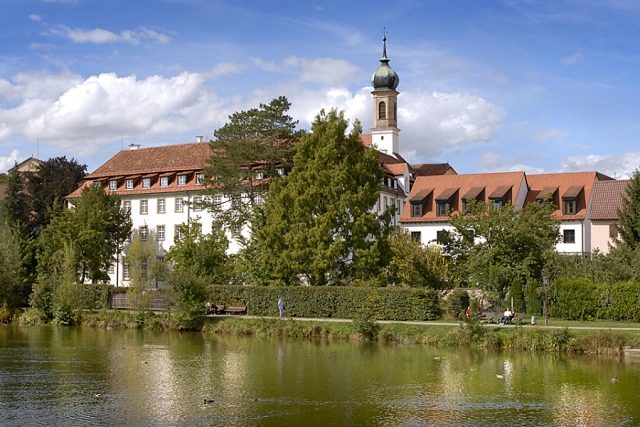
The Carmelite Monastery in Rottenburg am Neckar is a Baroque building from the 17th century, which today houses the seminary, the diocesan museum, and the diocesan library of the Diocese of Rottenburg-Stuttgart.
In 1276, Count Albert II of Hohenberg gifted a site on the Neckar riverbank to the mendicant order of the Carmelites for the construction of a monastery. The water castle of the Lords of Rotenburg, who exercised dominion in the region on behalf of the Counts of Hohenberg, is presumed to have been at this location. In 1281, the foundation stone for the construction of the monastery was laid. The Bishop of Constance confirmed its founding in 1292, and it was consecrated to the Holy Trinity in the same year. In the second half of the 15th century, the monastery was rebuilt after the first structure had fallen into disrepair.
From 1534, the monastery became a focal point of Reformation efforts in Rottenburg. Three years later, the convent, which had comprised 20 monks towards the end of the 14th century, consisted of only the prior and two other monks. The complete dissolution of the monastery was prevented only by the energetic intervention of the Provincial P. Andreas Stoß, a son of the sculptor Veit Stoß. By the end of the 16th century, the monastery had recovered, with 20 monks. Against strong resistance within the convent, the stricter version of the order's rule was adopted in 1651. During the city fires of 1644 and 1735, the entire monastery complex, including the archive and library, burned down and had to be rebuilt each time. During the Enlightenment, the convent diminished in size: in 1783, there were only eight, and in 1792, only six priest-monks.
After Württemberg's annexation of Rottenburg, the monastery was dissolved in 1806. Some monks continued as secular clergy, while others were pensioned off. The monastery's property was sold or leased. The monastery buildings were initially used as barracks. Since 1817, the buildings have housed the seminary of the Diocese of Rottenburg-Stuttgart. The choir of the church, which was completely cleared out at the time, serves as the house chapel. The converted nave initially housed apartments for clerics; since the first half of the 20th century, it has been the location of ecclesiastical offices and the diocesan library. After extensive renovation starting in 1991, the diocesan museum and library have been housed in the nave since 1996.
Architecture and Furnishings+
From 1281, the monastery was built directly on the Neckar. In 1475/77, under the direction of Master Hans Schwarzacher, the builder of the Rottenburg Cathedral tower, a new Gothic four-wing complex was constructed. After the devastating city fires of 1644 and 1735, the church and monastery were re-consecrated in 1747. The plans for this still-existing new building came from the Hohenzollern building inspector Hermann Schopf from Hechingen. The furnishings involved, among others, the sculptor and stucco artist Josef Anton Feuchtmayer from Mimmenhausen, the Carmelite brother Modestus also as a sculptor and art cabinetmaker, and the painters Josef Adam Mölk from Vienna and the prince-bishop's court painter Franz Sebald Unterberger from Brixen.
Of the exceedingly rich church furnishings, only a confessional outside Rottenburg in the parish church of St. Peter and Paul in Obernau has survived to this day; the seminary contains some fine art cabinetmaking and stucco work, e.g., in the dining hall.
Today, the building is used as a seminary. The church, desacralized in 1806, housed the diocesan museum and the diocesan library after a fundamental renovation. The former choir of the church is used as the house chapel of the seminary.
Diocesan Museum
The Diocesan Museum was founded in 1862 and possesses a comprehensive collection of sacred sculptures and panel paintings from the 13th to the 18th century. Painting of the 15th and 16th centuries forms a particular focus. Most of the artworks originate from southwestern Germany. The oldest exhibit is a reliquary from 700. The treasury houses historic vestments and one of the most extensive collections of reliquary glasses with examples from the 2nd to the 19th century.
Diocesan Library
The Diocesan Library was founded in 1916 as a specialized academic library and comprises 150,000 volumes, accessible to everyone. Among them are 116 incunabula and 30,000 titles published before 1800. Parts of the monastery library have also been preserved here. Furthermore, the library manages the holdings of the rural chapter libraries in the deaneries of the diocese, with an additional 150,000 volumes.
See also: Rottenburg Seminary
Take Mobile History with you
You are reading this text for free. Premium adds what matters on the road: descriptions read aloud, sites found through your camera, whole regions taken offline.
- Every description, including the ~17,700 Premium sites
- Audio guide: have descriptions read to you on location
- AR finder: see sites through your camera, with distance and bearing
- Unlimited saved sites
14 days free, then from €2.99 a month. Cancel anytime.
Source: Wikipedia · Licence: CC BY-SA 4.0
This description draws on the facts documented in the linked Wikipedia article; Wikipedia content is licensed under CC BY-SA 4.0. Wording and editing: Mobile History.
Location: 48.4755, 8.9342