The church can be visited
MonasteryKoblenz-Ehrenbreitstein
Kapuziner Abbey
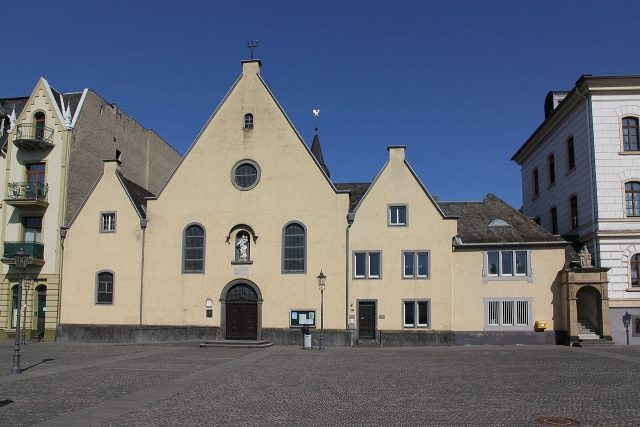
The Capuchin Monastery of Koblenz (Latin: Conventus Fratrum Minorum Capuccinorum Confluentiae) was a monastery in Koblenz, operated by Capuchin friars from 1627–2008 with interruptions. The monastery in the Ehrenbreitstein district was the seat of the provincial administration of the Rhenish-Westphalian Order Province from 1908–2007. The Baroque church of St. Francis belongs to the monastery complex.
At the personal request of the Trier Elector Philipp Christoph von Sötern, the Capuchins settled in Ehrenbreitstein in 1627. On October 18, 1628, the foundation stone for the construction of a monastery was laid. The building was completed in 1629 and consecrated to the Apostles Philip and James as patron saints.
During the Thirty Years' War, Ehrenbreitstein, including the Capuchin monastery, was devastated in 1636 due to fierce fighting for the Ehrenbreitstein Fortress located above the city. Reconstruction took place in 1655 under Elector Karl Kaspar von der Leyen. A year later, under Auxiliary Bishop Otto Johann Theodor von Senheim (1633–1662), the monastery received the patron saints Francis of Assisi, Charles Borromeo, and Apostle Philip.
After the conquest by French revolutionary troops and the subsequent secularization of church and monastery, the Capuchin properties initially passed to Nassau-Weilburg in 1803, and later to the Duchy of Nassau. The monastery was evacuated on February 16, 1813, and its interior sold. Prussia finally took over the monastery in 1815 as part of its Rhine Province and established a train depot and barracks in the monastery garden. The monastery buildings, including the cloister, were largely demolished in 1860. The Capuchins returned to their monastery in Ehrenbreitstein on June 29, 1861, and settled in the remaining buildings. In 1865, Count Hermann von der Schulenburg (1829–1865), formerly a Prussian officer, later Father Ludovikus OFMCap, died here. During the Kulturkampf, the Capuchins had to leave the monastery again from 1875 to 1887. Afterwards, further buildings were purchased for monastery use.
The Capuchin monastery became the seat of the provincial administration of the Rhenish-Westphalian Order Province in 1908. In 1930, the Capuchins purchased the neighboring Konradhaus and established an apprentice home there for their youth welfare institution, Seraphisches Liebeswerk. A connecting wing was built between the Konradhaus and the Capuchin monastery, above whose portal a figure of Konrad von Parzham still stands today. During an air raid on Koblenz on September 25, 1944, the monastery was hit by an aerial mine and the roof was damaged. After the destruction of the Holy Cross Church in the air raid of December 31, 1944, the Ehrenbreitstein parish used the monastery church for its services. With the completion of a new building in 1964, the community moved into the new church building. Due to its proximity to the Rhine, the monastery was flooded by high water in 1740, 1920, 1926, 1970, 1993, and 1995.
The provincial administration of the Rhenish-Westphalian Order Province moved to Frankfurt am Main in 2007. The last Capuchins left the monastery in Ehrenbreitstein at the end of September 2008. Since May 2009, the monastery church has served as the parish church for the Holy Cross parish. The Holy Cross Church has been used only for cultural purposes since 2010.
Monastery Church of St. Francis+
The Church of St. Francis, St. Philip Ap. and Charles Borromeo, consecrated in 1657, belongs to the Capuchin monastery. It is the only preserved Baroque church in the city of Koblenz. The typical Capuchin church with a Loreto Chapel possesses remarkable furnishings from the 18th century. The court architect Johannes Seiz erected three new altars in the church in 1753. At the same time, the Venetian artist Vincentius Daminij created six altarpieces. The pulpit was donated in 1755, and an organ was installed in 1760.
The monastery church is a simple barrel-vaulted hall building made of tuff blocks. The west front has three gables. The central gable is larger than the other two. Under the northern gable is the Loreto Chapel, and the monastery gate is connected to the southern one. It has a gabled roof with a roof turret. Above the round-arched portal is a niche with a figure of the Mother of God from 1655. The coat of arms of Archbishop Karl Kaspar von der Leyen is attached to the plinth.
The interior is dominated by the columned, visible-wood high altar in the choir. Two oratories were installed on the sides of the altar in 1763, crowned by rocaille cartouches in which lions hold the electoral coat of arms. On the north side is the Loreto Chapel. On the east side of the elongated hall with a barrel vault stands a Mother of God altar. The visible-wood column altar, donated in 1739, has a filigree tendril crown with figures of saints.
The current organ was built in 1925 by the firm Johannes Klais Orgelbau from Bonn and renovated in 1990.
Take Mobile History with you
You are reading this text for free. Premium adds what matters on the road: descriptions read aloud, sites found through your camera, whole regions taken offline.
- Every description, including the ~17,700 Premium sites
- Audio guide: have descriptions read to you on location
- AR finder: see sites through your camera, with distance and bearing
- Unlimited saved sites
14 days free, then from €2.99 a month. Cancel anytime.
Source: Wikipedia · Licence: CC BY-SA 4.0 · Image: http://de.wikipedia.org/wiki/Datei:Kapuzinerkloster_09_Koblenz_2013.jpg
This description draws on the facts documented in the linked Wikipedia article; Wikipedia content is licensed under CC BY-SA 4.0. Wording and editing: Mobile History.
Location: 50.3587, 7.6110