The foundation of Obermünster Abbey, dedicated to the Assumption of Mary, is presumed to be in the late 8th century, possibly by Duke Tassilo III. Its first documented mention occurred in 866. Under King Louis the German and his wife Hemma, who served as abbess until her death in 876, the abbey received early patronage. Emperor Henry II elevated the abbey to the status of a free princely Imperial Abbey after 1002 through donations and privileges. Admission to the abbey was exclusive, requiring proof of eight noble ancestors, and for foreign women, even sixteen. Emperor Conrad II and Empress Gisela joined the abbey as canon and canoness. Its imperial immediacy was confirmed by Emperor Frederick II in 1216 and recognized as a secular women's collegiate church by Pope Innocent VIII in 1484. During the secularization, the Imperial Abbey was dissolved in 1810 and incorporated into the Kingdom of Bavaria, with the last residents retaining residence rights until 1822.
Obermünster
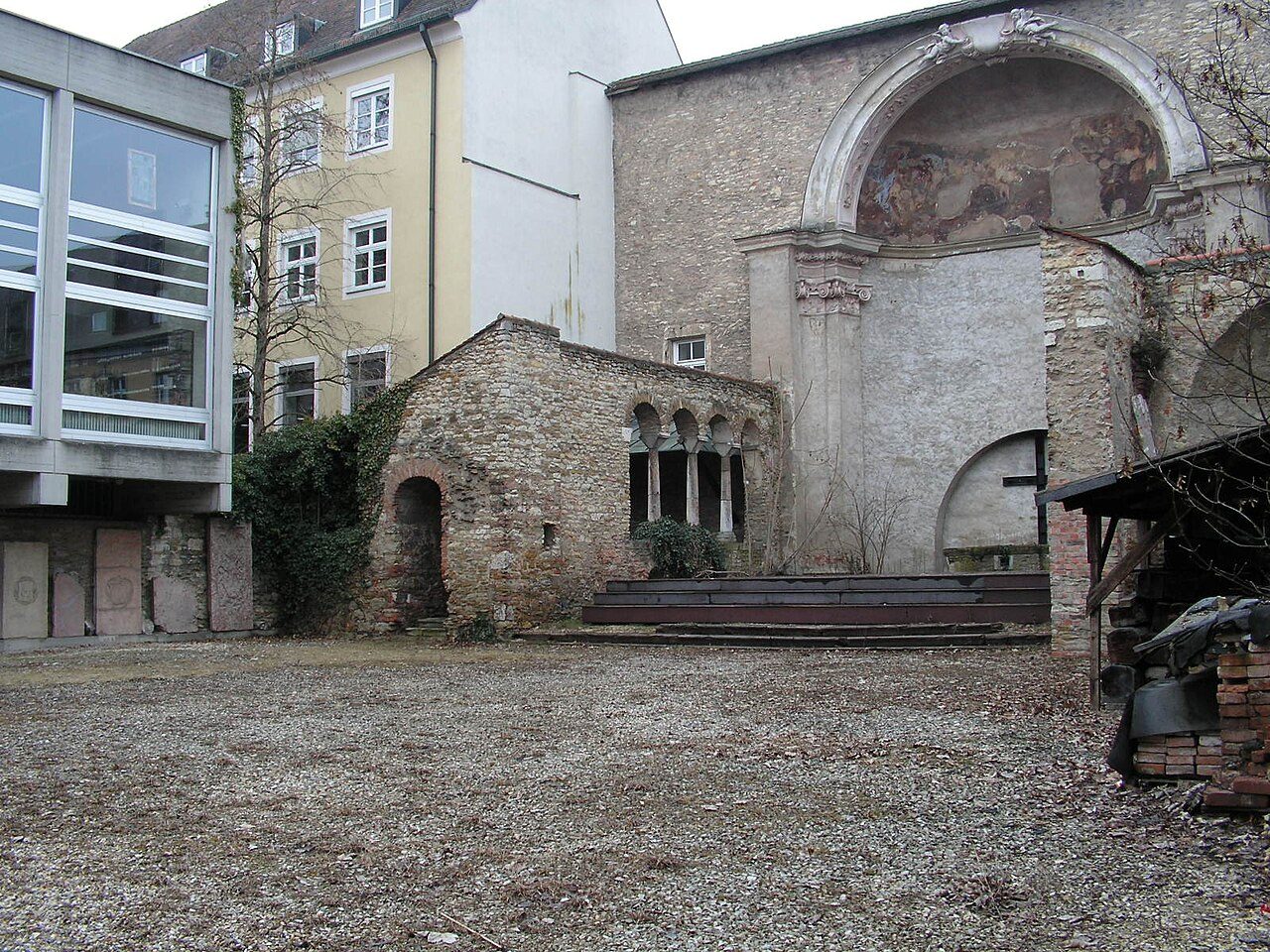
The former Canonesses' Collegiate Church of Obermünster in Regensburg, a significant Bavarian architectural monument, is a historic monastic complex with origins in the late 8th century. It is distinguished by its long history as an Imperial Abbey and is now a central location for ecclesiastical institutions and culture. Although its associated church was largely destroyed in World War II, the ruins have been preserved as a memorial, while the freestanding church tower has endured as a prominent landmark.
History+
Location+
The Canonesses' Collegiate Church of Obermünster is situated in the southern Old Town of Regensburg, Bavaria, in the area known as the Obermünster Quarter, west of Jesuitenplatz. The complex is located at an elevation of approximately 345 meters above sea level.
On site+
Following secularization and destruction in World War II, the preserved abbey buildings underwent extensive renovation and were supplemented with new constructions. Today, the ensemble houses the Diocesan Center, the Episcopal Central Archive, the Episcopal Central Library, and the art collections of the Diocese of Regensburg in the Diocesan Museum Obermünster. The ruins of the former church serve as a memorial and a place where Regensburg scouts annually receive the Peace Light from Bethlehem. The undamaged bell tower stands freely as a campanile and is visible from afar.
Nearby+
- Thurn und Taxis Palace (Palace, approx. 226 m away)
- Palais Löschenkohl (Residence, approx. 246 m away)
- Dompropstei (Residence, approx. 398 m away)
- Stift zu Unserer Lieben Frau (Sacred building, approx. 438 m away)
Take Mobile History with you
You are reading this text for free. Premium adds what matters on the road: descriptions read aloud, sites found through your camera, whole regions taken offline.
- Every description, including the ~17,700 Premium sites
- Audio guide: have descriptions read to you on location
- AR finder: see sites through your camera, with distance and bearing
- Unlimited saved sites
14 days free, then from €2.99 a month. Cancel anytime.
Source: Wikipedia · Licence: CC BY-SA 4.0 · Image: sue107 / CC BY-SA 3.0 via Wikimedia Commons
This description draws on the facts documented in the linked Wikipedia article; Wikipedia content is licensed under CC BY-SA 4.0. Wording and editing: Mobile History.
Location: 49.0159, 12.0953