The remains of the Castle can be visited
CastleKaiserslautern
Barbarossaburg Castle
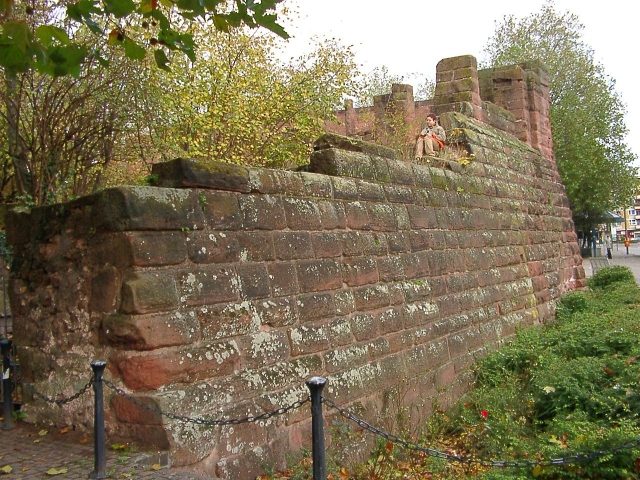
The listed Imperial Palace of Kaiserslautern, popularly known as Barbarossa Castle, is a fortified and administrative complex built by Emperor Frederick Barbarossa in the 12th century as a royal palace in Kaiserslautern (today Rhineland-Palatinate). Today, the complex is a ruin.
The remains of the Imperial Palace are located on the slope of the Rittersberg in the city center of Kaiserslautern directly on Burgstraße below the site where the new town hall is located today. In the 12th century, there was still a rock plateau surrounded by the Lauter river.
Complex+
Only bossage ashlar blocks of red sandstone from the foundation of the Imperial Hall and sparse masonry remains of the double chapel of the castle, built approximately between 1160 and 1215, are preserved today. The visible rows of masonry are in the southwest corner of the site. A paving in the lower area of the town hall square, which corresponds to the floor plan of the hall building (28 m x 19 m), is also visible.
During construction work in the vicinity of the Imperial Palace, further masonry remains and underground passages were uncovered. East of the (newer) Casimir Hall, clear traces of paths to the presumed old entrance of the castle can be seen. In the castle's cellar, masonry remains are visible, which are attributed to the late Salian period and associated with Barbarossa's father, Duke Frederick the One-Eyed.
The remains of the castle ruin are freely accessible, but the Casimir Hall and the underground passages can only be visited as part of guided tours.
Castle History+
6th to 11th Century
Excavations on the hill, which took place in 1991/1992, unearthed a burial ground with Linear Pottery culture finds from the 6th century BC, the earliest evidence of settlement on the castle grounds.
In 830, the place is attested as the Carolingian Villa Luhtra, but it is presumed that the court complex already stood at the same location in the 7th century. Originally, there was also a necropolis with 188 proven graves over an area of 1400 m².
The court came into the possession of the Salians in 985 and was still referred to as curtis (Latin for court) in 1114. A 1.40 meter thick defensive wall built in the 10th century, during the late Salian period, along the eastern and southern boundary could be proven. Given the traditional and still common name Rittersberg, the castle-like settlement was probably administered by lower-ranking ministeriales.
12th to 14th Century
The complex was newly built as a mighty palace from 1152 to 1158 by Emperor Frederick Barbarossa, who referred to it as his domus regalis (Latin for royal home). In 1162, he appointed Gotfried von Lutra, who later became the progenitor of the Knights of Hohenecken, as castle administrator. Subsequently, the palace was regularly visited by rulers, such as Barbarossa with his son Henry VI in 1184. In the years 1214, 1215, and 1217, Barbarossa's grandson, Emperor Frederick II, stayed here. In 1215, he had the complex redesigned and held a court day there in 1234. The first episode of the legend of the pike in the Kaiserwoog, which takes place in this era, is not historically substantiated.
In 1269, King Richard of England married his bride Beatrix of Valkenburg in the double chapel of the castle, dedicated to Saint Nicholas. In 1305, 13 nobles, including the Counts of Zweibrücken-Bitsch, were appointed as royal burgmannen (castle men) in Lautern. The complex came into the possession of John the Blind in 1322, then to his son, Archbishop Baldwin of Trier, in 1332, and was finally pledged to the Electoral Palatinate in 1357. Subsequently, Electoral Palatinate chief officials were stationed at the castle. Further construction measures were probably carried out in 1367, when Elector Ruprecht I was allowed to use toll revenues for the expansion of the castle.
16th to 19th Century
Palatine Count Johann Casimir had a magnificent Renaissance castle built in the immediate vicinity of the Imperial Palace between 1570 and 1580. Both the Imperial Palace and the castle were severely damaged in 1635, when imperial troops of Generalfeldzugmeister Melchior von Hatzfeld stormed and partially razed the city, and again in 1688 during the War of the Palatine Succession by French troops. In 1703, the French set the castle on fire and finally blew it up.
In 1714, Elector Johann Wilhelm had the remains of the Imperial Palace rebuilt in a simpler form as a hunting lodge. It served as an administrative seat until troops of the French Revolution burned it down in 1792. In the hastily rebuilt castle, the district clerk Horn took up residence in 1804. In 1813, the complex was auctioned off by the French administration, which later led to its partial demolition and massive alteration. In 1820, the northwest corner was completely demolished, and the Palatine Central Prison of the Royal Bavarian Government was built there. In 1842, the southeastern section with the castle was converted into the private brewery B. C. Waechter zur Kaiserburg.
From the 20th Century Onwards
During the Nazi era, the newer buildings were demolished in 1934. The last significant change to the remains of the Johann Casimir Castle occurred in 1935.
In the 1960s, extensive excavation and restoration work took place. During the construction of the Kaiserslautern Town Hall in 1968, parts of the Imperial Palace and the castle were irrevocably destroyed. The excavations carried out in connection with the town hall construction have not yet been scientifically analyzed.
In 2010 and 2011, exploratory excavations took place on the area of the former Imperial Palace.
Legends+
Funeral Procession Through the City
It is said that every year on June 10th, the anniversary of Emperor Barbarossa's death, at midnight, the magnificent silhouette of the castle, as it once stood, appears to Sunday's children in the moonlight. From their graves, the knights and squires who served under Barbarossa rise and undertake a funeral procession along old paths through the city in honor of the great deceased. At the first crow of the rooster, the Imperial Castle and its retinue disappear again.
The Sleeping Emperor
Barbarossa is said not to have drowned in the Saleph River; he had merely disappeared without a trace because he was held captive "by the Turks" for a long time. One day, he managed to free himself by cunning and returned unnoticed to his castle in Lautern. However, due to a curse by the Turks, he was not allowed to leave his castle again until the ravens no longer circled it.
One day, the knight from the nearby Beilstein Castle, out of curiosity, entered the vaults of the Imperial Palace. Deep below, he found the emperor, dressed in a crimson cloak, sitting asleep at a table. The emperor awoke and asked the visitor: "Are the ravens gone?" When the Beilsteiner replied no, the emperor lowered his head and continued to sleep.
Take Mobile History with you
You are reading this text for free. Premium adds what matters on the road: descriptions read aloud, sites found through your camera, whole regions taken offline.
- Every description, including the ~17,700 Premium sites
- Audio guide: have descriptions read to you on location
- AR finder: see sites through your camera, with distance and bearing
- Unlimited saved sites
14 days free, then from €2.99 a month. Cancel anytime.
Source: Wikipedia · Licence: CC BY-SA 4.0 · Image: http://de.wikipedia.org/wiki/Datei:Kapfaka.JPG
This description draws on the facts documented in the linked Wikipedia article; Wikipedia content is licensed under CC BY-SA 4.0. Wording and editing: Mobile History.
Location: 49.4457, 7.7681