The church can be visited
MonasteryKönigslutter
Kaiserdom
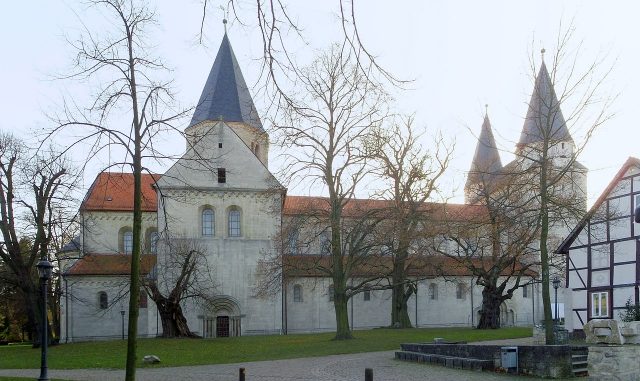
The Imperial Cathedral of Königslutter in Königslutter am Elm, dedicated to the Apostles Peter and Paul, was founded in 1135 by Emperor Lothair III as a Benedictine abbey church and burial place for himself and his family. The completion of the Romanesque building took place – after Lothair's death and the transfer of the imperial title to the Hohenstaufen dynasty – around 1170 under Henry the Lion. The church building is a cruciform pillar basilica, which, with a length of 75 m and a height of 18 m, was of enormous dimensions for its time. The Imperial Cathedral was erected at the highest point in the town.
Significance+
The church building is one of the most important cultural monuments of Romanesque architecture in Germany and was the first large vaulted structure north of the Harz mountains. It was conceived as a symbol of imperial dignity and is comparable in importance to the Salian Imperial Cathedral in Speyer. The construction shows a direct succession to churches in Upper Italy, such as the cathedrals of Modena, Verona, and Piacenza.
The predecessor of the church building was a canoness convent, which the Counts of Haldensleben erected in the 11th century. It was located near the then village of Lutter on the Lutter stream, which originated here on the edge of the Elm. In 1135, Emperor Lothair, German King since 1125 and German Emperor in 1133, converted the convent into a Benedictine monastery. In doing so, he founded the emerging Imperial Cathedral as the monastery church. In the founding charter, he granted the monastery extensive land near the village, forest shares in the Elm, and other scattered possessions up to the Drömling, about 20 km away, including the Wulvosburg, probably a precursor building to the Wolfsburg.
Two years after construction began, Emperor Lothair of Supplinburg died in 1137 in Tyrol while returning from an Italian campaign. His mortal remains were interred in the unfinished church. After his death, the building, made of Elm limestone, was completed in a simpler manner with reduced plans. The two western towers were only completed in the 15th century. Endowed with numerous relics by its founder Emperor Lothair, the church developed into a well-known pilgrimage site in the late Middle Ages. The main pilgrimage day was June 29, the feast of the two church patrons Peter and Paul. Pilgrims came from Lübeck, Lüneburg, the Rhineland, and Thuringia.
With the introduction of the Reformation in the Duchy of Brunswick-Lüneburg, the Imperial Cathedral also became Lutheran. The monastery continued as an evangelical foundation under the leadership of Lutheran abbots. Among the most significant of them was Johann Fabricius (abbot from 1701 to 1729). He was buried in the collegiate church; his epitaph is located in the southern transept.
List of Pastors and Superintendents since the Reformation
Since the Reformation, the following persons have held the office of pastor or superintendent:
- 1570–1583 Johann Cotta
- 1583–1584 Benedict Cuppius
- 1584–1608 Johann Wedde
- 1608–1613 Johann Siegfried
- 1614–1623 M. Gunther Danelius
- 1624–1654 Siegbert Sidelius
- 1655–1682 Valentin Hake
- 1682–1692 Fr. Mathias Hake
- 1693–1713 Joh. Julius Bremer
- 1713–1717 Hrch. Konr. Dedekind
- 1717–1719 Andreas Dunsing
- 1720–1722 Val. Heinr. Hake
- 1722–1731 Sup. Joh. Wilh. Dörner
- 1732–1740 Sup. Ant. Aug. Oesterreich
- 1740–1741 Heinr. Detlev König
- 1742–1778 Sup. Joh. Esaj. Hoyer
- 1778–1812 Sup. Georg Heinr. Bode
- 1812–1831 Johann Georg Heinr. Bode
- 1831–1875 Chr. Theod. Dieckmann
- 1876–1884 Hr. Ludw. Wilh. Willecke
- 1885–1897 Fritz Freist
- 1898–1922 Paul Nebelung
- 1922–1931 Walter Schomburg
- 1931–1958 Propst Rich. Diestelmann
- 1958–1984 Curt Raths
- 1984–2014 Manfred Trümer
- from 2014 Martin Senftleben
Architectural Description+
The church is a three-aisled basilica on a cruciform plan with a double-towered westwork and an octagonal crossing tower. Two construction phases are discernible from the different execution of its parts. First, from 1135 to approx. 1150, the large monastic choir was built in the east, which stands in the tradition of Cluny II. From Cluny in Burgundy, France, the reform of the Benedictine order originated in the 10th century. Of its three church buildings, the last two provided decisive impulses for the architecture of the other order churches. The eastern part of the church had the rich ornamentation of this French building as its ideal.
However, in 1150/60, the plans were changed, and with the beginning of the western construction and the execution of the nave, an ascetic formal language created a clear contrast to the richly decorated eastern part. Here, there was a return to the oldest local building traditions with a rectangular, Lower Saxon westwork with two towers.
The building consists of Elm limestone, which was quarried near the town on the slopes of the Elm. The cathedral gained particular importance through its rich artistic decoration in the form of sculptural works by Lombard stonemasons. This includes, above all, the church entrance, the Lion Portal, and the Hunting Frieze on the outer facade.
The Lion Portal of the northern side aisle dates from the first construction phase. The architectural sculpture, which is evident not only here but also on the eastern parts and in the cloister, bears a very strong resemblance to buildings in Ferrara, Verona, and Piacenza in Lombardy, suggesting that a group of stonemasons previously active in Italy brought these forms to Königslutter. It is significant that the Upper Italian model circle is characterized by the adoption of ancient forms. Thus, classicizing individual forms were brought to Königslutter via Italy. Such a thing was previously unknown in Saxony, as were monumental vault construction and sophisticated masonry techniques. The first building in Königslutter, as an imperial foundation, had a formative effect. Königslutter is the Saxon counterpart to the Salian Imperial Cathedral in Speyer.
Worth seeing is the cloister, built from 1150 onwards, of which the north and west wings are still preserved. The older north wing, with its wealth of ornamented columns and capitals, is one of the most beautiful of its kind in Germany.
There are several interpretations of the so-called Hunting Frieze on the outer wall of the apse. The interpretation of the central, eastern-facing scene "Hares tying up hunters" is puzzling. The majority of research interprets this scene on the basis of biblical texts and late antique and medieval exegetical literature – for example, the writings of the Church Fathers or the Physiologus – as the victory of good over evil. Jürgen Bernhard Kuck, however, argues that the frieze, beyond the obvious hunting scenes depicted, stages man as a victim of the devil and sees the relief "Hares tying up hunters" as a trick picture, deliberately placed at the spot behind which, on the other side of the wall, in the interior of the apse, the altar is located.
A mirror-inverted inscription Hoc opus eximium vario celamine mirum sc (ulpsit) - "This excellent work, wonderful through manifold chisel work, carved" at the end of the Hunting Frieze breaks off at the point where an artist's name would be expected. Instead, below it is the depiction of a hunter shouldering a killed hare. It is interpreted as a hidden artist's signature of Nicolaus of Verona, who belonged to the Magistri Comacini. His name is composed of the Greek words nikáo (to conquer) and laós (people). He becomes the hare-conqueror nikáo lagos by adding the letter g. It can be assumed that the viewers of the image possessed a sufficient level of education to decipher the hidden signature via the detour of Greek.
It is presumed that the stonemasons and stonecutters working at the cathedral workshop spread a "Königslutter style". The construction method of the cathedral served as a model for other sacred buildings in southern Lower Saxony and also in the area up to the Elbe.
Since 1986, there has been an Imperial Cathedral Museum opposite the cathedral in a building formerly used by a stonemasonry school. It provides information about the building history of the church, its builder Emperor Lothair, and the Benedictine monastery, and houses a stonemasonry museum.
Extensive renovation work was carried out from 2002 until the 875th anniversary celebration in 2010.
Imperial Tomb
In addition to Emperor Lothair III, the following are buried in the Imperial Tomb inside the church:
- Lothair's son-in-law Henry the Proud († 1139) (father of Henry the Lion)
- Lothair's wife Richenza († 1141)
- unknown child
On the Imperial Tomb is the Latin name Lotharius II. Lothair himself called himself "the Third". He was the third ruler of this name since Charlemagne. However, one of his predecessors was "only" king and not emperor (Lothair II, ruler of the Middle Kingdom of Lotharingia). In the Baroque period, when the sarcophagus was designed, the numbering was based only on rulers with imperial dignity.
The Imperial Tomb was already opened in 1620. A lead imperial orb and an inscription tablet describing Lothair's death and the political situation at the time were removed. In addition, a burial crown, sword, and chalices were removed, which have since been lost. In 1708, the tomb was redesigned by the sculptor Michael Helwig, as falling vaults had shattered the old tomb in 1640. Another opening of the tomb took place in 1978 by archaeologists. Further finds were made, such as parts of a lead scepter, a gold and a silver ring with the Christian symbols Alpha and Omega. The empress's tomb contained a lead burial crown and a bouquet of flowers.
Painting
At the end of the 19th century, the former medieval church painting was painted over with yellow paint. At the suggestion of Prince Albrecht of Prussia, a restoration of the church was decided. This included a new painting of the church interior, which was carried out from 1887–94 by the Brunswick court decorator Adolf Quensen according to designs by August Essenwein. The historicist painting style is based on Romanesque, and in the vaults, on Baroque models. The paintings are now considered an important historical document of the late 19th century.
About 100 years later, in the 1990s, significant damage to the paintings was discovered, resulting from environmental conditions such as acid rain and structural safety procedures in the 1960s/70s, when tie rods and 300 tons of concrete were introduced into the masonry. These conditions and the alkalinity of the concrete in limestone masonry accelerated salt formation and thus damaged the painting. Since the restoration completed in 2010, the 19th-century painting has been fully restored to its original color intensity.
Organ
The large romantic-symphonic organ in the gallery was built between 1892 and 1895 by the organ building company Furtwängler & Hammer (Hanover). In 1984, the instrument was rebuilt and electrified by the organ building company Hillebrand. In the course of a comprehensive renovation of the organ between 2008 and 2010, the instrument was restored to its historical state of 1895 by the organ building company Hartwig Späth (Freiburg). During the organ's reconstruction in 1984, the trackers and rollerboards were stored. This fortunate circumstance made it possible to restore and reinstall the old mechanical action. The cone-chest instrument has 44 stops on three manuals and pedal. The actions are mechanical.
Emperor Lothair Lime Tree+
The Emperor Lothair Lime Tree near the cathedral is a natural monument of supra-regional importance, as the tree is one of the oldest and thickest lime trees in Lower Saxony. The tree is said to have been planted in the year the cathedral began construction in 1135 at an execution site. Whether it is actually almost 900 years old is not known. Popularly, the lime tree is also called the Thousand-Year-Old Lime Tree. The tree is now about 20 m high and has a trunk circumference between 11 and 15 m. It no longer grows in height, but only in width. The trunk is bricked up inside. The lowest branch, leaving the trunk at a height of 1.5 m, is supported against breaking. In addition, wire ropes hold the tree together. It has been a natural monument since 1956, and in 1975, a tree care measure was carried out by a tree surgeon.
Take Mobile History with you
You are reading this text for free. Premium adds what matters on the road: descriptions read aloud, sites found through your camera, whole regions taken offline.
- Every description, including the ~17,700 Premium sites
- Audio guide: have descriptions read to you on location
- AR finder: see sites through your camera, with distance and bearing
- Unlimited saved sites
14 days free, then from €2.99 a month. Cancel anytime.
Location: 52.2448, 10.8161