Memorial
MemorialPorta Westfalica
Kaiser-Wilhelm-Memorial (Porta Westfalica)
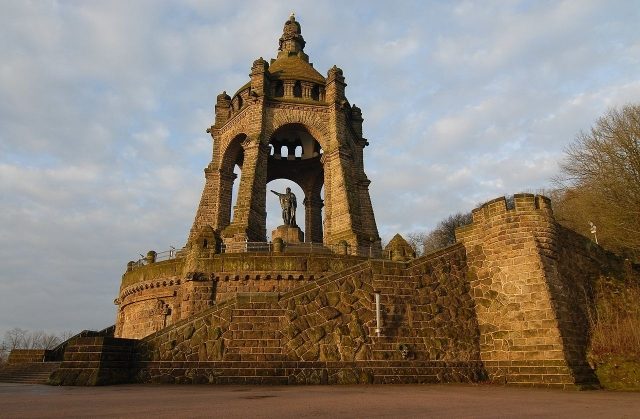
The Kaiser Wilhelm Monument is a monument in honor of Emperor Wilhelm I, which the then Prussian province of Westphalia had erected between 1892 and 1896. It was built on the eastern flank of the Wittekindsberg at the Porta Westfalica. The architect of the monument was Bruno Schmitz, the emperor's statue was designed by
The Kaiser Wilhelm Monument is the landmark of the city of Porta Westfalica.
Geography+
The Kaiser Wilhelm Monument stands at the easternmost end of the Wiehen Hills on the eastern slope of the Wittekindsberg (). At the Porta Westfalica, the narrow breakthrough valley of the Weser between the Wiehen Hills in the west and the Weser Hills in the east, it stands west or above Barkhausen at an approximate height of .
The entire structure, approximately 88 m high, is visible from great distances. From it, there is a good view, for example, of the city of Porta Westfalica and the North German Plain.
After the death of Wilhelm I, Kaiser Wilhelm Monuments were commissioned all over Prussia. On March 15, 1889, the Landtag of the Province of Westphalia, by a narrow majority, designated Porta Westfalica as the location for its monument. Kaspar von Zumbusch was chosen as the sculptor. For the architectural design, the province announced an architectural competition, to which 58 designs were submitted. A first prize was awarded by the jury, which also included von Zumbusch, to the Berlin architect Bruno Schmitz, whose design was also selected for implementation. Another first prize was awarded to the Dresden architects Richard Reuter and Theodor Fischer.
Preparations for construction began in the summer of 1892. The construction costs for the entire monument, including land acquisition, access road, etc., were estimated at around 800,000 Marks, but in the end, the monument cost 1 million Goldmarks. Approximately 13,000 cubic meters of masonry were executed and 3,000 meters of steps were laid. On October 18, 1896, the monument was inaugurated in the presence of Emperor Wilhelm II and Empress Auguste Viktoria as part of a celebration attended by between 15,000 and 20,000 people.
In the Weimar Republic, the Emperor was no longer the focus, and no commemorative ceremony took place for the 25th anniversary of its construction. It was not until 1926 that the monument once again became the center of attention: national associations called for a "German Day" here.
Design+
The structure rises above a platform, partly carved out of the rock, partly artificially created. The limestone obtained during the excavation of the terrace was immediately reused for the construction of the remaining part and for the backfilling of the actual monument. During the construction of the platform, settlements occurred in the ground, causing stones to loosen and some even to fall. Above the platform, Schmitz arranged a twelve-meter-high substructure with a high terrace, to which a stately staircase leads. Behind this, between two coats of arms, is the inscription "Wilhelm the Great - the Province of Westphalia". From the high terrace, the baldachin protecting the emperor's statue rises, resting on six relatively narrow pillars to ensure the best possible view of the statue.
For all visible architectural parts, Porta sandstone from the nearby "Wolfsschlucht" quarry was used. The stones from this quarry have a coarse grain with a grayish-brown, somewhat greenish shimmering color. Dark streaks often occur due to high iron content. The sandstone surfaces exposed to rain were impregnated with Testalin for better weather resistance.
The statue of Wilhelm I shows him in the uniform of the Garde du Corps with high boots, tunic, and cuirass. The coronation mantle flows from his shoulders. Wilhelm I has raised his right hand and rests his left on the broadsword. He wears a laurel wreath on his head.
The statue was cast in bronze in Vienna, the hometown of the sculptor von Zumbusch. Its height is approximately seven meters, and that of the stone pedestal on which it stands is another five meters.
Monument Tunnel+
In the so-called Monument Tunnel below the monument, armaments-critical products were manufactured during World War II in the so-called U-relocation. When the British Army of the Rhine had brought the area under its administration, the Monument Tunnel was blown up on April 23, 1946, to render it unusable. The population feared a collapse of the monument, whose base had already been slightly damaged by artillery shelling. Subsequently, part of the forecourt at the monument collapsed, but the monument remained undamaged.
Road of Monuments+
Since 2008, the monument has been part of the Road of Monuments, a network of German monuments and memorial sites founded on the initiative of the Leipzig City History Museum. The aim of the network is to "more closely connect the memorial sites as former focal points of the past and to make them more tangible as a whole through joint marketing measures."
Take Mobile History with you
You are reading this text for free. Premium adds what matters on the road: descriptions read aloud, sites found through your camera, whole regions taken offline.
- Every description, including the ~17,700 Premium sites
- Audio guide: have descriptions read to you on location
- AR finder: see sites through your camera, with distance and bearing
- Unlimited saved sites
14 days free, then from €2.99 a month. Cancel anytime.
Source: Wikipedia · Licence: CC BY-SA 4.0
This description draws on the facts documented in the linked Wikipedia article; Wikipedia content is licensed under CC BY-SA 4.0. Wording and editing: Mobile History.
Location: 52.2454, 8.9053