To be privately owned
The Castle can be visited
CastleKühndorf
Johanniter Castle
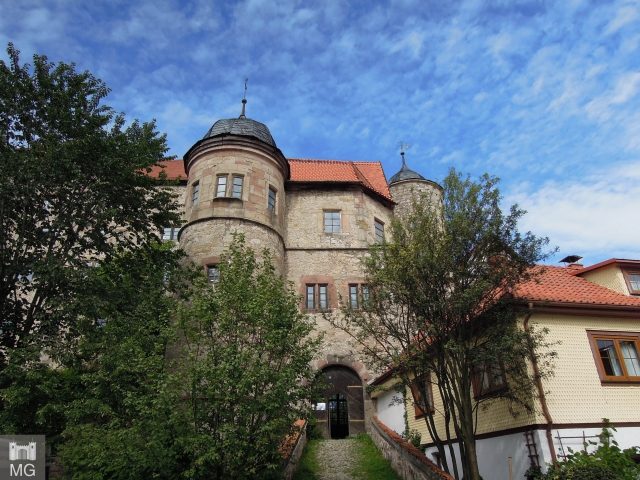
Kühndorf Castle, later also known as Schloss Kühndorf, was built in 1315 by the Order of St. John on the remains of a predecessor castle as a keep made of broad residential towers and expanded by the Counts of Henneberg into their last residence. Since 1991, the castle has been renovated with private funds and can be visited. Kühndorf Castle is the only private property on the Thuringian Castle Road.
Kühndorf Castle is located north of the village center of Kühndorf in Thuringia at the foot of the Dolmar. The village is seven kilometers east of Meiningen on district road 581 towards Zella-Mehlis/Suhl.
Settlement
Kühndorf Castle stands on ancient settlement ground. Already in the Celtic period, there was a settlement with fortifications on the Dolmar. After the Celts migrated, the region was settled by Germanic tribes. Up to the Thuringian Forest by the Thuringians, but in the Werra Valley by the Franks. With the settlement of the Franks, organized villages were established, and the first documents appeared. Kühndorf is one of the first places mentioned in documents in this region: Already in 795, Chunitorpfe appears in a deed of gift to the Abbey of Fulda. Politically, Kühndorf belonged to the Franconian Circle since the late Middle Ages, which had its center in Würzburg.
The Lords of Kühndorf
In 1137, a document was issued in the imperial palace in neighboring Rohr, bearing the seal of a Gottfried von Kühndorf. For the first time, someone is named after this place, and it can be assumed that he was a nobleman who sat on a horse as a knight in war and had a knight's seat in Kühndorf.
The Predecessor Castle
In 1274, a castle, now in the possession of the Counts of Henneberg, is mentioned for the first time. Remains of this stone building can still be seen in the current castle: the stump of the keep with bossed ashlar from the first half of the 13th century and spolia built into the walls. However, this castle was demolished in 1315 and replaced by a new building of the Order of St. John.
The Keep of the Order of St. John
Under Berthold VII, known as Berthold the Wise, the County of Henneberg experienced a golden age. Berthold VII was one of the most important domestic policy advisors to three German kings and emperors and was temporarily appointed guardian of the Bohemian king, being elevated to the status of an Imperial Prince during this time. Berthold VI, the elder brother of Berthold the Wise, was destined for the clergy and joined the Order of St. John in 1291, holding high offices there. In 1315, Berthold the Wise sold to his brother Berthold VI and the Order of St. John the Dolmar mountain, surrounding villages, and explicitly Kühndorf Castle with permission to build a new castle there. It is completely unusual for the Order of St. John to build a castle in the middle of the Henneberg region, as the Order had no military function in Central Europe. Only three other castles of the Order are known in the German-speaking world, with Kühndorf being the only one preserved in Germany.
Kühndorf Castle was built as a keep with two broad residential towers, typical of the order. A coat of arms stone from the time of construction shows the separation into secular and monastic areas.
Expansion by the Counts of Henneberg-Römhild
After Berthold VI and his nephew Berthold VIII, who also lived at Kühndorf Castle as Grand Prior of the German Tongue, had died, the Order lost interest in Kühndorf Castle. The castle was put up for sale and was eventually divided among various interested parties. In 1444, Georg I of Henneberg-Römhild finally bought all shares and modernized the castle for defense with firearms by adding a zwinger system with five towers around the castle.
Residence of the Counts of Henneberg-Schleusingen
The Römhild line died out with Hermann VIII in 1549, and Kühndorf Castle passed into the possession of the Henneberg-Schleusingen line. Under Wilhelm IV of Henneberg-Schleusingen, a district court for the surrounding villages was established in Kühndorf. His son Georg Ernst even moved his residence to Kühndorf Castle for a short time in 1569. In 1583, the lineage died out with Georg Ernst von Henneberg-Schleusingen.
Inheritance by the Dukes of Saxony
The Henneberg region was inherited in 1583 by the Dukes of Saxony, who only maintained the administrative and judicial seat of the Kühndorf office in Kühndorf, so Kühndorf Castle fell into a Sleeping Beauty slumber. Apart from minor alterations in the gatehouse, Kühndorf Castle retained its late Gothic character.
At the Congress of Vienna in 1815, the Kühndorf office was ceded to Prussia and henceforth belonged to the Province of Saxony.
Owners of the Castle 1900 to 1945
Already in 1902, Prussia sold the lower castle to Michael Keßler, a farmer from Kühndorf, who divided the castle among his six daughters, and the upper castle to Rittmeister Simon. In 1920, the upper castle was resold to Dr. Treupel, a doctor from Jena, who set up an armory, a restaurant, and a hostel there. In 1945, the upper castle was expropriated and became public property under the legal responsibility of the municipality. In the post-war years, refugees and displaced persons were accommodated, and school meals were established.
Current Use+
In 1991, Dr. Johann-Friedrich and Gudula von Eichborn bought the upper castle from the municipality and the lower castle from private hands. Extensive renovation and maintenance measures followed. The historical substance was uncovered again, and the castle was opened for viewing. In 2006, Konstantin and Sophie von Eichborn moved to Kühndorf and took over the management of the castle from their parents. As a special event, the castle revival in autumn transports visitors 500 years back to the time of the Counts of Henneberg. Today, Kühndorf Castle is mainly used for family celebrations such as weddings, birthdays, and family reunions or holiday stays.
Take Mobile History with you
You are reading this text for free. Premium adds what matters on the road: descriptions read aloud, sites found through your camera, whole regions taken offline.
- Every description, including the ~17,700 Premium sites
- Audio guide: have descriptions read to you on location
- AR finder: see sites through your camera, with distance and bearing
- Unlimited saved sites
14 days free, then from €2.99 a month. Cancel anytime.
Source: Wikipedia · Licence: CC BY-SA 4.0 · Image: Mobile Geschichte
This description draws on the facts documented in the linked Wikipedia article; Wikipedia content is licensed under CC BY-SA 4.0. Wording and editing: Mobile History.
Location: 50.6097, 10.4915