The church can be visited
ChurchMainz
St.-Johannis-Church
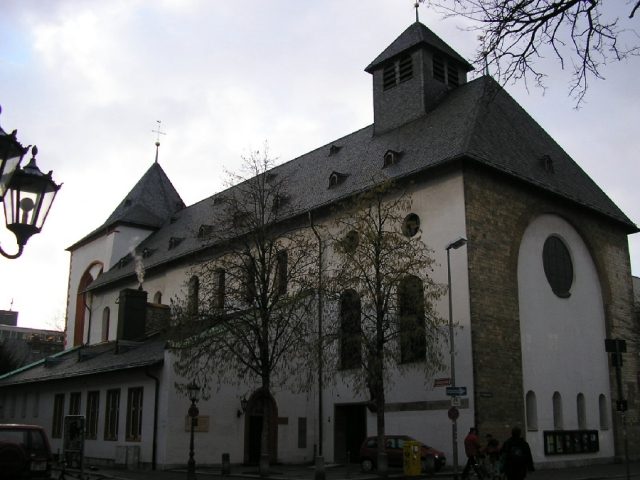
St. John's Church is considered the oldest church in Mainz and the only preserved cathedral building from the late Carolingian and early Ottonian periods in Germany. From its consecration in 910 until the consecration of the cathedral located a little further east in 1036, it was the cathedral church of the Archdiocese of Mainz and was therefore later also referred to as Aldeduom (Old Cathedral). It was taken over by the Protestant community in 1828. Its patron saint is John the Baptist.
Christianity in Mainz and the First Episcopal Church+
When Christianity first took root in Mogontiacum cannot be definitively determined. The current state of research indicates that for the period before the Constantinian shift, there are no definitive indications of any organized Christianity, however structured, nor of Christian martyrs in Mogontiacum, Roman Mainz. Only with Sidonius, in the middle of the 6th century, is there a historically verifiable Bishop of Mainz.
However, an organized church community under the leadership of a bishop can be assumed as early as the middle of the 4th century. The first reliable evidence of a larger Christian community existing in Mogontiacum dates to the year 368. Ammianus Marcellinus reported, in connection with the invasion of the Alamanni under Rando, of a large number of Christians who had gathered for a church festival and were partly abducted by the Alamanni.
At the same time, the existence of an episcopal church can also be assumed, which was probably located in the area of today's St. John's Church. However, the location of an official Roman episcopal church and its period of origin are still unclear and are controversially discussed in expert circles. It is relatively certain that this church cannot have been located under the current cathedral grounds. Under the nearby Protestant church of St. John, excavations in 1905 and 1950/51 brought to light, among other things, foundations of a late Roman building. However, these could not be clearly assigned to a religiously used building during the unpublished excavation at that time. Nevertheless, these foundations have since often been interpreted as the remains of the first episcopal church, which is to be imagined as a church family with a cathedral. The period after 350 and before 368 (mention of a larger Christian community by Ammianus Marcellinus) is now considered a possible time of origin for the episcopal or at least larger church. Alternatively, according to older research, an early Christian-Frankish episcopal church of St. Martin with the Church of Mary (today St. John's) as a catechumen church is still postulated, but this is not archaeologically verifiable.
However, Christian community life came to a standstill during the Migration Period. Only under Bishop Sidonius († after 580) did church life become possible again in Mainz. The poet Venantius Fortunatus describes how Sidonius renewed church buildings. This is the oldest report on church construction measures in Mainz.
At the end of the 8th century, there may have been a change of patronage at today's St. John's Church. Originally built as or near an archaeologically unverifiable Church of Mary, after the burial of some relics of St. Boniface by Bishop Lul in 754, the patronage passed to Boniface. As early as 823, a Boniface Chapel near the Church of Mary is mentioned. Since the relic tomb of St. Boniface was explicitly mentioned as being in St. John's at the end of the 18th century, the Boniface Chapel could have been a structurally independent part of the later St. John's Church as early as 754, but at the latest by 910. The construction of a baptistery in Mainz under Bishop Sidonius in the 6th century is attested in literature, whose patronage was transferred to the old church upon the consecration of the new cathedral. Since no change of the diocesan patron St. Martin is to be assumed in the second half of the 1st millennium, St. Martin also comes into consideration as patron, especially since the Mainz Cathedral Chapter still celebrated a service in St. John's on St. Martin's Day in the 18th century. Finally, a double patronage should also be considered: Hatto's building of 910 had two choirs, each with an altar, which - as in today's cathedral - must have been dedicated to two different saints.
St. John's Church in the Middle Ages+
Archbishop Hatto I rebuilt the then cathedral church starting around 900 and consecrated it in 910. This makes it one of the oldest cathedral buildings in Germany, after Trier Cathedral. Hatto's building, with modifications added over time, is the St. John's Church that has survived to this day. This church, as the cathedral church of the Diocese of Mainz, was initially dedicated to Saint Martin of Tours. After 975, Archbishop Willigis began a new cathedral construction, the new Mainz Cathedral, east of the existing cathedral. The new building was also consecrated to Saint Martin in 1036; all furnishings and prebends of the cathedral chapter were transferred from the old cathedral, which became known as "Aldedum" or Old Cathedral in the following centuries, to the new church. After the consecration of the new building, a collegiate church was established in the Old Cathedral. Only for 1128 is the patronage of St. John for the Old Cathedral documented in writing, but it is likely to have been established as early as 1036.
King Henry was crowned king in the Old Cathedral in 1002. And Archbishop Erkanbald found his final resting place here in 1021.
Probably due to poor foundations, the transept was demolished in the Romanesque period and the crossing was converted into a nave bay. In the mid-13th century, St. John's Church was in such a poor state that Pope Gregory IX granted an indulgence in favor of the church. However, major construction work only began in the 14th century. The west choir was replaced by a tall Gothic extension.
Major changes only occurred again in the Baroque period: in 1685, the floor was raised by more than 2 m, and a wooden groin vault was installed; in 1737, the east apse was demolished and a portal was inserted instead; in 1747, the west choir was covered with a Welsche Haube (onion dome); in 1767, the Paradies, a covered connecting passage between St. John's Church and the Cathedral, burned down.
With the French occupation in 1792, its use as a collegiate church ended. The building was used as a warehouse and for military purposes. Finally, the collegiate church was formally dissolved with the Reichsdeputationshauptschluss (Principal Resolution of the Imperial Deputation). In 1828, its ecclesiastical use was restored, and St. John's Church was made available to the Protestant community. Extensive restoration work followed. The cloister to the north of the church was lost, the east portal and the side aisle arcades were bricked up. The separated side aisles were repurposed and partly rented out.
From 1906, the church was redesigned in Art Nouveau style, post-medieval installations were removed, and structural investigations took place. The design of the church was entrusted to the Darmstadt architect Friedrich Pützer. He built a new portal system in the east and redesigned the side aisles. Pützer also designed the entire interior as a Gesamtkunstwerk (total work of art).
In August 1942, the church completely burned out after an air raid on Mainz. The church was so severely damaged that its demolition was considered. The reconstruction was led by the Darmstadt architect Karl Gruber. He had all of Pützer's installations removed. His design was based on the ideal image of Hatto's original late Carolingian church building. Probably due to lack of funds, the transept, which had already been lost in the Middle Ages, was not reconstructed, nor could the destroyed Welsche Haube of the west choir be restored. The lowering of the floor to its original level failed not least for static reasons, as the old foundations were inadequate. The Baroque wooden vaults were not reconstructed; instead, Gruber had a wooden pointed barrel vault installed, which comes close to the original spatial effect of an open roof truss and mediates to the high Gothic west choir.
In September 1956, St. John's Church was reconsecrated after renovation. Since autumn 2009, extensive renovation work on the roof truss and masonry of the building has been carried out. To raise the necessary funds, numerous events, including a benefit concert in the neighboring Catholic cathedral, were planned.
Architecture+
Hatto's church is one of the few surviving late Carolingian church buildings. It was built as a basilica, its wide nave being higher than the narrow side aisles. The building was designed as a double-choir complex in an east-west direction.
To the east is a choir area the width of the nave. The side walls of the east choir are opened by two round-arched windows each and round windows (so-called oculi) above them. West of the choir is a rectangular nave flanked by narrow side aisles. The nave walls in the upper area (the clerestory) are pierced by four round-arched windows each, below which four arcades (now closed) open into the former side aisles (now community rooms). This nave is adjoined by a square bay, which today resembles the eastern one, but at the time of construction was the crossing of the nave and transept. This was probably followed in late Carolingian and Romanesque times by a semicircular apse, which was replaced in the 14th century by a high Gothic choir on a square plan.
Organ+
The organ was built in 1961-1962 by the organ building company Förster & Nicolaus (Lich). The slider chest instrument has 40 stops on three manuals and pedal. The key actions are mechanical, the stop actions are electric. The organ was later equipped with an electronic setter system and sequencer.
Take Mobile History with you
You are reading this text for free. Premium adds what matters on the road: descriptions read aloud, sites found through your camera, whole regions taken offline.
- Every description, including the ~17,700 Premium sites
- Audio guide: have descriptions read to you on location
- AR finder: see sites through your camera, with distance and bearing
- Unlimited saved sites
14 days free, then from €2.99 a month. Cancel anytime.
Source: Wikipedia · Licence: CC BY-SA 4.0 · Image: http://commons.wikimedia.org/wiki/File:Johanniskirche_mainz.jpg
This description draws on the facts documented in the linked Wikipedia article; Wikipedia content is licensed under CC BY-SA 4.0. Wording and editing: Mobile History.
Location: 49.9984, 8.2724