Lutheran guest house
CastleSalzburg
Johannes Castle
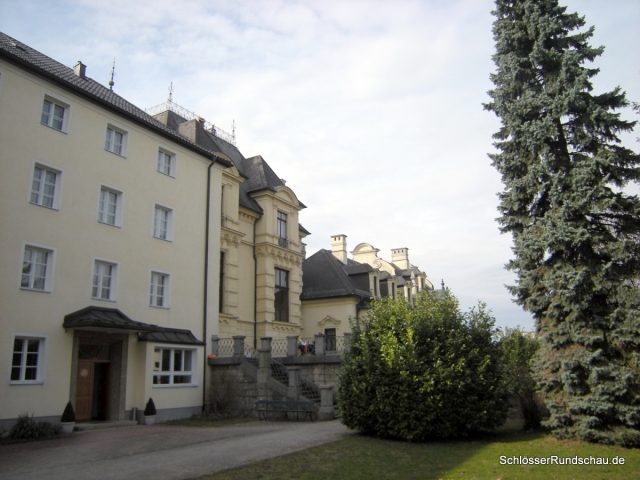
The Johannesschlössl is located on the Mönchsberg in Salzburg, easily accessible by car, elevator, and short, romantic footpaths. Formerly also known as Thennschlössl, Altschlössl, or Dekanatsschlössl after its owners, today it is called Pallottinerschlössl and serves as an apostolate house and guesthouse of the Pallottine Order (address Mönchsberg 24).
The Johannesschlössl was probably built in the 14th century. A marble plaque, created by Johann Krafft von Weittingen, states that the Lords of Weittingen built the small castle. However, this is not very credible, as such a family was unknown in Salzburg in the 14th century. Around 1565, Georg Tenn was the first owner of the Thennschlössl known by name. After the Thenn family, it was owned by Ludwig Alt; his only daughter Magdalena married the princely councilor and under-marshal Sebastian von Haunsperg in 1586. From them, Prince-Archbishop Wolf Dietrich von Raitenau acquired it in 1589. He expanded and refurnished it. The Prince-Archbishop also built the St. Johannis Chapel, which gave the castle its name. However, the Archbishop's peace was too often disturbed here, so in 1595 he exchanged the Thennschlössl for a city plot belonging to the cathedral chapter (i.e., the deanery) (hence the name Dekanatsschlössl).
Cathedral Dean Anton von Thun took over the property in 1595. In 1603, as a plaque testifies today, Johann Kraft von Weittingen, then Cathedral Dean, renovated the chapel. It was consecrated to St. John the Baptist.
In 1678, Cathedral Dean Christoph von Liechtenstein exchanged the Dekanatsschlössl, as it was now called, for the Huggentalsche Castle Schönleiten. The small castle was subsequently used by officials of the cathedral chapter. In 1653, a new cistern was built. In 1678, the property was acquired by the Salzburg regional government, which quartered soldiers and their families in the building; a school for the children of the soldiers was also established, with a corporal or private serving as teacher, who also performed sacristan duties in the castle chapel. After the soldiers, invalids also moved in, and later prisoners. After the Napoleonic Wars, the castle was used as a hospital and convalescence center for soldiers.
After the abolition of the regional government, i.e., the state parliament, the property came to the Kamerlärar, who auctioned it off to Josef Reischauer in 1843. After several interim owners, the castle was acquired in 1858 by Ludwig Achleitner, who established a match factory here and, from 1859, an inn. From the heirs of Achleitner, the property passed in 1884 to Anna Reichl, née Dirnhofer, who renovated the castle, set up new apartments, and revived the inn license.
The Time of Colonel Paschkoff+
In 1892, the Russian Colonel Basilius von Paschkoff bought the castle, a very wealthy man who owned several mines in the Urals. He had the property extensively restored by the architect Karl Demel. A spiral staircase was installed at the back of the central wing, the tower was raised, and a complete new building in Renaissance style with a large hall on the raised ground floor was added to the old central wing. After the October Revolution, many Russian emigrants also lived here. His guests included Field Marshal Mannerheim, who had stopped the Bolsheviks in Finland; Serge Jaroff, the founder of the Don Cossack Choir, was also a guest here. Paschkoff's nephew Michael Saskowitsch, later a world-class tennis player, grew up here with his uncle in the 1920s. Colonel Paschkoff himself became impoverished and had to spend his old age as a taxi driver in Paris.
The Time of the Pallottines+
In 1926, the Pallottines acquired the Johannesschlössl from Paschkoff and furnished it for their theologians who were studying in Salzburg. Until 1941, it was a seminary for the South German Pallottine Province. In 1941, the castle was confiscated by the Salzburg Nazi Gauleitung, and the Pallottines were expelled.
On November 17, 1944, the south wing was destroyed by a bombing raid. In 1945, the castle was used as a reception camp for wounded soldiers. A year later, the first plans were made to rebuild the house. The reconstruction took years. It was not until 1954 that the Johannesschlössl could be completed and consecrated, serving as an apostolate house. From here, the parish of Vinzenz Pallotti Lehen is also looked after. Ten years later, the castle received a new chapel according to plans by the city architect Franz Wagner. This was consecrated in November 1964.
Today, the Johannesschlössl is a religious guesthouse (Cambio and Evangelization Center Salzburg – EZS, House Mönchsberg No. 22) and is open to individual guests or groups seeking contemplation and tranquility.
Take Mobile History with you
You are reading this text for free. Premium adds what matters on the road: descriptions read aloud, sites found through your camera, whole regions taken offline.
- Every description, including the ~17,700 Premium sites
- Audio guide: have descriptions read to you on location
- AR finder: see sites through your camera, with distance and bearing
- Unlimited saved sites
14 days free, then from €2.99 a month. Cancel anytime.
Source: Wikipedia · Licence: CC BY-SA 4.0 · Image: http://schloesserrundschau.de/salzburg/schloesser/salzburg24.html
This description draws on the facts documented in the linked Wikipedia article; Wikipedia content is licensed under CC BY-SA 4.0. Wording and editing: Mobile History.
Location: 47.8022, 13.0331