Condominium apartment
CastleFreital-Pesterwitz
Jochhöhschlösschen
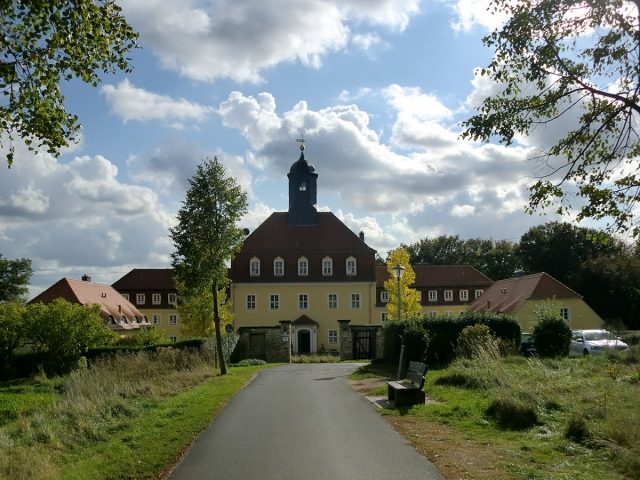
The Jochhöhschlösschen is a Baroque castle in the Freital district of Pesterwitz in the Sächsische Schweiz-Osterzgebirge district. The building now contains condominiums.
The castle was built between 1795 and 1797 by Günther Carl Albrecht von Nimptsch, owner of the Roßthal manor, as a winemaker's house. It consists of a two-story central building, two single-story side wings, and two cavalier houses arranged on the entrance side. Below the castle was a vineyard with a winery and a small inn. The vineyard and park grounds were surrounded by a Pläner wall. In 1803, Günther Carl Albrecht's brother, Friedrich Hugo von Nimptsch, took over the castle.
In 1820, the pleasure castle, as part of the Pesterwitz manor, passed to Baron von Thümen. In 1847, Carl Friedrich August Dathe von Burgk acquired the castle. Already in October 1848, he gifted it to his son Arthur Dathe von Burgk for his wedding. However, the latter did not live in it but rented the property to miners. The salute cannons placed in front of the house were the only heavy weaponry of the insurgents of the Dresden May Uprising in 1849 and are now in the possession of the Dresden City Museum.
Since 1898, no more wine has been cultivated at Jochhöhschlösschen. Due to the phylloxera catastrophe, the grapevines had died and were not replanted. Since the 1980s, the winemaking tradition has been continued elsewhere in Pesterwitz. As part of the Dresdner Elbhänge large vineyard area, the name Pesterwitzer Jochhöhschlösschen is used, even though there is no longer any connection between the viticulture managed by the Pesterwitz estate and the Jochhöhschlösschen.
In the years that followed, the castle lost its significance as a residential castle and served only as a pleasure house. In 1935, the city of Freital established an old people's home in the castle. This was closed in 2000 and moved to a new building near the village square. The castle was privately renovated for residential purposes. Since 2003, there have been 19 condominiums on the property.
Development of the Castle Name+
The original name of the castle, 'Juchhe', is said to stem from the squire's joy of life. As a friend of poetry and rural festivals, he is said to have uttered a 'Juchhe' cheer upon seeing his little castle.
Around 1830, the designation 'Juchhöh' emerged. This became increasingly widespread and remained in use until a hiking map in 1957. Since about 1840, the currently known name 'Jochhöh' has been verifiable.
Take Mobile History with you
You are reading this text for free. Premium adds what matters on the road: descriptions read aloud, sites found through your camera, whole regions taken offline.
- Every description, including the ~17,700 Premium sites
- Audio guide: have descriptions read to you on location
- AR finder: see sites through your camera, with distance and bearing
- Unlimited saved sites
14 days free, then from €2.99 a month. Cancel anytime.
Source: Wikipedia · Licence: CC BY-SA 4.0 · Image: http://commons.wikimedia.org/wiki/Category:Jochh%C3%B6hschl%C3%B6sschen#mediaviewer/File:Das_Jochh%C3%B6hschl%C3%B6sschen_in_Freital-Pesterwitz,_Blick_von_Norden.jpg
This description draws on the facts documented in the linked Wikipedia article; Wikipedia content is licensed under CC BY-SA 4.0. Wording and editing: Mobile History.
Location: 51.0197, 13.6631