Cultural center
CastleGrimma - Kössern
Kössern Castle
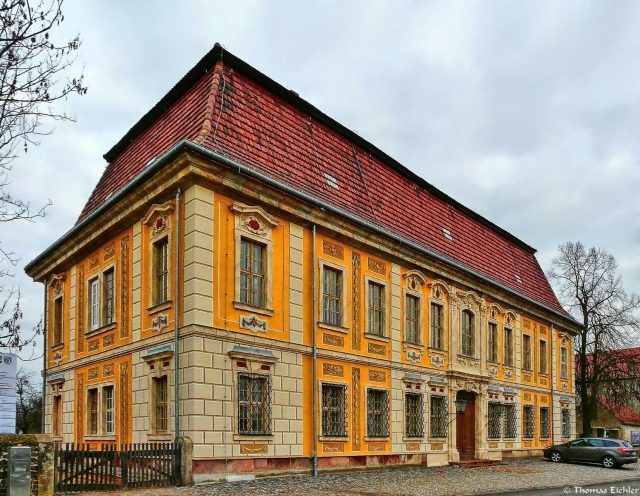
Siegmund von Haugwitz is mentioned as the owner of a manor in Kössern in 1612. Later, it belonged to the von Erdmannsdorff family. From this family, Wolf Dietrich von Erdmannsdorff, the "hereditary, feudal, and judicial lord" of Kössern, Chief Court Huntsman, and Senior Minister at the court of Augustus the Strong, stood out. Between 1703 and 1718, he had numerous residential houses, the "Cavalier House," the "manorial tavern," and also the hunting lodge built in Kössern.
Hunting parties were very popular during the time of Augustus the Strong, serving as a suitable pastime for their status, social gatherings, and representation. The Senior Minister at the electoral court also did not want to stand aside. His hunting lodge provided the architectural setting for the manorial hunting parties and accommodation for guests from the court.
The completion of the building was once indicated by two obelisks, which, in addition to the lord's name, also contained the year 1711. However, missing documents for the construction leave open the assumption that there was likely a lack of official approval. The origin of the building material is also doubtful. Furthermore, there are no records about the master builder of the hunting lodge. From the design of the building, Matthäus Daniel Pöppelmann can, with great probability, be assumed as the architect.
From 1772, Kössern was owned by the von Abendroth family. In 1945, the owners were dispossessed and expelled by the communists.
A two-story building with a mansard roof rises above a rectangular floor plan. Access is almost at ground level into a small anteroom, decorated with four columns and a coat of arms stone. To the right, a staircase leads to the upper floor. Ceiling paintings and rich stucco decorations enlivened the upper rooms.
Unfortunately, construction work, caused by the building's use for childcare, led to numerous changes in recent years. Chimneys were installed in the rooms, additional walls were erected for partitioning, and a heating system was installed. This not only changed the room layout but also led to the partial destruction of the ceiling design.
Nevertheless, the hunting lodge is a gem of Baroque architecture. It witnessed many splendid festivities. The richly painted facade and the ballroom with fireplaces and numerous ceiling paintings formed the festive setting and bore witness to the splendor of times past.
But even today, culture has its firm place in the building. Regular concerts invite guests to visit. The ballroom with its Blüthner grand piano offers a stylish ambiance for this. In addition to renowned artists, young talents are also supported by the Förderverein (support association), who always meet an expert and enthusiastic audience here.
In front of the hunting lodge, at the time of its creation, there was a large Baroque garden, which is unfortunately completely destroyed today. No records exist about its appearance. Only the current orchard meadow still testifies to its location.
Take Mobile History with you
You are reading this text for free. Premium adds what matters on the road: descriptions read aloud, sites found through your camera, whole regions taken offline.
- Every description, including the ~17,700 Premium sites
- Audio guide: have descriptions read to you on location
- AR finder: see sites through your camera, with distance and bearing
- Unlimited saved sites
14 days free, then from €2.99 a month. Cancel anytime.
Source: Wikipedia · Licence: CC BY-SA 4.0 · Image: Thomas Eichler
This description draws on the facts documented in the linked Wikipedia article; Wikipedia content is licensed under CC BY-SA 4.0. Wording and editing: Mobile History.
Location: 51.1810, 12.7855