Restaurant
CastleBad Iburg
Iburg Hunting Castle
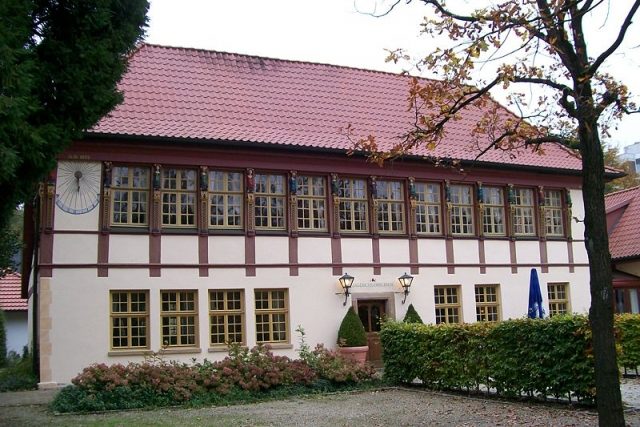
The Jagdschlösschen (also known as Altes Forsthaus Freudenthal) is a former prince-bishop's estate from the late 16th century in Bad Iburg (Lower Saxony).
Iburg Castle was the residence of the bishops and prince-bishops of Osnabrück between 1100 and 1672. From 1591 to 1623, Philipp Sigismund von Braunschweig-Wolfenbüttel, Duke of Braunschweig and Lüneburg, was the Protestant Prince-Bishop of Osnabrück, residing in Iburg. Below the castle hill, he had a pleasure garden laid out on its southern slope. In 1595, he had the Freudenthal House built there, a two-story half-timbered building with a hip roof. The castle mill, which is now located on the Charlottensee, an artificial lake created in the first half of the 20th century below the castle hill, also dates from his time. Philipp Sigismund von Wolfenbüttel was succeeded as Prince-Bishop until 1625 by Eitel Friedrich von Hohenzollern. His successor, the Counter-Reformation Franz Wilhelm von Wartenberg, ordered the dismantling of the hunting lodge in 1650 and its reconstruction in the Thiergarten, on whose grounds the Waldkurpark is now located.
In the Jagdschlösschen, the rooms used by the prince-bishop and his entourage were on the upper floor, which was accessible via an outdoor staircase that no longer exists. On the ground floor were the utility rooms, accessible via an entrance behind the outdoor staircase.
After the secularization in 1803, the Jagdschlösschen became the residence of the district foresters. They were allowed to operate a restaurant with a bar there. The name Altes Forsthaus Freudenthal dates from this period.
In 1958, the then municipality of Iburg bought the building and its associated lands. The building continued to be used as a restaurant. Next to the former forester's house, the town built the Kurhaus, which opened in 1967. The Kurhaus and the forester's house were renovated and expanded. The former forester's house was reopened on October 21, 2001, under its former name Jagdschlösschen. The garden was redesigned, and the work was completed in April 2004.
Of cultural-historical significance are 24 wooden figures below the roof cornice, created by the Osnabrück sculptor Adam Stenelt. He is also credited in Bad Iburg with three epitaphs in the Fleckenskirche St. Nikolaus, reliefs on the organ gallery of the Catholic Schlosskirche St. Clemens, the coat of arms of the Schlossmühle, and carvings on the house Große Straße 6.
Take Mobile History with you
You are reading this text for free. Premium adds what matters on the road: descriptions read aloud, sites found through your camera, whole regions taken offline.
- Every description, including the ~17,700 Premium sites
- Audio guide: have descriptions read to you on location
- AR finder: see sites through your camera, with distance and bearing
- Unlimited saved sites
14 days free, then from €2.99 a month. Cancel anytime.
Source: Wikipedia · Licence: CC BY-SA 4.0 · Image: https://de.wikipedia.org/wiki/Datei:BadIburgJagdschl%C3%B6sschen.jpg
This description draws on the facts documented in the linked Wikipedia article; Wikipedia content is licensed under CC BY-SA 4.0. Wording and editing: Mobile History.
Location: 52.1622, 8.0369