Hotel
CastleNeustadt-Glewe-Friedrichsmoor
Friedrichsmoor Castle
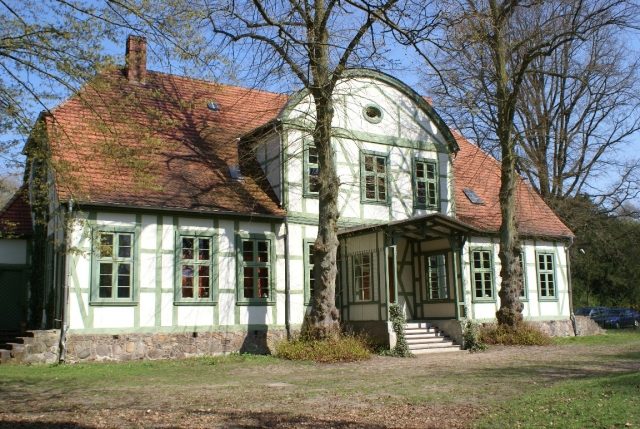
Friedrichsmoor Hunting Lodge is located in the eponymous district of Neustadt-Glewe in the middle of the Lewitz in West Mecklenburg and was the hunting seat of Mecklenburg dukes.
The sparsely populated "Lewitz" was ideally suited as a hunting ground. Today, the hunting lodge is surrounded by old oak trees, the Breite Graben flows past the castle to the north, and a deciduous forest adjoins the castle grounds.
Around 1700, Duke Friedrich Wilhelm had a log cabin, clad and painted with oak planks, built as a hunting lodge on the site of the present-day castle. Duke Friedrich Franz I had this replaced between 1791 and 1793 by the single-story, three-winged half-timbered building, which goes back to plans by court architect Johann Christoph Heinrich von Seydewitz. At the time of construction, there was a shortage of wood, as the Lewitz was almost completely deforested around 1770. The foresters of the forestry office, which had existed in Friedrichsmoor since 1709 and were responsible for procuring the timber, ensured reforestation over the years.
Until 1918, the building served exclusively for hunting purposes of the regional rulers. In the 20th century, the red deer rut in September was the highlight of the hunt. With the exception of these four to six weeks a year, the building stood empty. Before the hunting season, the house was spruced up once a year and the interior walls were whitewashed with lime. The head foresters were responsible for the maintenance of the hunting lodge. Notable visitors included Emperor Wilhelm I, Wilhelm II, and Chancellor Otto von Bismarck.
From 1957, the FDJ youth camp "Meliorationsobjekt Lewitz" was housed here, which aimed to improve the agricultural management of the area. Afterwards, the Institute for Land Improvement of the University of Rostock was the legal owner of the castle. Until the fall of the Berlin Wall, it remained a school object and office building of VEB Meliorationsbau. Since 1991, the hunting lodge has been used as a restaurant, café, and hotel, with an interruption between 1996 and 2000.
Once, avenues radiated from the castle, which are no longer recognizable today. However, the 15-kilometer long, straight connection to Ludwigslust Residential Palace is largely preserved.
Sights+
Since 1964, the garden hall has housed the scenic wallpaper "la chasse á Compiègne" (The Hunt of Compiègne), which was printed in Paris in 1814 after designs by Antoine Charles Horace Vernet and acquired by Grand Duke Friedrich Franz I in Hamburg. It previously hung in Friedrichsthal Hunting Lodge northwest of Schwerin. It depicts scenes of a courtly red deer hunt. It is assumed that this hunting wallpaper is the only surviving example of this print.
Take Mobile History with you
You are reading this text for free. Premium adds what matters on the road: descriptions read aloud, sites found through your camera, whole regions taken offline.
- Every description, including the ~17,700 Premium sites
- Audio guide: have descriptions read to you on location
- AR finder: see sites through your camera, with distance and bearing
- Unlimited saved sites
14 days free, then from €2.99 a month. Cancel anytime.
Source: Wikipedia · Licence: CC BY-SA 4.0 · Image: Roland Neubert, Halle (Saale)
This description draws on the facts documented in the linked Wikipedia article; Wikipedia content is licensed under CC BY-SA 4.0. Wording and editing: Mobile History.
Location: 53.4593, 11.5710