To be privately owned
CastleNürnberg-Ziegelstein
Imhoff Castle
Martin Carl Haller, who died in 1652, was survived by only one daughter, Catharina Helena (1626–1684), who had married Georg Wilhelm Schlüsselfelder (1596–1679) in 1647. Their only daughter, Helena Catharina, married Georg Andreas Imhoff in 1666 [cf. Mögeldorf I], whose family then remained in possession of Ziegelstein for over 150 years.
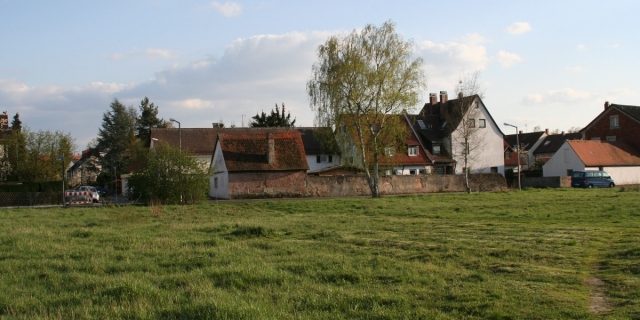
After the old Haller Castle remained a ruin, a new manor house was built to its east, on the southern edge of the Ziegelstein Espans (village green). There are conflicting reports about its origins. However, the builders were probably only Georg Wilhelm Schlüsselfelder or Georg Andreas Imhoff, who, with his wife, took over the imperial fief, which was considered a male and female fief, soon after their marriage.
On an engraving from the beginning of the 18th century, the Imhoffschlösschen presented itself as a two-story building of five (actually only four) by three axes with a gabled roof and a dormer on the west side; two outbuildings adjoined it to the east. The characteristic octagonal roof turret was probably built before 1743, while the dormer was later removed.
Georg Andreas Imhoff, chief regional administrator since 1706, died in 1713. After the death of his wife Helena Katharina in 1727, the will was contested. The inheritance dispute before the Imperial Court Council in Vienna ended with the settlement of July 1728 and installed the grandson Georg Christoph Gottlieb Imhoff (1701–1768) as owner, but also granted rights to the co-heirs, the sisters Helena Katharina von Furtenbach and Helena Regina, married to Johann Albrecht Karl von Mü(h)lholz, as well as their cousin Maria Helena Ebner von Eschenbach (1714–1760).
After the death of Georg Christoph Gottlieb, his son Johann Sigmund Georg followed, who was first enfeoffed with the imperial fief of Ziegelstein in 1770. The son, who at times served as castle bailiff in Nuremberg, died in December 1831. He left behind only one daughter, Barbara Sabina Maria, married to a first lieutenant Friedrich Christoph Rech, who died childless in April 1833 [cf. Erlenstegen VI]. The manor house then fell to a community of heirs, consisting of the four children of the postmaster Burkhard Carl Friedrich von Mühlholz (a grandson of Helena Regina von Furtenbach), who died in Ansbach in 1829. Three years before the legal abolition of patrimonial jurisdiction in 1848, August von Mühlholz and his co-heirs ceded the judicial rights to the Bavarian state.
In 1866, the municipality of Ziegelstein finally bought the manor house as a replacement for the old schoolhouse, which had become completely inadequate and had been in use since 1660 (old house number 12 = Ziegelsteinstraße 182, destroyed in World War II). The manor house (old house number 19 = Am Anger 28), referred to as a "hunting lodge" after Pastor Julius Kelber, where lessons are said to have been held temporarily before, was converted into a schoolhouse with a teacher's apartment and could be occupied in November 1868. The former manor house was used as a schoolhouse until about 1922, when the steadily growing number of pupils necessitated a new building.
Unfortunately, the municipality sold the remaining parts of the castle complex in 1867/68 to various interested parties, which initiated an unfavorable development for the monument. House numbers 18 and 20 (Am Anger 26 and 34) were sold to Johann Georg and Eleonora Hollfelder, the eastern extensions of the manor house, house numbers 19 b and 19 c, to the shoemaker Johann Häckel and a Georg Adam Stauber.
The castle itself survived World War II relatively unscathed, only the distinctive roof turret was destroyed in 1945. Unfortunately, the volume on art monuments for the city of Nuremberg falsely claimed the complete destruction of the manor house, which was apparently confused with the Hallerschlösschen; the Imhoff residence was not recognized as such and therefore appears as a farmhouse (!) with the wrong dating "core mid-19th century". Promptly, the preserved parts of the castle complex were removed from the monument list after 1980. They have since been completely disfigured by a multitude of modernization attempts and clearly demonstrate, as a cautionary example, what development Bavaria's rich cultural heritage will take without monument protection.
Take Mobile History with you
You are reading this text for free. Premium adds what matters on the road: descriptions read aloud, sites found through your camera, whole regions taken offline.
- Every description, including the ~17,700 Premium sites
- Audio guide: have descriptions read to you on location
- AR finder: see sites through your camera, with distance and bearing
- Unlimited saved sites
14 days free, then from €2.99 a month. Cancel anytime.
Source: Wikipedia · Licence: CC BY-SA 4.0 · Image: http://de.wikipedia.org/wiki/Datei:Ziegelstein_Anger_Mauer_f_n_keichwa.jpg
This description draws on the facts documented in the linked Wikipedia article; Wikipedia content is licensed under CC BY-SA 4.0. Wording and editing: Mobile History.
Location: 49.4880, 11.1089