To be privately owned
ManorOtzberg - Habitzheim
Habitzheim Manor
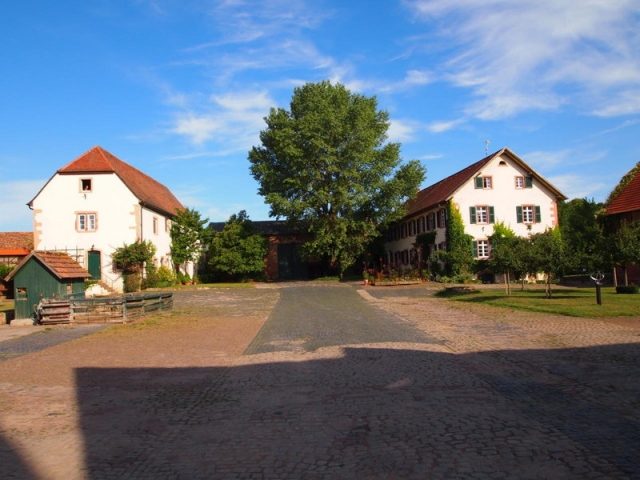
Habitzheim Castle is a former moated castle, now built over as a farm complex, originally created as an outwork of the nearby Otzberg Fortress. It is located in the present-day district of Habitzheim in the municipality of Otzberg in the Darmstadt-Dieburg district in Hesse, at the foot of the Odenwald.
The castle was centrally located in the present-day village, near the current church, and likely served as an outer bailey for Otzberg Fortress and to secure the Fulda possessions around Otzberg. It was certainly the founding place of the emerging village, with a line of sight to the fortress and control over the foreland towards Dieburg and Reinheim.
The exact time of its construction is unknown. However, it likely originated around the same time as Otzberg Fortress, i.e., no later than the 13th century. The first documentary evidence dates from 1323. The moated castle was a Fulda fief held by the Lords of Bickenbach. To secure the moated castle, a diversion of the small Hasselbach stream, which flows through the present-day village, was used to fill the moat. The Bickenbach family split into various lines with different shares in the castle. A part of this passed to the House of Erbach after the death of Conrad III von Bickenbach in the mid-14th century.
Documents confirm that by 1373 at the latest, Count Johann I von Wertheim owned a part of the "Feste Haboltsheym," as described in a settlement with their liege lord, Count Palatine Rupprecht.
Barely eleven years later, a castle peace (Burgfrieden) was agreed upon for and around Habitzheim Castle between Else von Katzenelnbogen, Schenk Eberharten von Erbach, and the aforementioned Ruprecht II of the Palatinate.
With the sale of the Fulda shares of Umstadt and Otzberg, the dominion passed to the Electoral Palatinate, which then granted the fiefs (see also Condominium Umstadt).
In 1395, the Bickenbach family documented that they held one-sixth of the castle as a fief from Ruprecht II and intended to maintain the castle peace. Between 1398 and 1504, the Erbach family is mentioned in multiple documents as holding a part of the castle (approx. three-quarters) and the village of Habitzheim, including the Vogtship and court, as a fief from the Electoral Palatinate. Only the Ulner-Hof, which they acquired from the Gayling von Altheim, was their direct property. In 1407, the Elector Palatine King Ruprecht, as Count Palatine of the Rhine, sold the Electoral Palatinate shares of the castle to the Erbach family for 6937 gold guilders (redeemed in 1482). In 1458, the Bickenbach family pledged their share to the Erbach family for 300 Rhenish guilders with the approval of the liege lord, the Electoral Palatinate.
How the Wertheim lines acquired the castle is not precisely documented, but from the end of the 15th to the end of the 16th century, they must have gradually bought up the castle and its shares. They probably took over the fief of the Erbach family after Ludwig the Bavarian is mentioned in the succession documents of 1482 concerning the former Erbach fiefs to the Ulner von Dieburg, who from then on belonged to the House of Löwenstein-Wertheim-Rochefort. In 1528, the last share owned by Schenk Valentin von Erbach was sold to Count Friedrich von Löwenstein for 6000 guilders. A dominion was formed, encompassing the present-day villages of Habitzheim, Spachbrücken, Zeilhard, and Groß-Zimmern, excluding the then independent village of Klein-Zimmern (Mainz territory) and Georgenhausen located within it.
(At least) twice in the course of the following centuries, the Löwenstein-Wertheim family's dominion was temporarily taken away by the Landgraves of Hesse due to warlike events. Once as a result of the Thirty Years' War, according to a document from 1623 concerning Habitzheim Castle: After Emperor Ferdinand II had placed Counts Johann Casimir and Georg Ludwig zu Löwenstein under the imperial ban, confiscated their castle and village, and gifted them to Baron and imperial privy councilor Peter Heinrich von Stralendorf, the latter sold it to Hesse-Darmstadt in the same year. This is documented by the original deed of sale between the Hessian Landgrave Ludwig and the Baron for the sale of the castle and its appurtenances (the village of Habitzheim) for the respectable sum of 25,000 Reichstalers. The Löwenstein family probably lost their property for the first time shortly after its acquisition during the Bavarian Feud, when in 1504 Landgrave Wilhelm II of Hesse, the Middle, conquered the Electoral Palatinate territories in present-day South Hesse up to Heidelberg on behalf of the Roman-German King Maximilian I.
Only until the beginning of the 16th century did the Counts of Löwenstein-Wertheim-Rochefort themselves reside in Habitzheim. From then on, the castle was inhabited by an Amtmann (bailiff), whose task was the administration of the dominion. As political structures changed significantly during the transformations in the first half of the 19th century, the castle lost its function as an administrative seat. Barns and stables were expanded and converted for use as an estate.
Burgmannen (Castle Vassals)
In 1357, an Eberhard Kylian (knight's squire) sold half of his castle fief to Schenk Eberhard VIII zu Erbach. In 1372, knight's squire Heinrich Aumann also sold to Erbach. The Lords die Kuche, von Ulbach, von Beldersheim, and the Ulner von Dieburg are mentioned. Palatine castle fiefs were granted to the Lords von Franckenstein, von Wasen, the Ganse von Otzberg, the Mertze von Crotzel, von Hotzfeld, and, for example, in 1435 by Count Palatine Otto to the von Habern. Several of these names are simultaneously castle vassals of Breuberg Castle.
Construction History
Over the centuries, the castle complex was altered, rebuilt, redesigned, or expanded several times. It represented a moated castle on a floor plan that is still recognizable today. The current manor house with the opposite building formed the residential castle, while the large square of the current farm buildings consisted of stables and barns. The complex was surrounded by a moat, fed by the diverted water of the Hasselbach stream. The main castle and residential castle were also temporarily separated by a moat, spanned by a drawbridge. Only the building opposite the residential castle, where the current so-called Yellow Hall is located, has survived the centuries almost unchanged. It dates from around the year 1500, which can be seen from the rear window frames. Today it is referred to as the church or chapel building, although it was originally a residential building. The reason was the devastation of the Thirty Years' War, which almost wiped out the population of Habitzheim, except for a few families, as a result of war and plague. At that time, settlers were brought to Habitzheim from the Spanish Netherlands, which was then under Spanish rule and of Catholic faith. These had no church space of their own, as the local population was of Reformed faith. For this purpose, the ground floor of the building was converted into a church space. The furnishings of the current Catholic church originate from this. Around 1850, the moated castle was then converted into a farm complex. The building was thereafter only used as a chicken coop and grain storage. The manor house was newly built in 1760 in place of a building that had been demolished at that time due to dilapidation. In the course of the transformations in the first half of the 19th century, the castle lost its function as an administrative seat and was converted into a farm estate by expanding barns and stables. From 1852 to 1972, the Heil family from Darmstadt and their descendants managed the farm estate as tenants. With the land reform after the Second World War, the farm estate lost almost half of its area.
Since 1972, the farm estate has been managed by its owners, the Löwenstein family, themselves. Buildings no longer used for agriculture have been restored and converted to adapt them to their new functions. One of the two cowsheds was transformed into a banquet hall, which is rented out for weddings and other celebrations. The other stable was converted into a printing shop, the old distillery was redesigned into an art forge, and living space was created on the first floor. The old sheepfold is now a warehouse, another stable houses the blacksmith's studio and an office for the printing shop. A locksmith also works on the premises. However, the farm estate still serves agricultural production, which was converted to organic farming in 1992.
Current Inventory+
Yellow Hall
The Yellow Hall is located in a building from the early 16th century. After 200 years as a Catholic church space, it was brought back to its former glory after a long slumber through a three-year comprehensive renovation in the mid-nineties of the last century and converted into a meeting and banquet hall. Up to 80 people can now be seated in the hall. The Yellow Hall is also registered as a civil registry office.
Vaulted Stable
The Vaulted Stable was built in the 19th century as a cowshed. Today, between the artfully carved sandstone columns under 24 vaulted caps, there is space for up to 160 people and a large dance stage. A room for party service, an anteroom for the buffet, and sanitary facilities expand the ensemble.
Take Mobile History with you
You are reading this text for free. Premium adds what matters on the road: descriptions read aloud, sites found through your camera, whole regions taken offline.
- Every description, including the ~17,700 Premium sites
- Audio guide: have descriptions read to you on location
- AR finder: see sites through your camera, with distance and bearing
- Unlimited saved sites
14 days free, then from €2.99 a month. Cancel anytime.
Source: Wikipedia · Licence: CC BY-SA 4.0 · Image: http://www.wehrbauten.de/thread.php?threadid=971
This description draws on the facts documented in the linked Wikipedia article; Wikipedia content is licensed under CC BY-SA 4.0. Wording and editing: Mobile History.
Location: 49.8511, 8.8782