To be privately owned
ManorNürnberg-Schniegling
Hörmannscher Sitz Manor
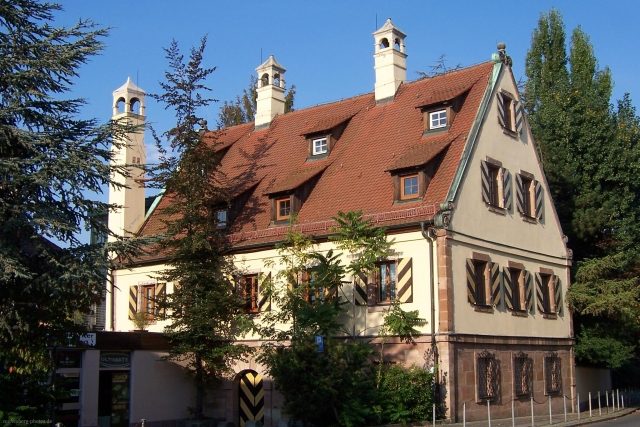
It seems questionable whether a new manor house was built under Sebastian Lanzinger soon after the destruction of the former Sitzinger Hammergut around 1632. Decades after the end of the war, ruins were still visible in Schniegling. After Lanzinger's death, presumably around 1650, the property fell to a community of heirs, who finally agreed on an acquisition by co-heir Daniel Besserer. Besserer probably died around 1665, and again after an inheritance agreement, the presumed son-in-law Johann Adam Hilling acquired the former Hammergut. Around 1690, the large property was broken up, so that the residential and operational buildings, as well as the gardens and other agricultural areas, were sold to several interested buyers.
Part of the factory premises was acquired in 1692 by the merchant Johann Daniel van Lierd, as well as by Johann Jakob and Johann Gustav Silberrad, the sons of the council consultant Dr. Stephan Jacob Silberrad. From 1698, they had a veneer factory built here to produce mainly ivory, precious wood, and tropical wood veneers with the help of the famous Augsburg veneer sawyer Johann Dürsch. After the project apparently failed, the consortium sold the hammer with outbuildings and a "fire site" in 1706 to the iron dealer Johann Elias Schöpff. The veneer saw was separated from the property and sold in 1712 to Georg Pömer, then soon after to Christoph Löchner.
The new manor house is said to have been built during the period of frequent changes of ownership since 1692. On December 3, 1722, it went with the veneer factory to Petrus Berlin, who converted the factory into a mirror factory with the help of his father-in-law Johann Friedrich Schober [cf. Gleißhammer II]. Allegedly, however, he sold the manor house around 1733 to the manufacturer Wilhelm Gottfried Hörmann, whose family coined the later name. In the late 18th century, Johann Christian Hörmann was the owner. He was succeeded by the ennobled Karl von Hörmann, who died in 1817 and bequeathed the property to his daughters Maria Katharina von Schmidt and Susanna Martha Bödecker. After an agreement within the family, the von Schmidt family remained owners until 1838. Before 1854, the property had then passed to Margaretha Barbara Daumer.
The manor house, a two-story building with a gable roof, sandstone ashlar surrounds, and a volute gable, has been preserved to this day and keeps alive the memory of Schniegling's importance for Nuremberg's economic history.
Take Mobile History with you
You are reading this text for free. Premium adds what matters on the road: descriptions read aloud, sites found through your camera, whole regions taken offline.
- Every description, including the ~17,700 Premium sites
- Audio guide: have descriptions read to you on location
- AR finder: see sites through your camera, with distance and bearing
- Unlimited saved sites
14 days free, then from €2.99 a month. Cancel anytime.
Source: Wikipedia · Licence: CC BY-SA 4.0 · Image: http://schloesserrundschau.de/bayern/schloesser01/nuernberg42.html
This description draws on the facts documented in the linked Wikipedia article; Wikipedia content is licensed under CC BY-SA 4.0. Wording and editing: Mobile History.
Location: 49.4682, 11.0270