Monastery (active)
MonasteryMünchen
Herz-Jesu-Kloster
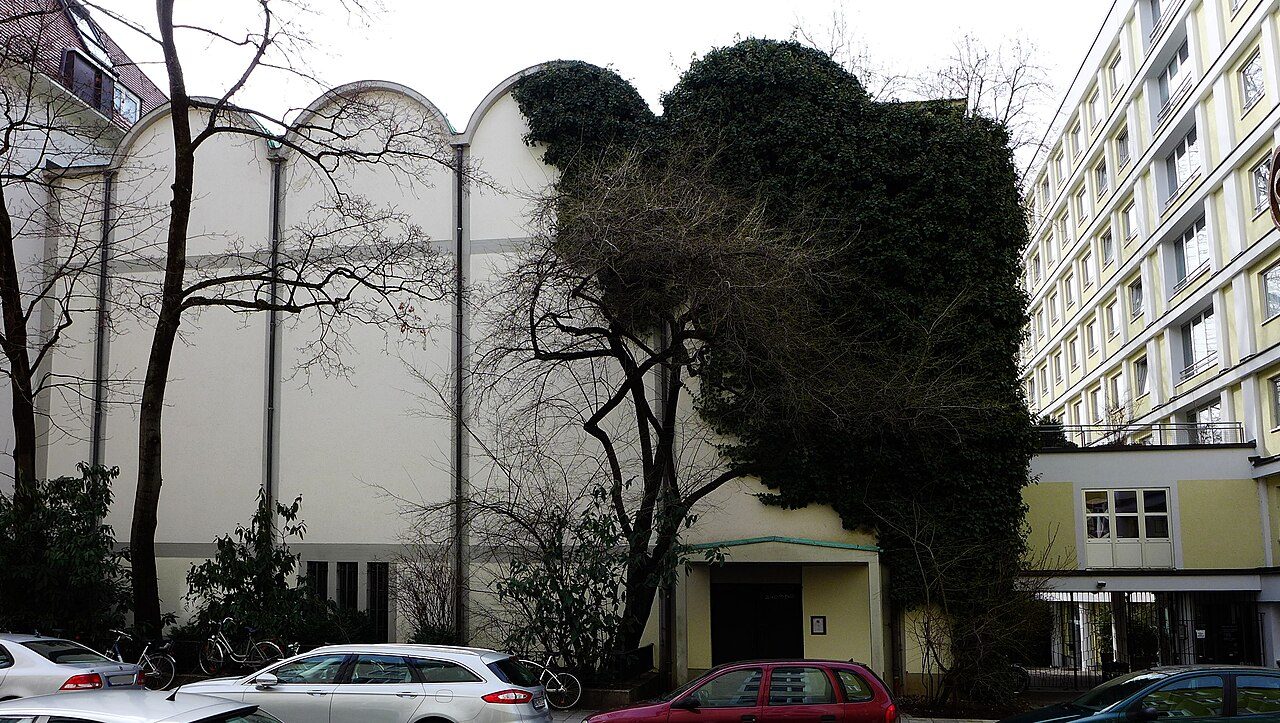
The Herz-Jesu-Kloster in Munich, a notable architectural monument in Bavaria, houses a monastery church considered a pioneering structure in reinforced concrete architecture. Located in the Isarvorstadt district, the sacred building presents itself as a three-aisled hall church in exposed concrete, with its design shaped by regional artists. It is a place of contemplation and a testament to modern sacred architecture after the Second World War.
History+
The history of Herz-Jesu-Kloster is marked by destruction and reconstruction. An original building from 1869, designed by Michael Reifenstuel, was completely destroyed by bombing during World War II. The current monastery complex, which includes the church and a girls' dormitory, was built between 1953 and 1955 according to designs by Alexander von Branca and Herbert Groethuysen. The foundation stone was laid on August 16, 1953, and the church was consecrated on June 5, 1955. In 1963, an organ by the Rieger company was installed. A comprehensive renovation of the church took place in 1995, and in 1999, it was recognized as a cultural monument.
Location+
The Herz-Jesu-Kloster is situated at Buttermelcherstraße 10 in the Isarvorstadt, a central district of Munich in Bavaria, Germany.
On site+
The monastery church is the first church in Munich to be built entirely using reinforced concrete. It is a three-aisled hall church in exposed concrete. The sisters' choir area is enclosed on both sides of the altar towards the main nave. The interior features works by regional artists: The choir mosaic was created by Karl Knappe, the tabernacle and sacrament altar by Heinrich Kirchner, and the altar block by Fritz Koenig and Karl Reidel. Chandeliers and the altar cross were crafted by Johannes Dumanski, while the choir screens, holy water fonts, and bronze fittings of the portals are by Blasius Gerg. The wrought-iron works were executed by Herbert Altmann. The organ on the rear gallery was built in 1963 by the Rieger company from Vorarlberg and has 25 stops. The bell tower houses three historically valuable bronze bells, which are still rung by hand via rope pull.
Nearby+
- Hochbunker Blumenstraße (Military buildings, approx. 392 m away)
- Schloss Alter Hof München (Castle, approx. 643 m away)
- Palais Törring-Jettenbach (Residence, approx. 759 m away)
- Frauenkirche (Sacred building, approx. 784 m away)
Take Mobile History with you
You are reading this text for free. Premium adds what matters on the road: descriptions read aloud, sites found through your camera, whole regions taken offline.
- Every description, including the ~17,700 Premium sites
- Audio guide: have descriptions read to you on location
- AR finder: see sites through your camera, with distance and bearing
- Unlimited saved sites
14 days free, then from €2.99 a month. Cancel anytime.
Location: 48.1323, 11.5783