To be privately owned
ManorNürnberg-Altenfurt
Altenfurt Manor
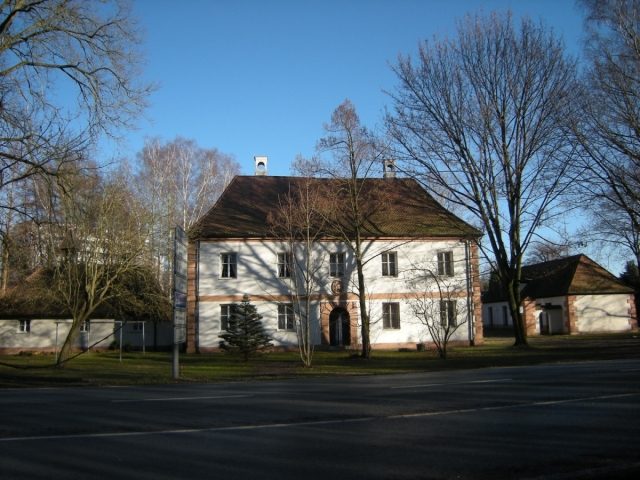
The manor house in Altenfurt, located near the famous Romanesque rotunda chapel of St. John and St. Catherine, is believed to have originated from a forest farmstead of the Lorenzer Reichswald. In 1438, the Nuremberg monastery of St. Egidien acquired the forest service fief. As early as 1487, a residential building could be traced there, which was available to the higher dignitaries of the convent during their occasional stays in Altenfurt. Presumably, the manor house later developed from this. In the report on the exploration of the landscape, carried out in 1504 before the outbreak of the Landshut War of Succession, no manor was yet noted. It only appeared in 1512 and was in the hands of Sebald Wolf. In 1523, Cunz Koler's widow sold it to the Nuremberg citizen Cunz Reyter, from whom it passed to Hans Kastner and his wife Barbara. They sold it in 1551 to Wolf Peßler for 440 guilders. His stepdaughter Katharina Mordeisen sold the manor in 1582 for 350 guilders to Hans Haller von Hallerstein.
The Hallers owned Altenfurt until 1686. In that year, Wolf Jakob Nützel, who married Anna Maria, daughter of Hans Christoph Haller, acquired the manor through marriage. The alliance coat of arms of the Haller and Nützel, which can be seen with the year 1691 above the round-arched door, commemorates this marriage. Under the Nützel, a new stable was built next to the manor house in 1732. After the extinction of the Nützel in the male line in 1747, Altenfurt fell back to the Haller von Hallerstein. Johann Georg Haller (1685–1763) began modernizing the manor house in the early 1750s. In 1753, he applied for the addition of a stair tower to gain more living space by removing the old staircase. The Lorenzi Forest Office granted him the necessary timber for this.
After the death of his son Georg Christian (1788), his son-in-law Jakob Christian Wilhelm Scheurl, who had married his daughter Maria Helena Haller in 1785, took over the manor, which apparently already suffered from some damage. In 1805, a major repair could no longer be avoided, during which the completely rotten ceiling above the stable also had to be renewed. In 1816, the entire manor house finally passed to the Scheurl family, who sold it to the Catholic Church Foundation Altenfurt in 1950.
The building fabric of the two-story manor house, covered with a hip roof, is said to date back to the 17th century. It was significantly shaped by the modernization under Johann Georg Haller in the years 1753/54. This presumably also produced the representative stucco work with Rococo style elements in the hall and in some rooms. Renovations in 1953 and 1962/63 brought about not exactly sensitively executed changes to the Baroque structure.
Take Mobile History with you
You are reading this text for free. Premium adds what matters on the road: descriptions read aloud, sites found through your camera, whole regions taken offline.
- Every description, including the ~17,700 Premium sites
- Audio guide: have descriptions read to you on location
- AR finder: see sites through your camera, with distance and bearing
- Unlimited saved sites
14 days free, then from €2.99 a month. Cancel anytime.
Source: Wikipedia · Licence: CC BY-SA 4.0 · Image: http://schloesserrundschau.de/bayern/schloesser01/nuernberg31.html
This description draws on the facts documented in the linked Wikipedia article; Wikipedia content is licensed under CC BY-SA 4.0. Wording and editing: Mobile History.
Location: 49.4066, 11.1642