Cultural Events
ManorNeustadt an der Weinstraße - Mußbach
Mußbach Manor
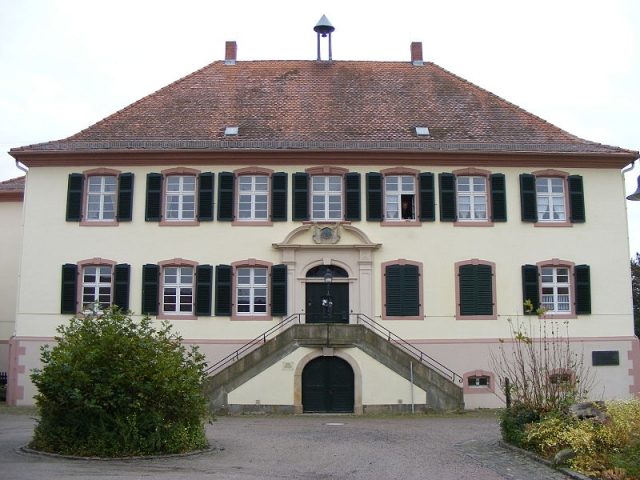
The Herrenhof estate in the former wine-growing village of Mußbach, which has been a district of Neustadt an der Weinstraße (Rhineland-Palatinate) since 1969, is an extensive and excellently restored farmstead. It has been documented since the 7th century and for most of its history belonged to a religious order, from whose spiritual lords its name is derived.
Sometimes, Herrenhof refers not only to the listed building ensemble but also includes the adjacent lands, which are managed under the name Staatsweingut mit Johannitergut (State Winery with Johanniter Estate).
Geographical Location+
The actual estate, just under one hectare in size, is located next to the old St. John's Church, the northwestern end of the entire complex. It initially belonged to the Herrenhof grounds; in the High Middle Ages, it was built as an order church on the site of a smaller predecessor church. Although the address An der Eselshaut 18 suggests it, there is no direct access to this street due to the church in front. Access is via Herrenhofstraße, which runs to the east, while Lutwitzistraße (without access) forms the western boundary.
Today, residential buildings surround the total area, which has shrunk from originally about six to three hectares; in the Middle Ages, it was outside the built-up village center, which it borders with its northern part. The larger southern part is occupied by the Herrenhof vineyards, covering a good one and a half hectares, which form the Mußbacher Johannitergarten site in the middle of the village. The vineyard area extends south to the street An der Bleiche, where the Mußbach stream was piped underground in the 20th century, and west to the southern end of the street An der Eselshaut. In the southeastern area, the new St. John's Church was built in the late 1950s and consecrated in 1959.
Middle Ages
The founding documents date back to the 7th century, making the Herrenhof the oldest continuously operated winery in the Palatinate. The earliest records of the estate prove it to be a monastery farm of the Benedictine Abbey of Weißenburg, located about 50 km south-southwest in what is now French Alsace. In 985/991, the Salian Duke Otto of Worms took the farm, along with 67 other farmsteads, from this monastery. Since then, the property belonged to the Salian and Staufer rulers and was initially granted as a fief to ministeriales. Eventually, it came into the hereditary possession of the lower nobility of the region.
In 1290, Werner, Schenk von Ramberg, transferred the estate to the Order of St. John. It belonged as a so-called Membrum (Latin for member) to its commandery Heimbach in the South Palatinate municipality of Zeiskam. While the commandery was devastated in the Peasants' War in 1525, the Mußbach sub-commandery remained intact. After the Reformation, it remained in the possession of the Catholic branch of the order, which had been renamed the Order of Malta. Towards the end of the 16th century, the Herrenhof was at the peak of its economic prosperity: in 1589, the estate included the adjacent St. John's Church, dedicated to the patron saint of the order, the Heidmühle on the Speyerbach below Neustadt, 375 hectares of arable land, 116 hectares of meadows, 5 hectares of self-managed and 35 hectares of "eternally leased" vineyards, as well as 165 hectares of order forest east of Mußbach. The order also held the tithe and a number of levies from the farmers, the so-called "Gülten," as well as fishing rights in the Speyerbach and Rehbach. Surpluses flowed to the Heimbach commandery until 1512, then to the Grand Prior in German Lands and Commander of Heimbach, who had his seat across the Rhine in Heitersheim, Baden. Every year in summer, the officials of the electoral Oberamt were invited to a banquet followed by entertainment at the Herrenhof. From this tradition, the Eselshautfest has developed, which is celebrated annually over two weekends in June/July on the grounds of the Herrenhof.
Modern Era
The wars of the 17th century led to the decline of the Herrenhof. In 1621, in the third year of the Thirty Years' War, troops of Ernst von Mansfeld, who advocated for the Reformed Church, and the Spanish General Fernández de Córdoba, who sided with the Catholic League, fought against each other in the Mußbach area; in doing so, they devastated not only the agricultural areas around the village but also the village itself, including the Herrenhof. Before economic recovery could take hold, the Palatinate War of Succession broke out in 1689, during which the French King Louis XIV had primarily the left-bank parts of the Electoral Palatinate burned down. Except for the church, parts of the Herrenhof, and a few houses, Mußbach also sank into rubble and ashes. Whether the original Schaffnerhaus (steward's house) immediately south of St. John's Church, built like the church in the High Gothic era, was destroyed in the first or second war, remains unclear. Nevertheless, the Order of Malta managed to restore the Herrenhof, except for this Schaffnerhaus, to some extent and operate it profitably for another century.
When the French Revolution spread to the German territories on the left bank of the Rhine towards the end of the 18th century, the possessions of the Order of Malta were also secularized in 1797. Napoleon eventually transferred the Herrenhof to his Legion of Honor. In 1811, he had the estate divided and auctioned off to replenish his war chest. The largest share was acquired by the wealthy tobacco merchant Jakob Kraetzer. His descendants managed the estate for four generations. In 1870, Otto Sartorius the Elder, brother-in-law of great-grandson Josef Kraetzer, joined the company as a partner; in 1899, he took it over entirely by buying out the relatives. When he died in 1911, his son of the same name, Otto Sartorius the Younger, succeeded him and managed the winery until his death in 1977. However, he had already transferred ownership to the state of Rhineland-Palatinate in 1970, which has since managed the Herrenhof vineyards as a state winery.
Restoration and Current Use
In 1983, the Fördergemeinschaft Herrenhof Mußbach e.V. (Herrenhof Mußbach Support Association) was founded. It began with the restoration of the architectural ensemble, which was largely completed in 1991. Since then, the building complex, with its numerous representative rooms and its huge paved inner courtyard, has served the city of Neustadt and the district of Mußbach as a backdrop for cultural and festive events, and the Herrenhof also enables large art exhibitions.
Festival Hall
The threshing floor on the upper floor of the press house has been converted into a festival hall with a stage, which can accommodate more than 300 spectators. It is primarily used for concerts, theater performances, cabarets, and other events, e.g., the award winners of the "Jugend musiziert" competition from the region are regularly presented here.
Wine Museum
The Wine Museum "Getreidekasten" (Granary) is located in the former granary building and can be visited by appointment. In the basement, the former tithe cellar, machines and equipment used in viticulture from the early 19th century until after World War II are presented, including the "Halbstück-", "Stück-", and "Mehrstückfässer" (barrels of various sizes), whose names refer to the unit of measure "Stück". On the raised ground floor, information is provided about all the work of the winemaker, from the establishment of a vineyard to the harvesting and pressing of grapes and the actual wine production.
Eselshautfest
The Eselshautfest has been taking place since the 1970s at the end of June/beginning of July. It replaced the Kerwe as Mußbach's most important festival in the 1990s and has become one of the Palatinate wine festivals that attract visitors from beyond the region. The name of the festival is derived from the village's most famous vineyard, the Mußbacher Eselshaut. Visitors gather in the spacious area of the Herrenhof between the two churches. The festival lasts a total of six days, over two weekends, from Friday to Sunday each time.
Layout+
The architectural styles of the renovated buildings do not date back to the original period but belong to later epochs: High Gothic, Renaissance, Baroque, and Wilhelminian era.
Courtyard, Wall and Portal
The building ensemble of the Herrenhof is grouped quadrangularly around the central courtyard. So-called "Wetzrillen" (sharpening grooves) on surrounding gate jambs confirm that it once served as a "Dinghof" where court hearings and votes took place. In the center of the courtyard is a 25 m deep well shaft, which no longer contains water. It is likely from the High Middle Ages and is probably the oldest existing part of the entire complex. Its depth proves that at the time of its construction, despite the Mußbach stream flowing uncontained only about 200 m to the south, the groundwater was no longer as high as it apparently was at the time of the village's founding; in 780, the village was first mentioned as Muosbach (i.e., mossy or swampy stream) in the inventory of Fulda Monastery. A boundary stone from the Heimbach Commandery shows the Johanniter cross, whose eight points refer to the eight Beatitudes of the Sermon on the Mount in the Gospel of Matthew 5:3–12 EU, while the four bars signify the cardinal virtues of justice, bravery, wisdom, and temperance. The ring wall around the courtyard is completely preserved on the east side and, at over 5 m high, proves that it was a fortified farm. The entrance in the northeast corner is a Renaissance portal from 1530, built from massive rusticated ashlar stones and was part of a large gate tower that was demolished after the property was auctioned off in 1811/12.
Manor House and Coachman's House
The manor house in the southeast, opposite the portal, extends from east to west. It was built in 1773/74 in Baroque style and served the order as the new steward's house. To its west is the so-called "Holländer-" (after the roof shape) or "Kutscherhaus" (coachman's house, because it was inhabited by the coachman), which was built around 1775 from the leftover sandstones of the old steward's house, which had burned down in the 17th century.
Johannitergarten, Villa, Stables and Workshop
Through an undeveloped gap, a large park-like garden and the Johannitergarten are reached, which has been used for viticulture for more than 1300 years. In its northwest corner, outside the fortified complex, stands a representative villa that Otto Sartorius the Elder had built in 1886/87 during the Gründerzeit as a wine trading house. The buildings in the south are completed by the stables and the workshop, which were built before 1500 and renovated in 1770–1772; their south side, facing the garden, is equipped with loopholes.
Press House and Coach House
In the west, a mighty press house stretches along Lutwitzistraße, with a large coach house attached to its northern end. The press house served the order as a barn and the coach house as a pressing area and storage facility for agricultural equipment and vehicles. A restored wine press is displayed as an exhibit on the eastern ring wall.
Granary, Stork Tower and Servants' Building
Immediately on the south side of St. John's Church lies the voluminous granary, called Getreidekasten. It is built of irregular rubble stones, and the attic is supplied with light through six dormer windows facing south. The Stork Tower serves as access to the upper floors, a formerly High Gothic, later Renaissance-style rebuilt and white-plastered stair tower with a unique Renaissance portal and a representative spiral staircase. The architectural design proves that the tower formerly belonged to the stately steward's house. This stood east of the granary, at right angles to it, and extended to the middle of the path running south of it between the entrance portal and the press house. The eastern outer wall of the steward's house, preserved in small parts, still shows windows and door arches. Further to the right, up to the main portal, runs an elongated two-and-a-half-story building, which housed the servants' apartments.
Take Mobile History with you
You are reading this text for free. Premium adds what matters on the road: descriptions read aloud, sites found through your camera, whole regions taken offline.
- Every description, including the ~17,700 Premium sites
- Audio guide: have descriptions read to you on location
- AR finder: see sites through your camera, with distance and bearing
- Unlimited saved sites
14 days free, then from €2.99 a month. Cancel anytime.
Source: Wikipedia · Licence: CC BY-SA 4.0 · Image: http://de.wikipedia.org/wiki/Datei:2007-Herrenhof-Mussbach-Haupthaus.jpg
This description draws on the facts documented in the linked Wikipedia article; Wikipedia content is licensed under CC BY-SA 4.0. Wording and editing: Mobile History.
Location: 49.3687, 8.1707