To be privately owned
ManorSteinhorst
Steinhorst Manor
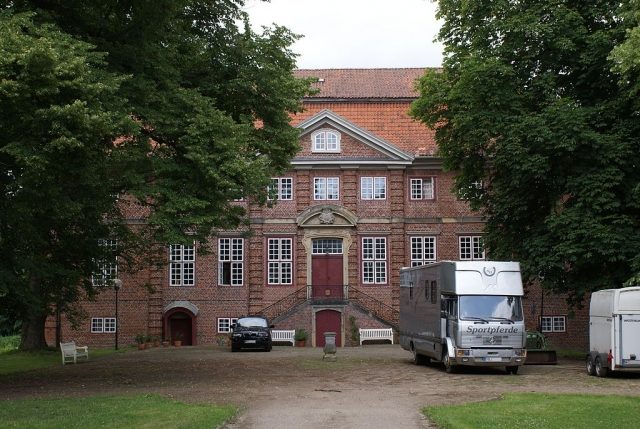
The manor house Steinhorst in Steinhorst in the district of Herzogtum Lauenburg was originally the manor house of the noble court of the same name and later an administrative seat. Due to this dual function, it mostly served only as an official residence; as the manor house of the Steinhorst estate, it was inhabited for only one generation in the 18th century. Steinhorst is considered one of the most important Baroque buildings in Schleswig-Holstein. It is currently in private ownership.
The Steinhorst estate was initially owned by the von Borstele family in the Middle Ages, who built two small moated castles on the site in the 14th century, which were already destroyed by around 1349. For the late 14th century, ownership by the von Steinhorst family is documented. The Steinhorst estate passed to the Dukes of Lauenburg in 1408, who elevated it to an Amt (administrative district) and later pledged it to the Duchy of Gottorf. The farmstead was destroyed as a result of the Thirty Years' War and rebuilt after 1648. In 1691, the Amt passed to the Gottorf minister Magnus von Wedderkop, whose son Gottfried had the present manor house built in the 18th century. He transferred Steinhorst to the Kingdom of Hanover in 1738, which, due to its location near the border, led to repeated disputes with the Kingdom of Denmark. In 1739, Steinhorst was reunited with Lauenburg; after the completion of the so-called unified state, the estate passed into the possession of the Danish king in 1815 and, after the war of 1864, to the Kingdom of Prussia. From 1876, the manor house housed the district court, and the estate was parcelled out.
After the Second World War, the manor house served to accommodate war refugees, and later it housed several apartments. The state of Schleswig-Holstein sold the manor house in 1973 to the cosmetics company Schwarzkopf, which used it as a training and guesthouse and had a small museum set up. Regular guests of the company included the former Minister President Uwe Barschel. In the 1990s, another sale took place, and the manor house has been in private ownership ever since. The building can only be viewed to a limited extent from the outside.
Building Stock+
The Manor House
The manor house was built untypically for the region, about 100 meters away from the farmstead, as the center of a Baroque courtyard and garden complex. The architect was Johannes Nicolaus Kuhn; work began in 1720 and ended in 1736. The manor house has a low plinth floor, a high main floor, and a low upper floor, and is covered by a high mansard roof. The building is entirely constructed of unplastered brick. The facades are plastically designed with brick pilasters and accented with cornice bands and portals of sandstone; the three-axis central risalit is emphasized by a frontispiece. Above the portal is the coat of arms of the builder.
The floor plan of the manor house is largely symmetrical: the centrally located vestibule, which also serves as a staircase, is followed on both sides by two salons each, as well as two cabinets in the east and three in the west; the rooms are connected en filade according to the French model. The movable furnishings have partly been lost over the centuries, but the fixed decoration in Baroque stucco work in the Régence style has been preserved to the present day.
The Garden
The house is surrounded on three sides by a moat and forms the center of a spacious Baroque garden complex, whose basic features, laid out from 1722, have been preserved to the present day. From the south, a long avenue leads to the courtyard facade of the manor house; to the north, the garden adjoins, which lost its originally formal design since the 19th century and was transformed into a landscape garden. The central main axis of the complex leads from the garden several kilometers north into the neighboring forest area.
Take Mobile History with you
You are reading this text for free. Premium adds what matters on the road: descriptions read aloud, sites found through your camera, whole regions taken offline.
- Every description, including the ~17,700 Premium sites
- Audio guide: have descriptions read to you on location
- AR finder: see sites through your camera, with distance and bearing
- Unlimited saved sites
14 days free, then from €2.99 a month. Cancel anytime.
Source: Wikipedia · Licence: CC BY-SA 4.0 · Image: http://de.wikipedia.org/wiki/Datei:Herrenhaus_Steinhorst.JPG
This description draws on the facts documented in the linked Wikipedia article; Wikipedia content is licensed under CC BY-SA 4.0. Wording and editing: Mobile History.
Location: 53.7207, 10.4871