To be privately owned
ManorCostedt
Rothhoff Manor (Costedt)
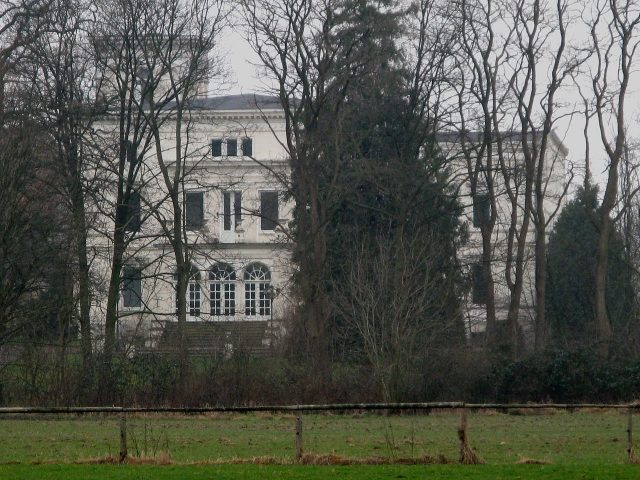
Rothenhoff Estate is a knight's estate located south of the Wiehen and Weser Mountains in the Great Weser Bend, in the village of Costedt, part of the city of Porta Westfalica in the Minden-Lübbecke district.
Rothenhoff was first mentioned in 1230. It was one of the court estates of the Bishops of Minden and, with the dissolution of the Prince-Bishopric of Minden, passed into the possession of the Prussian state. After the end of the Thirty Years' War, the estate was gifted to a Swedish envoy to secure Swedish consent for the transfer of the Prince-Bishopric of Minden to Brandenburg. This gift was revoked in 1666.
Under Napoleon, Rothenhoff became an imperial French domain, gifted to the French General de la Houssay, successful at Jena
and Auerstädt. For a short time, French marines under General Prince Eckmühl were quartered here.
After Prussia sold the estate to a Bremen merchant in 1822, it became a knight's estate in 1848 through the acquisition of additional lands, and its owner, Caesar zu Rothenhoff, became a member of the Prussian Landtag.
From 1945 to 1954, Rothenhoff Knight's Estate was used by the British as the headquarters of the Commander-in-Chief of the British Army of the Rhine. Prominent guests during this time included Princess Margaret and Prince Philip, Duke of Edinburgh, as well as Field Marshal Bernard L. Montgomery and General Dwight D. Eisenhower, who stayed at Rothenhoff Knight's Estate.
Buildings and Park+
The farm buildings and the manor house date from the era of the Bremen merchant family Caesar, who owned the knight's estate from 1822 to 1915. The manor house was built as a new construction in 1863 according to plans by the royal master builder Barring in the late Classicist style. The historic estate park was laid out in the style of an English landscape park in conjunction with the new construction of the manor house in 1863, to the east and north of the manor house. The farm complex with its associated manor house, as well as the hereditary burial site established in 1926, have been listed as historical monuments since 1984.
Current Use+
Already since the beginning of the 20th century, intensive gravel extraction has taken place on the formerly agriculturally used areas. Due to the progressive gravel extraction, the agricultural areas and facilities were sold and leased to local farmers in 1971, while the manor house and park are privately used. The parts of the park north of the manor house no longer exist. The park east of the house has largely retained its character. To the south, the park is bordered by a wall; to the east and north, it transitions into agricultural areas, bordered by hedges. The manor house and the park are in a good state of preservation due to the owner's initiative.
Miscellaneous+
On November 11, 1841, Caroline Elisabeth Francisca Sophie Caesar was born at Rothenhoff Knight's Estate. After her father's death, she moved with her mother to Kassel in 1851. Here, in 1862, she married the entrepreneur Oscar Henschel. Henschel was the owner of Henschel & Sohn, a machine factory that he developed into the world's leading locomotive factory. Sophie Henschel was one of the wealthiest women in the German Empire, endowed with an exemplary sense of social responsibility.
Take Mobile History with you
You are reading this text for free. Premium adds what matters on the road: descriptions read aloud, sites found through your camera, whole regions taken offline.
- Every description, including the ~17,700 Premium sites
- Audio guide: have descriptions read to you on location
- AR finder: see sites through your camera, with distance and bearing
- Unlimited saved sites
14 days free, then from €2.99 a month. Cancel anytime.
Source: Wikipedia · Licence: CC BY-SA 4.0
This description draws on the facts documented in the linked Wikipedia article; Wikipedia content is licensed under CC BY-SA 4.0. Wording and editing: Mobile History.
Location: 52.2297, 8.8639