To be privately owned
ManorRohlstorf
Rohlstorf Manor
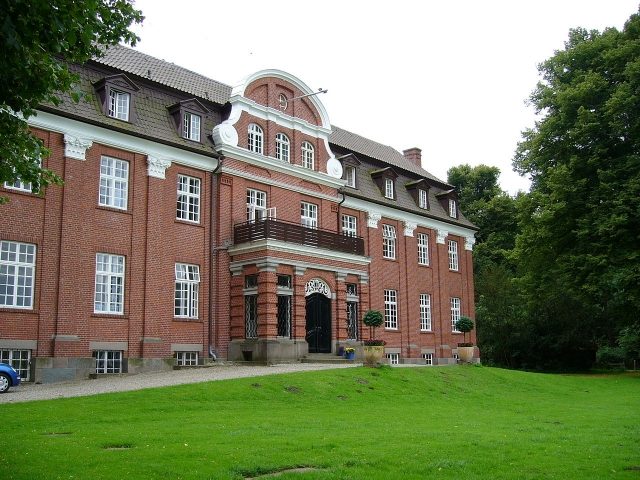
The Rohlstorf Estate is located directly on Lake Wardersee in the municipality of Rohlstorf, a few kilometers east of Bad Segeberg in Schleswig-Holstein. The neo-baroque manor house of the estate, built in the 16th century, now serves as the so-called Rohlstorf Castle Boarding School.
The Noble Estate of Rohlstorf was founded in the early 16th century. At that time, it was owned by the knightly Wensin family, who also resided at the Wensin Estate, which lies opposite Rohlstorf on the other side of Lake Wardersee. In 1601, Rohlstorf came into the possession of the Danish King Christian IV, who granted it as a fief to his general Christian Suhm in 1614. The general was murdered four years later, and Rohlstorf subsequently went to the king's illegitimate son, Ulrich Christian Gyldenlöve, as a provision estate. From 1625, the owners changed several times, and in 1661, the estate came into the hands of the Brockdorff family, who remained here well into the 18th century. The Brockdorffs were followed by changing owners again. In 1846, the estate passed to Kuno zu Rantzau-Breitenburg. According to his plans, a new manor house in the Neo-Gothic style was built at that time. At the end of the 19th century, Gut Rohlstorf was acquired by Ferdinand Eduard von Stumm for his second-born son Herbert von Stumm. In 1908, the estate comprised 1500 hectares. The von Stumm family had the current manor house built after a fire starting in 1912 and remained at Rohlstorf until the end of the Second World War. The manor house was confiscated by the British army in 1945 and subsequently served to accommodate refugees. In 1962, the boarding school was founded on the estate. The manor house then served to accommodate the students, and a former administrator's building was converted into the new manor house.
Present Day
Gut Rohlstorf has been owned by a Rantzau line again since 1992. The classic layout of the estate, consisting of the manor house and the farmyard, has changed due to its current use; the manor house is available for the boarding school operations, and some of the outbuildings have been converted into private residential homes. Agriculture continues to be practiced at Gut Rohlstorf; of the approximately 1100 hectares of land, about 600 hectares are arable land.
Due to its function as a school building, the manor house is usually not accessible to the public. Exceptions include regular open days and various events, such as theatrical performances staged by the schools.
Buildings+
The Manor House
The manor house is also known as Rohlstorf Castle; since the Danish royal family was among the owners of the estate in the past, this designation is also possible, even if Rohlstorf did not serve as a royal residence. The current manor house is the third building on this site. A first manor house was demolished for the new building of the 19th century designed by Kuno Rantzau. This second house was a multi-winged building with an observation tower, it was designed in the Neo-Gothic style and was already demolished again for the current Rohlstorf Castle at the beginning of the 20th century.
The two-story manor house from 1912, built of brick, is a late work of Historicism in Schleswig-Holstein in its neo-baroque execution. Its architectural design and proportions are directly influenced by the not-far-distant manor house at Gut Pronstorf, which is considered one of the main works of Baroque architecture in Holstein. In particular, the south-facing courtyard facade imitates the Pronstorf model. As there, two double-axis side risalits protrude from the facade, the center of which is emphasized by a gable - in Pronstorf by a triangular frontispiece, in Rohlstorf by a segmental gable adorned with volutes. Both buildings are structured with continuous pilasters in colossal order and covered with a mansard roof. The northern facade of the Rohlstorf manor house faces Lake Wardersee and dispenses with the wing-like risalits. A three-axis balcony is placed in front of the center of the building with the portal, and the gable resembles that of the south facade.
The interior rooms of the castle were originally designed in the historicist style of the turn of the century. Since the building has served as a boarding school building for many years, and no longer as a stately manor house, its furnishings are adapted to its current purpose. It houses the living quarters of the approximately 70 students; the actual lessons take place at the neighboring schools.
Surroundings
The estate is reached via an approximately two-hundred-year-old and two-kilometer-long lime tree avenue. The historic paving of the driveway is largely preserved and is a protected monument. Southeast of the manor house is the farmyard, which is still part of the estate's operations today. The yard is formed by typical farm buildings, such as barns and stables. Former administrator and servant houses now serve as residential buildings, and the former coach house has been converted into the new manor house. The Annette-von-Rantzau-Gemeinschaftsschule has been located in one of the farm buildings since 2010. Of the other buildings, the former granary with its high stepped gable is particularly noteworthy, whose oldest parts date back to the 16th century. The former landscape park now serves the boarding school as a recreational area.
Take Mobile History with you
You are reading this text for free. Premium adds what matters on the road: descriptions read aloud, sites found through your camera, whole regions taken offline.
- Every description, including the ~17,700 Premium sites
- Audio guide: have descriptions read to you on location
- AR finder: see sites through your camera, with distance and bearing
- Unlimited saved sites
14 days free, then from €2.99 a month. Cancel anytime.
Source: Wikipedia · Licence: CC BY-SA 4.0 · Image: http://de.wikipedia.org/wiki/Datei:Gut_Rohlstorf_Herrenhaus.jpg
This description draws on the facts documented in the linked Wikipedia article; Wikipedia content is licensed under CC BY-SA 4.0. Wording and editing: Mobile History.
Location: 53.9729, 10.4059