To be privately owned
ManorOberfrauenau
Oberfrauenau Manor
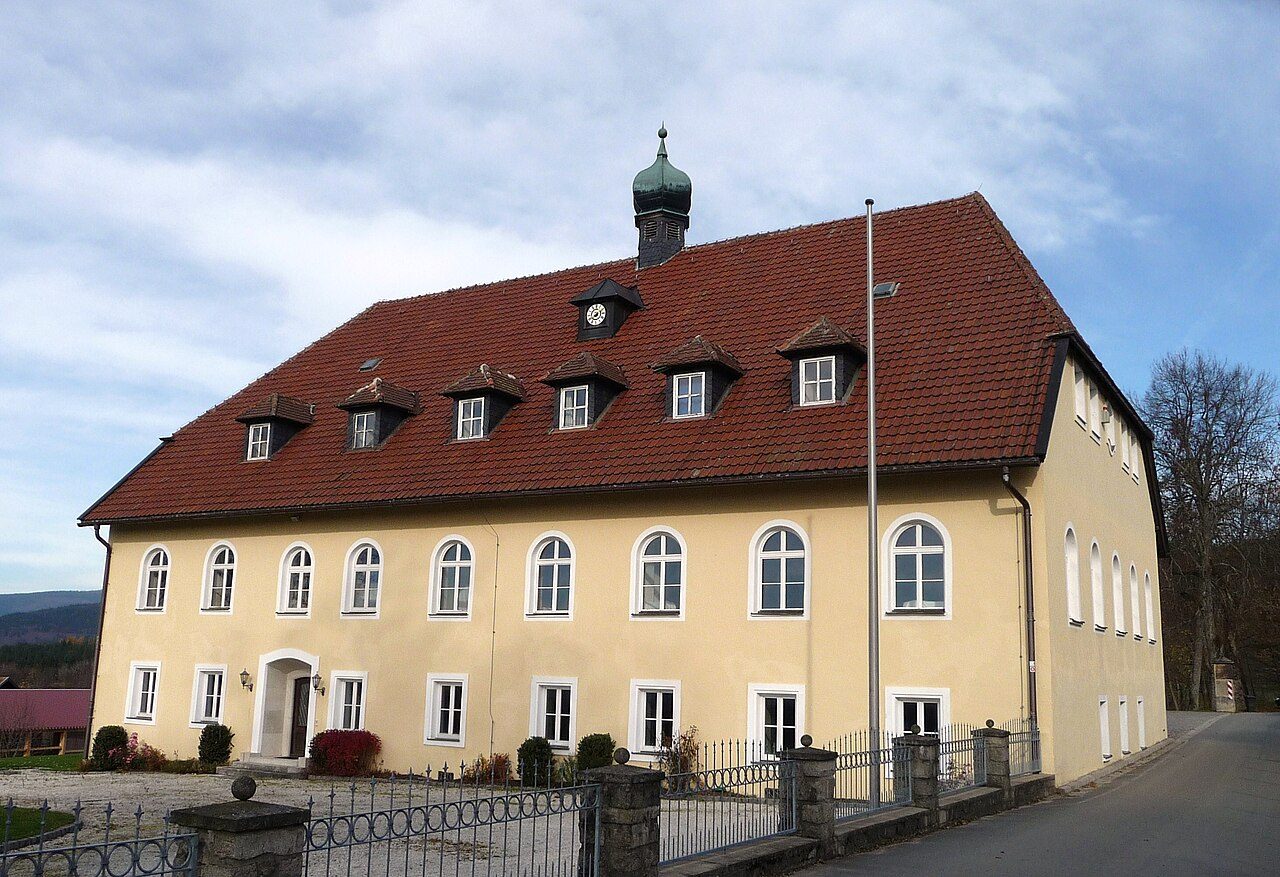
Oberfrauenau is an estate and a district of the municipality of Frauenau in the Regen district. In 1492, Balthasar Phaler sold his existing glassworks to Erasmus Moosberger. In 1605, Franz Poschinger acquired the Oberfrauenau glassworks estate, which has since been associated with the Frauenau branch of the Poschinger family, who have used the suffix "von Frauenau" since 1901.
Around 1650, the Old Castle, a manor house, was built, which still forms the center of the glassworks estate. On October 18, 1785, Elector Karl Theodor granted Benedikt Poschinger the lower Hofmannsrecht and jurisdiction along with a noble title. This gave the glassworks estate the status of a Hofmark, thereby removing it from the sovereign rule of the Elector and the Rinchnach provostry, and it became the property of the Poschingers.
Around 1825, Georg Benedikt von Poschinger built a new glassworks, the so-called Neuhütte, near the manor house. On August 16, 1860, this hollow glass factory burned down. Around 1835, Johann Michael von Poschinger built a mirror glassworks along with a mirror grinding shop on the northeastern edge of Oberfrauenau. After converting to hollow glass, glass was produced here until 1893.
In 1820, the Hofmark Oberfrauenau became a patrimonial court of the second class, which was abolished in 1848. In 1863, a Fideikommiss was formed to ensure the undivided and inalienable preservation of the family fortune.
A liquor license was granted in 1860 for the estate's inn, which is still in operation today. In 1878, the Oberfrauenau estate, with 3,476.36 hectares, was the largest noble estate in the region, ahead of the Oberzwieselau and Buchenau estates, also owned by the Poschingers, each with 2,209.50 hectares.
From 1875 to 1884, the New Castle was built in the Neo-Renaissance style according to the plans of the Munich architect Albert Schmidt. This building, adorned with pointed towers and bay windows, was surrounded by a garden whose showpiece was a water fountain. The castle served as the residence for the Barons von Poschinger until 1945.
After World War II, it was converted into the US command post for the Zwiesel-Frauenau area and later served as emergency accommodation for displaced persons. Hippolyt Poschinger von Frauenau unsuccessfully offered it to the state for purchase due to the damage incurred. Thus, in 1959, with the state's permission, he had it dismantled by a 50-man troop from the Mountain Pioneer Battalion 8 from Degerndorf (municipality of Brannenburg). On August 15, 1959, the largest and last of the three towers was blown up. In total, 750 kilograms of explosives were used in 410 operating hours, with 8,500 cubic meters of rubble being removed or distributed. Only the castle chapel with the family crypt remained. Cassette ceilings and doors from the castle are still located in the Degerndorf barracks today.
Take Mobile History with you
You are reading this text for free. Premium adds what matters on the road: descriptions read aloud, sites found through your camera, whole regions taken offline.
- Every description, including the ~17,700 Premium sites
- Audio guide: have descriptions read to you on location
- AR finder: see sites through your camera, with distance and bearing
- Unlimited saved sites
14 days free, then from €2.99 a month. Cancel anytime.
Source: Wikipedia · Licence: CC BY-SA 4.0 · Image: Konrad Lackerbeck / CC BY 3.0 via Wikimedia Commons
This description draws on the facts documented in the linked Wikipedia article; Wikipedia content is licensed under CC BY-SA 4.0. Wording and editing: Mobile History.
Location: 48.9986, 13.3195