To be privately owned
ManorWerl
Koeningen Manor (Werl)
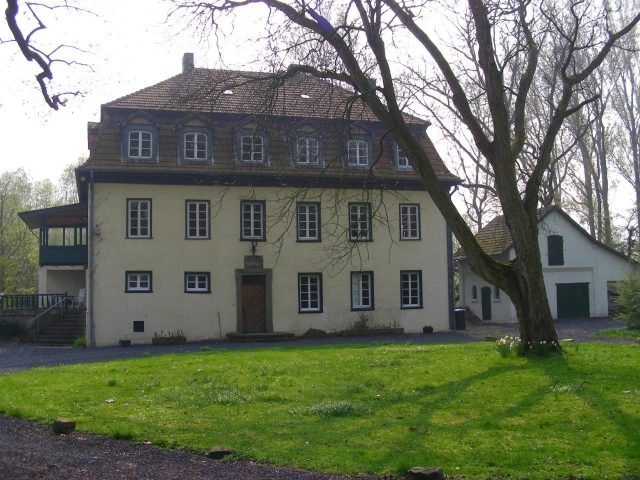
Haus Koeningen is a listed secular building in Werl, a town in the Soest district (North Rhine-Westphalia).
History and Architecture+
The house was first mentioned in a document in 1348 as a Cologne fief. On December 1, 1485, Werl mayor Wilhelm Papen was enfeoffed with the fortified house Koeningen (Koyninck) by the Counts of Tecklenburg. His wife was Aleke Lappe. The Barons von Plettenberg-Hovestadt bought the feudal lordship in 1691 from Count Klaus von Tecklenburg. The house is still owned by the von Papen-Könningen family today. Due to inheritance disputes, the house was also inherited in parts. It was disputed whether it was a male fief. In 1543, a part of the house came to the salt boiler Erasmus Schöler through his wife Katharina Papen. Through a settlement before the Imperial Chamber Court, the entire property came into the hands of Bertram von Papen in 1626. Dietrich von Eickel married his daughter Anna and then acquired the entire property. Further lawsuits were filed against the female line in 1683 and 1691, ending with a settlement in favor of Wilhelm Albert Papen. Wilhelm Albert's sons remained unmarried. In 1765, Goswin Kasper Papen bequeathed the house to his youngest sister Maria Antonette von Bendit. Her descendants also died childless, and so Koeningen passed to Anton Albert von Papen zu Westrich. To this day, Haus Koeningen has remained in the possession of the nephew of Chancellor Franz von Papen. Until 1938, when the manor house was vacant, the house was leased to various tenants. Currently, the agriculturally usable areas are leased.
The moated manor house of plastered half-timbering is partly slated. The attic with a mansard roof was added in 1923.
Chapel
North of the moat stands a chapel made of greensandstone. It was built in 1698. The straight-closed choir is recessed. The walls are structured by trefoil windows and a coat of arms portal. A roof turret was placed on the hip roof. The interior has a flat ceiling. The carved altarpiece from the second half of the 17th century shows a painting of the Adoration of the Magi.
Take Mobile History with you
You are reading this text for free. Premium adds what matters on the road: descriptions read aloud, sites found through your camera, whole regions taken offline.
- Every description, including the ~17,700 Premium sites
- Audio guide: have descriptions read to you on location
- AR finder: see sites through your camera, with distance and bearing
- Unlimited saved sites
14 days free, then from €2.99 a month. Cancel anytime.
Source: Wikipedia · Licence: CC BY-SA 4.0
This description draws on the facts documented in the linked Wikipedia article; Wikipedia content is licensed under CC BY-SA 4.0. Wording and editing: Mobile History.
Location: 51.5811, 7.9542