Golf club
ManorAlveslohe-Kaden
Kaden Manor
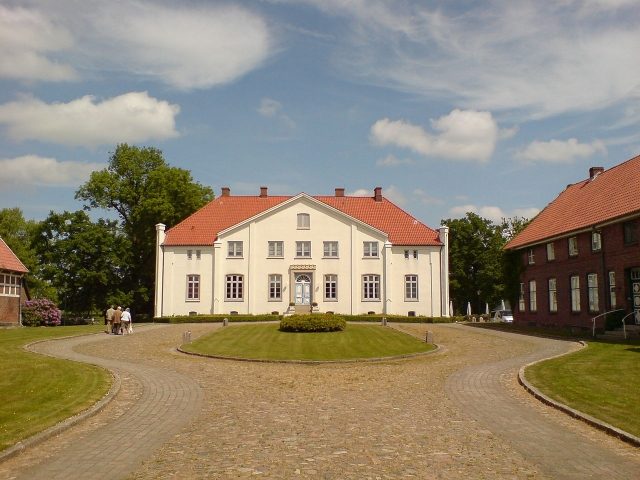
Gut Kaden near Alveslohe in Schleswig-Holstein was managed from the Middle Ages until the 20th century. The complex, located approximately 20 kilometers north of Hamburg, consisting of the manor house, farm buildings, and the former estate grounds, has served as a restaurant and focal point for the Golfclub Gut Kaden since 1984. Gut Kaden is known beyond Germany's borders through international professional golf tournaments. All the world's best golfers, including Tiger Woods, have already teed off at Kaden. From spring 2015, a guesthouse with 40 rooms will complement the estate's offerings.
The later noble estate was first mentioned in 1377 as "tho Caden". The early history of the estate is closely linked to the neighboring village of Alveslohe, which was owned by the so-called Knights of Alverslo. These sold the property around 1400 to the long-established Holsteiner family Reventlow, later it passed to the Danish King Christian I. The lands were sold in 1496 to the Ahlefeld family and remained in their possession for over 250 years. Around 1532, a first modest manor house was built, which primarily served as a widow's residence for the family branch residing in Haselau and Haseldorf. Until then, the estate consisted only of a farmyard.
During the 18th century, the Ahlefeldts increasingly found themselves in financial difficulties, and the estate in Kaden was finally sold in 1754 to the von Schilden family, who had a new manor house built. In the following decades, ownership changed frequently again, until the estate came into the possession of the Counts of Platen-Hallermund in the 19th century. Towards the end of the 20th century, the entire estate was sold and the current golf club was established.
The Manor House and Other Buildings+
The core of the manor house dates back to 1754. It is a two-story building with a seven-axis courtyard facade and a five-sided garden facade. Ernst Georg Sonnin, who became one of the most famous architects in Northern Germany in his era through the construction of Hamburg's Michaeliskirche, was commissioned as the master builder. Not much is known about the appearance of the original Baroque building, as the house was largely redesigned in the 19th century. What has been preserved are primarily the interior layout with a south-facing vestibule and a garden hall adjoining it to the north, as well as parts of the original stucco work and a Rococo-style portal in the garden-side facade. The renovation of the building took place under the Platen-Hallermund family from 1864 to 1870, during which the manor house was raised by one floor and the facades were decorated with sparse Neo-Gothic ornamentation.
The manor house serves as the clubhouse for the golf club and as a public restaurant. Since October 2008, civil weddings have been performed in the manor house.
The estate's operations were dissolved in the course of the 20th century, yet an extensive stock of buildings with barns, stables, and farm buildings of the former complex has been preserved. In the 18th century, the manor house was complemented by a simple Baroque garden, of which some avenues still remain. The garden areas are now fully integrated into the golf course.
Take Mobile History with you
You are reading this text for free. Premium adds what matters on the road: descriptions read aloud, sites found through your camera, whole regions taken offline.
- Every description, including the ~17,700 Premium sites
- Audio guide: have descriptions read to you on location
- AR finder: see sites through your camera, with distance and bearing
- Unlimited saved sites
14 days free, then from €2.99 a month. Cancel anytime.
Source: Wikipedia · Licence: CC BY-SA 4.0 · Image: http://de.wikipedia.org/wiki/Datei:Gut_Kaden_Herrenhaus.JPG
This description draws on the facts documented in the linked Wikipedia article; Wikipedia content is licensed under CC BY-SA 4.0. Wording and editing: Mobile History.
Location: 53.7854, 9.9480