Nursing home
ManorReipoltskirchen - Ingweilerhof
Ingweiler Manor
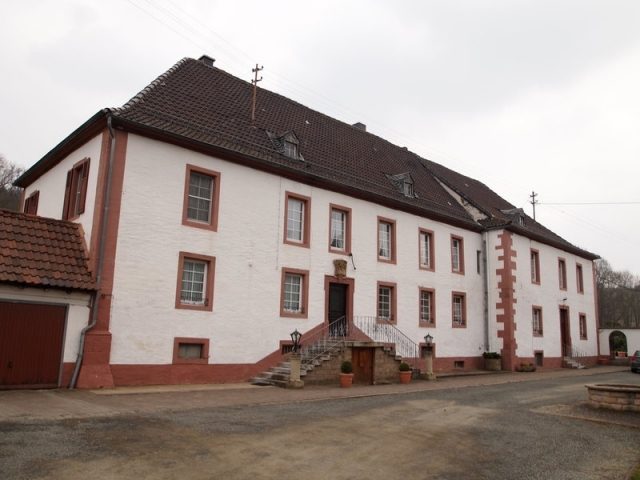
The Ingweilerhof is first mentioned in 1339 as "Ingemuodersweiler". As early as the 13th century, a so-called "Niederburg" (lowland castle) is said to have stood on the Ingweilerhof, which is believed to have been built before 1224. In 1339, a knight Engelbrecht von Reipoltskirchen received the Ingweilerhof from Count Georg von Veldenz zu Lauterecken as a hereditary fief for son and daughter, and it has belonged to the dominion of Reipoltskirchen ever since.
On December 31, 1580, descendants sold the fief of Ingweiler Castle, together with the associated farm, mill, sheep farms, and the western farm Ausbach, including all fields, meadows, estates, vineyards, forests, ponds, fisheries, game, tithes, guilders, interest, and all other authorities that the houses Ingweiler and Ausbach possessed, to Count Johann von Zweibrücken for 1600 guilders.
Thus, the Ingweilerhof and the Ausbacherhof came into the Duchy of Zweibrücken. In 1730, the Imperial Count of Hillesheim, - Lord of Reipoltskirchen -, acquired the Ingweilerhof and Ausbacherhof through a pledge. However, this pledge was redeemed in 1760 by Duke Christian of Zweibrücken. The ownership rights of the Count of Hillesheim to the Ingweilerhof were thereby dissolved.
On August 19, 1760, Baron Hans Assmuss von Esebeck received the Ingweilerhof, along with the Ausbacherhof, as a hereditary fief from Duke Christian IV, in gratitude for his loyal services - he was a minister at the court of Zweibrücken.
Just 10 years later, the Baron died at the Ingweilerhof and is buried there in the courtyard chapel. His family crest can still be seen today above the entrance portal of the former manor house.
His successor was his son Ludwig von Esebeck, Prime Minister at the court of Duke Karl August von Zweibrücken. Around 10 years after the lavish wedding of Baron von Hohenfels in 1782, the French Revolution also spread to our homeland and brought an abrupt end to the over 40 territorial areas in the Palatinate. The farm became French national property and was auctioned off. The auctioneer, having no use for the agricultural operation, sought a buyer and found him in the economist Daniel Schönbeck. His successors still manage - already in the 5th generation - the stately estate today. In 1951, a retirement home was established in the former manor house. Here, elderly people can spend their twilight years in quiet seclusion, beautiful surroundings, and caring support.
The mill, which was certainly once a ban mill for the Zweibrücken possessions in the dominion of the County of Reipoltskirchen, was bought in 1903 by the miller Theodor Graf, a member of the famous Graf milling family from the Alsenztal. The previous owner, a miller named Weyrich, was only in the mill for two years. (Before that, it was owned by a Blockwitz family). Unfortunately, this mill met a sad end. At the end of World War II, it was severely damaged on March 29, 1945, by advancing Americans during the detonation of an abandoned German ammunition truck that stood directly next to the property. It had to be demolished in 1948 and was only rebuilt as a residential house. Since then, the clatter in the quiet valley bottom has fallen silent.
Take Mobile History with you
You are reading this text for free. Premium adds what matters on the road: descriptions read aloud, sites found through your camera, whole regions taken offline.
- Every description, including the ~17,700 Premium sites
- Audio guide: have descriptions read to you on location
- AR finder: see sites through your camera, with distance and bearing
- Unlimited saved sites
14 days free, then from €2.99 a month. Cancel anytime.
Source: Wikipedia · Licence: CC BY-SA 4.0 · Image: http://www.wehrbauten.de/thread.php?threadid=1347
This description draws on the facts documented in the linked Wikipedia article; Wikipedia content is licensed under CC BY-SA 4.0. Wording and editing: Mobile History.
Location: 49.6189, 7.6791