Youth educational center
ManorLabbeck
Hasenacker Manor (Labbeck)
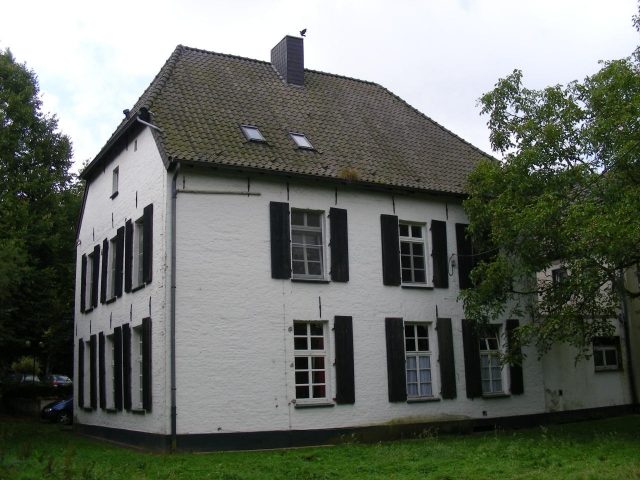
Hasenacker was initially a Cleves and then a Prussian leasehold. It can also be proven that a building stood on Hasenacker even before 1779.
In 1778, Baron Adolf Carl von Palland zu Osterveen became the owner of Hasenacker. In 1779, he replaced the dilapidated Hasenacker refuge with a new building. The costs for purchasing the estate, building the house, and a misjudgment of the income situation led to von Palland having to part with the Hasenacker estate. In a petition to the Cleves government in 1787, he asked for permission to sell the "... noble estate Hasenacker" to the bourgeois mayor Schwartz. Years ago, he had been persuaded to buy the small, insignificant estate out of ignorance, although it could barely support a half-farmer, let alone a nobleman. The estate also did not include noble privileges such as hunting rights and manorial lordship. Mayor and Justice Commissioner Friedrich Schwartz bought the estate in 1788. He was a son of the Sonsbeck pastor Johann Heinrich Schwartz, was born in Sonsbeck in 1738, and died on Hasenacker in 1819. After approval by the district administrator of Rheinberg, he was buried on Hasenacker. Previously, he had bequeathed 25 Thaler to the church in Sonsbeck for a new cemetery with the request to allow him a resting place under the trees of Hasenacker. This is located on the path towards the forest on the right side. The old grave site is covered with a large stone slab, but the grave is empty. The tombstone of Hegemeister Randebroek on the grave slab comes from the Labbeck cemetery.
After the death of Mayor Friedrich Schwartz, the Hasenacker estate got a new owner. This owner died in 1844 at the age of 39, and the property was sold to the farmer and mayor Bernhard Jordans in Marienbaum. In 1876, Hasenacker, with part of the surrounding lands, was purchased by the Prussian state as a forester's house and official residence. Hegemeister Max Randebroeck became the first forester on Hasenacker. He created the fish ponds at the forester's house, which received their water supply from the forest springs. The last forester on Hasenacker was Bernhard Artmann, who transformed the Tüschenwald into a model forestry district from 1955 to 1981 and had his official residence in the Hasenacker forester's house until 1966. The popular forestry official died suddenly at the age of 65 shortly after retirement.
After the last forester moved out, mine clearers moved into the forester's house for about 2 years, before the youth organization "Die Falken" from Gelsenkirchen took over the house in 1968 and passed it on to the Herne Falken two years later. From this organization, the Bildungs- und Freizeitwerk Herne e.V. emerged, which has been the sponsor of "Forsthaus Hasenacker" since 1974. In 1974, the first extension was commissioned, and in 1986, the second extension was completed. In 1990, the old building was placed under monument protection.
Forsthaus Hasenacker was recognized as a youth education center by the state of NRW in 1990.
Take Mobile History with you
You are reading this text for free. Premium adds what matters on the road: descriptions read aloud, sites found through your camera, whole regions taken offline.
- Every description, including the ~17,700 Premium sites
- Audio guide: have descriptions read to you on location
- AR finder: see sites through your camera, with distance and bearing
- Unlimited saved sites
14 days free, then from €2.99 a month. Cancel anytime.
Source: Wikipedia · Licence: CC BY-SA 4.0
This description draws on the facts documented in the linked Wikipedia article; Wikipedia content is licensed under CC BY-SA 4.0. Wording and editing: Mobile History.
Location: 51.6405, 6.3723