To be privately owned
ManorLich
Güll Manor (Lich)
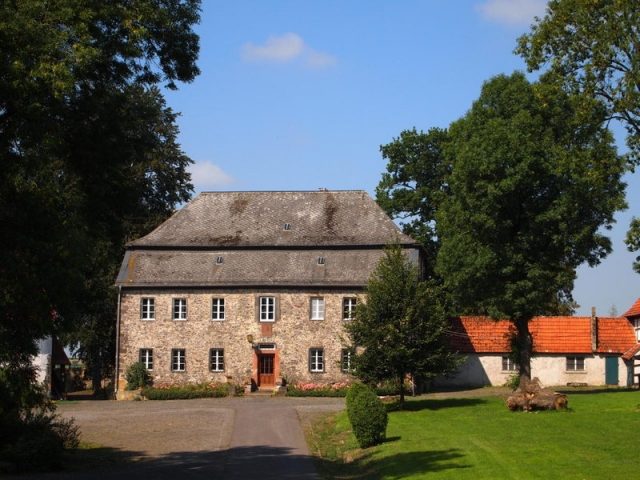
The Historic Hofgut+
History of the Hofgut+
The Hofgut is first mentioned in a document in 1151 during the founding of Altenburg Monastery by Konrad von Hagen.
From Manor to Monastery Property
Initially, the Hofgut served as a manor for local nobility. Over time, it developed into a significant agricultural center. In the 13th century, due to strategic marriages and land purchases, it became part of the extensive possessions of the Altenburg Monastery. This period marked a phase of economic prosperity for the Hofgut, as it benefited from the monastery's administrative and economic structures.
Secularization and New Ownership
With the secularization in the early 19th century, the Hofgut came into state ownership and was subsequently sold to private individuals. This change of ownership led to various structural changes and modernizations. The new owners, often wealthy merchants or industrialists, invested in the expansion of the agricultural facilities and the residential buildings. During this time, the Hofgut also served as a summer residence for some families.
Architectural Features+
The Hofgut consists of several buildings from different eras, reflecting its long history.
The Main House
The main house, originally from the 16th century, was extensively renovated in the Baroque period. It features a stately facade with ornate stucco decorations and large windows. Inside, historical ceiling paintings and a grand staircase have been preserved. The ground floor housed representative rooms, while the upper floors were used for living. A special feature is the small chapel integrated into the main house, which was used for private worship.
Farm Buildings
The surrounding farm buildings, including stables, barns, and a granary, date mainly from the 18th and 19th centuries. They are built of local sandstone and are characterized by their robust and functional design. The large barn, with its impressive wooden roof truss, is particularly noteworthy. These buildings illustrate the agricultural importance of the Hofgut over the centuries.
The Garden
The Hofgut is surrounded by a spacious garden, which was laid out in the English landscape style in the 19th century. It features old trees, winding paths, and a small pond. A historic orangery, which was used to cultivate exotic plants, is also part of the garden complex. The garden served not only for recreation but also for the cultivation of fruits and vegetables for the Hofgut's own needs.
Current Use+
Today, the Hofgut is privately owned and is used for various purposes.
Cultural Events
Parts of the Hofgut are regularly used for cultural events such as concerts, exhibitions, and readings. The historic ambience provides a unique setting for these events, attracting numerous visitors. The large courtyard is particularly suitable for open-air events in summer.
Agricultural Operations
Despite its cultural use, the Hofgut still maintains a small agricultural operation, focusing on organic farming. Regional products are cultivated and sold directly on site. This preserves the traditional character of the Hofgut and contributes to sustainable land use.
Future Prospects
The owners plan further renovations and expansions to make the Hofgut accessible to an even wider public. The focus is on preserving the historical substance while integrating modern uses. The goal is to establish the Hofgut as a regional center for culture, education, and sustainable agriculture.
Take Mobile History with you
You are reading this text for free. Premium adds what matters on the road: descriptions read aloud, sites found through your camera, whole regions taken offline.
- Every description, including the ~17,700 Premium sites
- Audio guide: have descriptions read to you on location
- AR finder: see sites through your camera, with distance and bearing
- Unlimited saved sites
14 days free, then from €2.99 a month. Cancel anytime.
Source: Wikipedia · Licence: CC BY-SA 4.0
This description draws on the facts documented in the linked Wikipedia article; Wikipedia content is licensed under CC BY-SA 4.0. Wording and editing: Mobile History.
Location: 50.4894, 8.7755