To be privately owned
ManorGelting
Gelting Manor
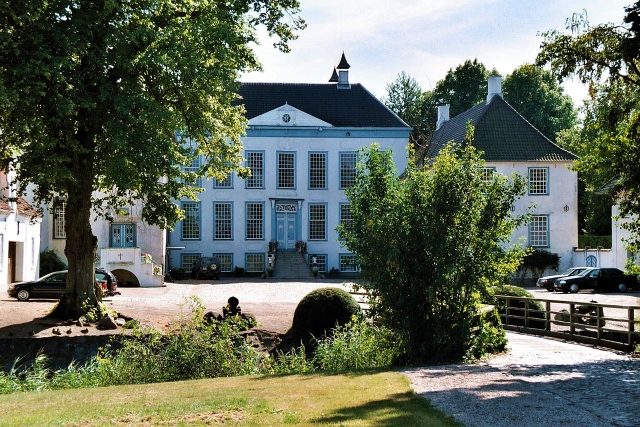
Gelting Estate, often referred to as Gelting Castle, is an old estate in Angeln. The three-winged complex with a courtyard of honor is surrounded by a medieval moat and rampart system and four bastions. It is privately owned by the von Hobe-Gelting family and cannot be visited. Since 1925, Gelting Estate also has a chapel; the altar is located in the historic tower, and the actual chapel rooms are in the east wing of the complex.
Until 1758
The estate was in the possession of the Danish king at least since 1231; in the Liber census Daniae, a tax assessment document listing the possessions and income of King Valdemar II Sejr, it is mentioned as "Gyæltling".
The estate later came into the possession of various noble families: in 1494, the knight Hans von Ahlefeldt received the Haseldorf Marsh, Haseldorf Castle, the five associated parishes, and Gelting, including the associated villages and some scattered possessions, in exchange for other territories. At this time, the current east wing of the complex with the round tower already stood.
Under the rule of the Ahlefeldts, the west wing of the manor house was built in the 17th century. Relatively soon after, the estate went bankrupt; in 1712, it was to be auctioned in Eckernförde. A relative of the previous owners stepped in and saved the property from this fate; however, after inheritance disputes arose, Gelting Estate again came into the possession of the Danish Crown. The royal family's attempt to sell the property in parcels failed.
From 1758
After stables and barns had been renewed or renovated and a new gatehouse had been built in 1754, the estate apparently became easier to sell:
In 1758, the merchant Sönke Ingwersen acquired the property. In the following year, Ingwersen was ennobled by the Danish King Frederick V and was henceforth allowed to call himself "Baron von Geltingen". He changed his first name to "Seneca". In 1777, he was granted the Imperial Nobility in Vienna. This first Baron von Geltingen had acquired his fortune with the East India Company and now used it to expand the estate and redesign the manor house in the Dutch style. Around 1770, the two-story central building of the castle, covered by a hip roof, was erected. Furthermore, the new owner acquired his own theater, where pastoral plays and similar were performed. However, this "comedy house" was not used for long and was eventually demolished.
Ingwersen engaged, among others, Johann Caspar Bechstedt, who worked for him from 1775 to 1780 and transformed the property into a French garden. Bechstedt laid out part of the garden symmetrically around an axis formed by a canal. Another part he equipped with numerous winding paths. "Summer House" and "Cascade" were two ornamental features of the garden; on the other hand, kitchen and utility gardens and a "Melonery" could also be found on the property.
In the manor house, the owner's horticultural interest was reflected, among other things, in the motifs of the stucco decoration created by Francesco Antonio and Michel Angelo Taddei for the ballroom. The theme of utility gardening is illustrated by a watering can, pumpkin, hoe, and spade, while pleasure gardening appears in the form of asparagus, flowers, and pruning shears. The Chinese Cabinet was equipped around 1760 with wallpaper showing plant and animal motifs on a light blue background. This wallpaper - produced in Europe - was restored in 1888 and again in the 1990s; moisture damage and infestation with silverfish had made this necessary.
After his father, the first Baron von Geltingen, died, Christian Friedrich Rudolph von Geltingen took over the complex; under his aegis, the design of the garden was completed. Christian Friedrich Rudolph von Geltingen died in 1820. The property now passed to his nephew Levin Ludwig Christian Leopold von Hobe, a descendant of his sister Adriana Sebranda and the bailiff Andreas August von Hobe. Later, he was given the title of a Danish Baron and now called himself Levin Ludwig Leopold von Hobe Freiherr von Gelting.
This third Baron, as well as the two subsequent generations, gradually transformed the garden into a landscape garden. Among other things, they added a small pond in the eastern part of the garden and had some solitary trees planted. The fourth Baron Siegfried von Hobe-Gelting lived until 1877, his son Bertram until 1911. Under Bertram von Hobe-Gelting, the east wing of the house was rebuilt and the central wing was renovated. Bertram von Hobe-Gelting's successor was again named Siegfried and lived until 1944. He ensured that the house received a chapel; the architect Bachmann from Berlin was commissioned with the construction. His successor was again named Bertram; he died in 1988 and again left the estate to a son named Siegfried. These last two owners ensured several renovations of the house, with the front facade being refreshed in the 1950s and the interiors in 1972. In 1970, the entire complex was entered into the monument register.
Gelting Estate is still owned by the von Hobe-Gelting family. A governess reported about the residents of the manor house in 1901: "Baroness is a charming, kind, finely educated lady and Baron, even in his appearance, a true nobleman. My four pupils, between seven and 14 years old, are good-hearted children. In addition, there are two adult daughters (18 and 20 years old) and the youngest, a five-year-old. The five sons are all away at schools and universities. They are only here during the holidays."
Take Mobile History with you
You are reading this text for free. Premium adds what matters on the road: descriptions read aloud, sites found through your camera, whole regions taken offline.
- Every description, including the ~17,700 Premium sites
- Audio guide: have descriptions read to you on location
- AR finder: see sites through your camera, with distance and bearing
- Unlimited saved sites
14 days free, then from €2.99 a month. Cancel anytime.
Source: Wikipedia · Licence: CC BY-SA 4.0 · Image: http://de.wikipedia.org/wiki/Datei:Schloss_Gelting.jpg
This description draws on the facts documented in the linked Wikipedia article; Wikipedia content is licensed under CC BY-SA 4.0. Wording and editing: Mobile History.
Location: 54.7501, 9.9048