Museum
ManorRatingen
Cromford Manor
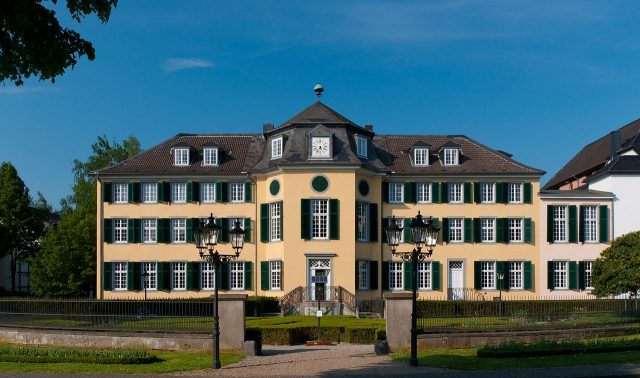
The Cromford textile factory in Ratingen, Rhineland, was founded in 1783 by Johann Gottfried Brügelmann and was the first factory on the European mainland.
Background+
Brügelmann, who came from a wealthy merchant family in Elberfeld, learned – probably in the early 1770s – during a longer stay in Basel about the invention of the water frame by the Englishman Richard Arkwright in the central English village of Cromford. After his return to the Wuppertal, the yarn market was booming, and demand could hardly be met. Brügelmann recognized the potential in the mechanization of the hitherto labor-intensive spinning process – there were about 10 spinners for every weaver.
However, Richard Arkwright intensely protected his invention, patented in England. He tried to keep its functioning a secret. The British government also ensured that the secret could not be taken out of the country: it imposed the death penalty for betraying information about the machine. The value of this invention can be seen alone in the fact that until Samuel Slater's successful reconstruction of the machine in 1793, cotton for spinning was transported from the USA to England and then back again.
Nevertheless, Brügelmann managed to obtain a model of the water frame in 1783. Before that, he had already spent six years researching unsuccessfully with an alleged expert from the Siegerland region; subsequently, he had managed to acquire a Cromford carding machine, which, however, was useless to him without the water frame. It is unclear how he obtained this machine and the model of the water frame. According to the family chronicle, he is said to have smuggled himself into Arkwright's factory as a spinner and worked there, secretly stealing smaller spare parts until he believed he could replicate it at home. In a letter to Elector Karl Theodor, however, he writes that he had a devoted friend in England who procured the items for him. It is conceivable, however, that he did not want to admit to industrial espionage in the letter.
Construction and Operation of the Factory+
Brügelmann had previously searched for a suitable location for his factory. In his Wuppertal homeland, the "Garnnahrung," a cartel-like association of merchant families, and social constraints hindered him. He finally found a disused oil mill, including milling rights, on the Anger river in the then Amt Eckamp, outside the city walls of Ratingen, near the moated castle Haus zum Haus. The Elector granted him a privilege for 12 years to operate mechanical spinning mills (Brügelmann had requested 40 years) as compensation for the investments to be made. In addition, labor was very cheap in the then impoverished Ratingen and less inclined to cause unrest, such as the weavers' uprisings that took place in Elberfeld and Barmen in the early 1780s.
He built two factory halls on the Anger and hired more Englishmen to help him produce functional water frames. Ultimately, he succeeded in putting the factory into operation in 1784. All machines were driven by water wheels. He named the factory after the place where its English model stood: Cromford. Even today, the Ratingen area between Hauser Ring, Mülheimer Straße, and Junkernbusch is called "Cromford."
Business was excellent: an impressive five-story factory building was erected, alongside a luxurious manor house for 20,000 Reichstalers and a partly Baroque, partly English garden designed by Maximilian Friedrich Weyhe. 10 years after its opening, 400 workers were employed in the factory – an unimaginably large number of employees at the time. Shortly after Brügelmann's death in 1802, there were 600 – to this day the peak of the company's history, not least because after the Elector's privilege expired, numerous other spinning mills were soon built in the vicinity, many of them even larger and more modern than the Cromford textile factory.
After the death of the company founder, his two sons continued the business. The company, which had been greatly expanded in the meantime, operated until the 1960s and was then shut down.
The Cromford Textile Factory Today+
The more modern factory halls were built over by a villa district in the 1980s. What remains are the factory owner's manor house and the "Hohe Fabrik" (High Factory), the original core of the company.
In 1983, an industrial site was investigated and documented there for the first time using archaeological methods. Today, the buildings house part of the Rhenish Industrial Museum. In the old five-story building, all machines required for yarn production have been faithfully and fully functionally reconstructed. The factory can be seen in full operation, driven by the central drive wheel. An exhibition and optional guided tours explain the history of the factory, the process of yarn production, and the working conditions (e.g., child labor common at the time) and social circumstances.
Furthermore, the garden hall of Villa Cromford today serves as a venue for civil weddings of the city of Ratingen from spring to early autumn each year.
Take Mobile History with you
You are reading this text for free. Premium adds what matters on the road: descriptions read aloud, sites found through your camera, whole regions taken offline.
- Every description, including the ~17,700 Premium sites
- Audio guide: have descriptions read to you on location
- AR finder: see sites through your camera, with distance and bearing
- Unlimited saved sites
14 days free, then from €2.99 a month. Cancel anytime.
Source: Wikipedia · Licence: CC BY-SA 4.0 · Image: http://de.wikipedia.org/wiki/Datei:Herrenhaus_Cromford_Br%C3%BCgelmann.jpg
This description draws on the facts documented in the linked Wikipedia article; Wikipedia content is licensed under CC BY-SA 4.0. Wording and editing: Mobile History.
Location: 51.3061, 6.8529