To be privately owned
CastleNiederheimbach
Heimburg Castle
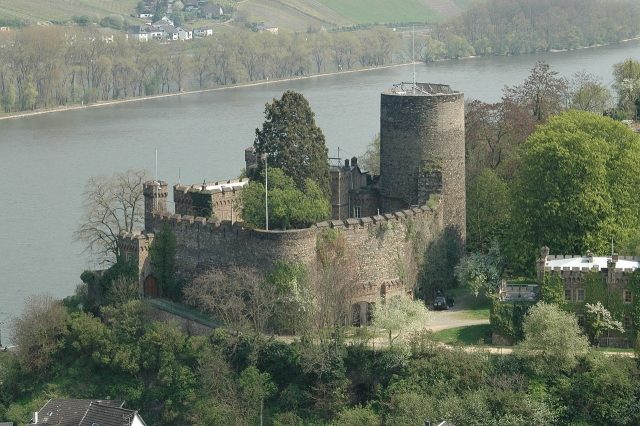
Heimburg Castle (also known as Hohneck Castle, less commonly Hoheneck Castle) is a medieval castle in the UNESCO World Heritage Upper Middle Rhine Valley, Mainz-Bingen district, Rhineland-Palatinate, Germany.
It is not to be confused with the similarly named castles Hohenecken near Kaiserslautern and Hoheneck near Ipsheim. The name Heimburg or Hohneck Castle, derived from the two forms "Hain(bach)eck" and "Hein(bach)burg" or "Hein(bach)berg", has been rendered differently over the centuries: in 1305 first Haineck, then Heyenburg, in 1344 for the first time Heimburg as today. In 1350 it was called Burg Heymberg or Hoh(e)neck.
Location+
The hilltop castle stands on a rocky outcrop on the northeastern steep slope of the Binger Wald directly above Niederheimbach, which is located between Bingen and Bacharach on the Rhine. From Bingen or the Rhine bend there, it is about 10 or 8 km (as the crow flies) away.
At the end of the 13th century, Niederheimbach became an enclave as an Electoral Mainz possession, as the Count Palatine of the Rhine acquired several castles (Fürstenberg Castle, Sooneck Castle, Reichenstein Castle) and possessions both north and south of it. To secure his possessions, the Archbishop of Mainz had Heimburg Castle built as a border castle from about 1294 (other sources refer to 1290) to 1305. It was reinforced in 1315 and from 1326 to '28.
After the Palatine renounced his possessions in favor of Electoral Mainz in 1344, the castle complex quickly became strategically insignificant.
Until 1438, it was the seat of a Mainz lower court. Like most castles in the Middle Rhine Valley, it was destroyed in the Palatinate War of Succession. In the course of Rhine Romanticism, a partial reconstruction took place by the ophthalmologist Theobald von Wackerbarth and then by Eduard Rabeneck.
During the later expansion by the industrialist Hugo Stinnes, the gatehouse and the residential wing were built towards the southeast. Additional window openings and the battlements also date from this period. The foundations of the tower and the curtain wall still date from the Middle Ages.
The castle is now privately owned and cannot be visited.
Take Mobile History with you
You are reading this text for free. Premium adds what matters on the road: descriptions read aloud, sites found through your camera, whole regions taken offline.
- Every description, including the ~17,700 Premium sites
- Audio guide: have descriptions read to you on location
- AR finder: see sites through your camera, with distance and bearing
- Unlimited saved sites
14 days free, then from €2.99 a month. Cancel anytime.
Source: Wikipedia · Licence: CC BY-SA 4.0 · Image: https://commons.wikimedia.org/wiki/File:Heimburg_1.JPG
This description draws on the facts documented in the linked Wikipedia article; Wikipedia content is licensed under CC BY-SA 4.0. Wording and editing: Mobile History.
Location: 50.0339, 7.8066