The Castle can be visited
CastleWetterzeube-Haynsburg
Haynsburg Castle
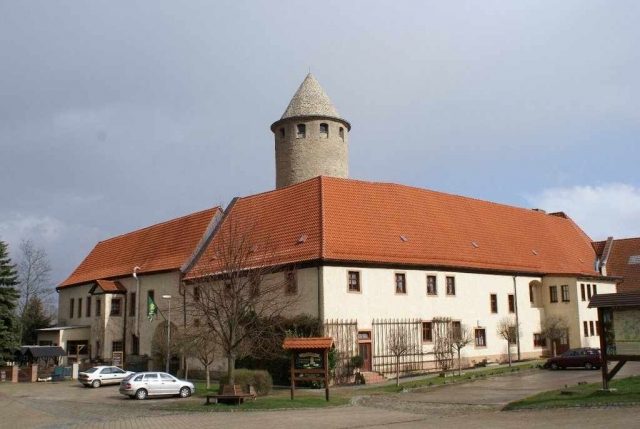
Haynsburg Castle is a castle in the Haynsburg district (Burgstraße 10) of the municipality of Wetterzeube in Saxony-Anhalt.
The castle was first mentioned in a document in 1185 with the nobleman "Conradus de Hagensberg", verifiable until 1223, and was named as a fortified place in a document by Margrave Heinrich in 1238.
After the castle and its associated lands were sold to Friedrich von Meissen in 1295, it came into the possession of the Diocese of Naumburg-Zeitz in 1305 after his renunciation of ownership. It was considered "the strongest bulwark in the Diocese of Zeitz-Naumburg", protected the imperial hunting lodge in Kayna, and secured and controlled the three elevated roads and the Elster fords passing by Haynsburg.
Since the castle could not be stormed in the Saxon Fratricidal War in 1450, it was significantly expanded under Bishop Peter von Schleinitz, restored in 1515 under Bishop Johannes III von Schönburg, further rebuilt, and remained in good condition.
Already used for agriculture in the 15th century, the castle received the title of a "Electoral Saxon Domain" after the dissolution of the Diocese of Naumburg-Zeitz in 1549. In 1815, through the resolutions of the Congress of Vienna, it became a state domain of Prussia until 1945. After the Second World War, the agricultural character of the castle was preserved; it initially became a provincial estate of Saxony-Anhalt and later, until the fall of the Berlin Wall (1990), a People's Own Estate (VEG).
Current Use+
After the fall of the Berlin Wall, the castle, which had already housed a kindergarten with a crèche since 1972, was developed into an important community center for tourism, with exhibitions and a restored, accessible keep from 1990.
Furthermore, the castle offers a castle tavern and accommodation, an equestrian center, and is the starting point for an excellent hiking area.
Description+
The castle complex forms a quadrangle surrounded by moats, with buildings enclosing the castle courtyard and a freestanding round keep, approximately 24.43 meters high (the oldest part of the castle, late 11th century), with a diameter of 12.81 meters and 4.18 meter thick composite sandstone blocks, which leave an interior space with sandstone masonry of only 4.45 meters in diameter. The lower part, beneath which a hollow space indicates a castle dungeon sealed by a beam ceiling, is 12 meters high, and the upper part is 24.43 meters high.
The keep could only be ascended, presumably via rope ladders or an adjacent building, through a high entrance and only received a ground-level entrance around 1880. Today, there is a continuous wooden staircase in the tower.
A defensive tower with a castle chapel on the upper floor, with an oval cross-section, has gone down in history as the Sidonius Tower. The name goes back to Magister Johann Sidonius, custos and canon at the collegiate church in Zeitz, who was imprisoned in this tower from 1685 to 1692 and died on March 3, 1692, at the age of 64.
Take Mobile History with you
You are reading this text for free. Premium adds what matters on the road: descriptions read aloud, sites found through your camera, whole regions taken offline.
- Every description, including the ~17,700 Premium sites
- Audio guide: have descriptions read to you on location
- AR finder: see sites through your camera, with distance and bearing
- Unlimited saved sites
14 days free, then from €2.99 a month. Cancel anytime.
Source: Wikipedia · Licence: CC BY-SA 4.0 · Image: Roland Neubert, Halle (Saale)
This description draws on the facts documented in the linked Wikipedia article; Wikipedia content is licensed under CC BY-SA 4.0. Wording and editing: Mobile History.
Location: 51.0187, 12.0689