The church can be visited
CathedralHavelberg
Havelberger Cathedral
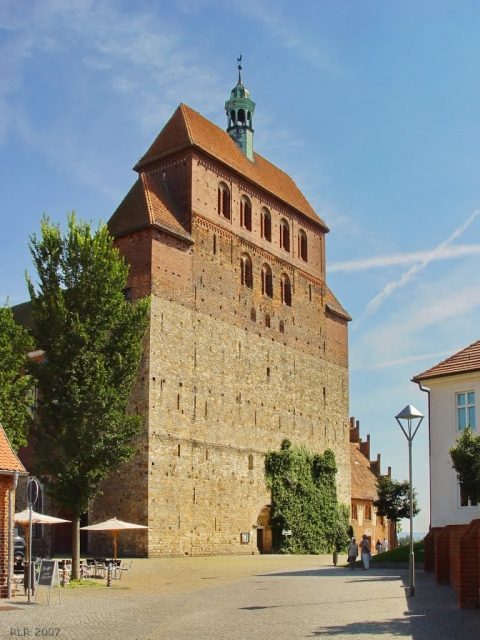
Havelberg Cathedral "St. Marien" is an Evangelical church in the Hanseatic city of Havelberg in Saxony-Anhalt. It was the main church of the Diocese of Havelberg. The Diocese of Havelberg itself was founded by King Otto I in 948. It was established as part of the German Ostsiedlung to missionize the local West Slavs. Havelberg, along with Brandenburg, was the earliest diocese east of the Elbe.
The consecration of the cathedral in Havelberg took place on August 16, 1170. Between 1279 and 1330, after a fire, the main choir of the building was rebuilt in Gothic style. Since then, the outer walls of the nave have consisted of an undecorated mixture of natural stone and brickwork. In 1907, a five-arched, Neo-Romanesque bell story with a roof turret was added to the westwork of the cathedral.
Evangelical since the Reformation, the cathedral and the city church St. Laurentius have belonged to a common parish since 1996. In 1996, the cathedral became the property of the Cathedral Foundation of the State of Saxony-Anhalt. Today, Havelberg Cathedral is considered one of the most important tourist stops along the Romanesque Road. The adjacent monastery buildings house the Catholic Chapel of St. Norbert, the Paradise Hall of the Evangelical congregation, and the Prignitz Museum with exhibitions on the history of the cathedral, city, and settlement.
Construction and Furnishings
Havelberg Cathedral owes its architectural-historical significance to its westwork, which, with its completely unornamented, massive form as a windowless block, represents the most decisive realization of the Saxon Westriegel in German architecture. The transversely oblong structure measures 30.2 x 6.1 m in floor area and is 31 m high up to the wall crown. The lower area is built from greywacke ashlar.
Inside the church building are grisaille ornament windows, the triumphal cross group, three sandstone candlesticks, and oak choir stalls from around 1300. The 20 reliefs and 14 sandstone sculptures housed in the rood screen and the lateral choir barriers, as well as the stained-glass windows, depict scenes from the life of Jesus and date from the beginning of the 15th century. Two windows with historicizing coat-of-arms representations were created in the early 20th century by Alexander Linnemann and Otto Linnemann from Frankfurt am Main.
Take Mobile History with you
You are reading this text for free. Premium adds what matters on the road: descriptions read aloud, sites found through your camera, whole regions taken offline.
- Every description, including the ~17,700 Premium sites
- Audio guide: have descriptions read to you on location
- AR finder: see sites through your camera, with distance and bearing
- Unlimited saved sites
14 days free, then from €2.99 a month. Cancel anytime.
Source: Wikipedia · Licence: CC BY-SA 4.0 · Image: Rainer Gindele
This description draws on the facts documented in the linked Wikipedia article; Wikipedia content is licensed under CC BY-SA 4.0. Wording and editing: Mobile History.
Location: 52.8268, 12.0787