University
ResidenceHeidelberg
Haus zum Riesen
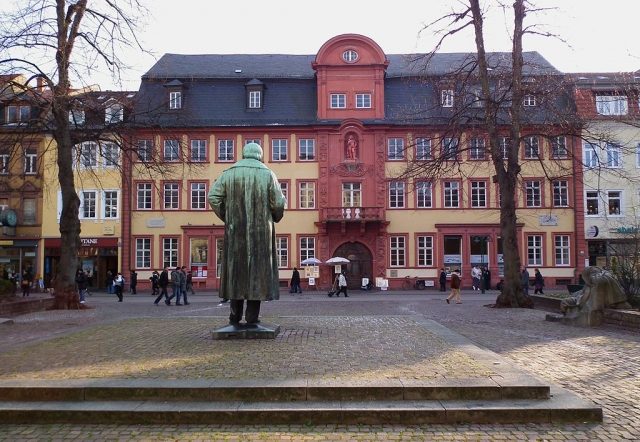
The House of the Giant is a building erected in 1707 in Heidelberg's Old Town. The building is named after a statue adorning the construction. It has been used by the University of Heidelberg since the mid-19th century, and several prominent scientists once worked there.
Before the palace, built in 1707 in Hauptstraße No. 52 in the Baroque style, the inn "Zum Löwen" was located on this property. The builder of the newly erected palace was the Privy Councillor and Lieutenant General Eberhard Friedrich von Venningen. The architect of the palace was Johann Adam Breunig, whose plans also included the Heidelberg Jesuit College and the Old University of Heidelberg.
The building was allowed to be constructed with explicit permission from the Elector using ashlar stones from the blown-up Thick Tower of Heidelberg Castle. The building received its name, House of the Giant, from a larger-than-life statue depicting the builder, created by Heinrich Charrasky. It adorns the central risalit at the height of the second floor. In the early 19th century, an inn with a brewery was operated in the building.
Ruprecht-Karls-University took over the building in the mid-19th century
Since the mid-19th century, various institutes of the University of Heidelberg have been located in the building. The chemist Robert Bunsen and the physicist Gustav Kirchhoff researched spectral analysis here.
Hermann von Helmholtz and Wilhelm Salomon-Calvi
The physiologist Hermann Helmholtz, inventor of the ophthalmoscope, the geologist Wilhelm Salomon-Calvi, and other prominent scientists also worked and researched here. Around 1907, under the direction of Wilhelm Salomon-Calvi, the House of the Giant was the seat of the Geological-Paleontological Institute of the University of Heidelberg.
The scientific documentation of the Mauer mandible
Here, Otto Schoetensack researched recovered fossil finds. In 1907/1908, at his workplace in the House of the Giant, Schoetensack examined and described the oldest hominid find in Central Europe, the Mauer mandible, which he named Homo heidelbergensis.
A type specimen of the Homo heidelbergensis mandible found in the sands of Mauer is located as a cast in the museum of the Institute for Geosciences at the University of Heidelberg.
Take Mobile History with you
You are reading this text for free. Premium adds what matters on the road: descriptions read aloud, sites found through your camera, whole regions taken offline.
- Every description, including the ~17,700 Premium sites
- Audio guide: have descriptions read to you on location
- AR finder: see sites through your camera, with distance and bearing
- Unlimited saved sites
14 days free, then from €2.99 a month. Cancel anytime.
Source: Wikipedia · Licence: CC BY-SA 4.0 · Image: http://commons.wikimedia.org/wiki/File:Haus_zum_Riesen_Anatomiegarten_Heidelberg.JPG?uselang=de
This description draws on the facts documented in the linked Wikipedia article; Wikipedia content is licensed under CC BY-SA 4.0. Wording and editing: Mobile History.
Location: 49.4104, 8.6981