To be privately owned
CastleDuisburg - Rheinhausen
Werthscherhof Manor
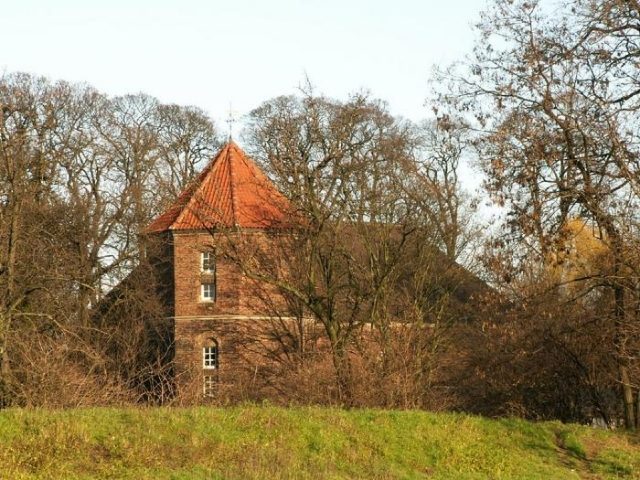
The Werthschenhof is in parts the remains of a hunting lodge built in 1487 by Count Vincenz von Moers in the Rheinhausen district of Duisburg. Of the originally four defensive towers, the octagonal southeast tower is still preserved on the current farm.
The farm cultivates the surrounding lands within the Rheinaue Friemersheim nature reserve, under controlled organic farming since 2002.
The name of the farm derives from "Werder", which refers to a river island or a strip of land between a river and standing water.
The origins of the farm are presumed to be in early medieval times. It is assumed that a defensive structure of the royal court of Friemersheim was already located on the Werth at that time.
Originally built around 1200 by the Lords of Friemersheim as a castle, the property was first pledged by Knight Bovo von Friemersheim to Johann von Moers in 1366 and finally passed into the definitive possession of the Lords of Moers in 1392.
Count Vinzenz von Moers had a hunting lodge for small game hunting established in place of the castle in 1487, which was destroyed by fire in 1584, except for the preserved 8-sided brick tower. This probably happened deliberately during the Truchsessian War by Count Adolf von Moers, to prevent it from falling into the hands of his opponent Archbishop Ernst von Bayern.
In 1812, Scheidtmann bought the farm at auction for 83,100 Francs.
The farm was frequently mortgaged, came into the possession of the Counts von Spee in 1828, the Krupp family in 1927, and has been owned by the city of Duisburg since 1991.
In 1910, a hoard of silver coins was found in a pot, including a Spanish coin dated to 1568. The pot was probably buried during the Dutch War of Independence against Spain in 1598. During the excavations that led to the find, several foundations were found one above the other, and a Roman coin was also discovered.
1.5 km north of Werthschenhof lies the Borgsche Hof, another castle complex. This is already mentioned in 1050 as the main seat of Werden Abbey and the seat of the court. In 1961, archaeological excavations by the Rheinisches Landesmuseum took place here, which only found evidence for the "Borch" of the Knights of Friemersheim from the 11th/12th century onwards.
However, Roman (from the 1st century) and Frankish (from the 7th/8th century) graves are known from the vicinity of the Wertschen Hof, at Saar- and Rheingoldstraße, which indicate important settlements near the Wertschenhof during these periods.
Since 2002, the farm has been cultivating the surrounding land under controlled organic farming. This also includes orchards with old varieties such as "Rheinischer Krummstiel" or "Bohnapfel". In addition, Limousin, a cattle breed with thick winter coats, and Haflingers are bred as horses in suckler cow husbandry.
Take Mobile History with you
You are reading this text for free. Premium adds what matters on the road: descriptions read aloud, sites found through your camera, whole regions taken offline.
- Every description, including the ~17,700 Premium sites
- Audio guide: have descriptions read to you on location
- AR finder: see sites through your camera, with distance and bearing
- Unlimited saved sites
14 days free, then from €2.99 a month. Cancel anytime.
Location: 51.3800, 6.7046