Cultural Events
To be privately owned
CastleHavixbeck
Stapel Castle
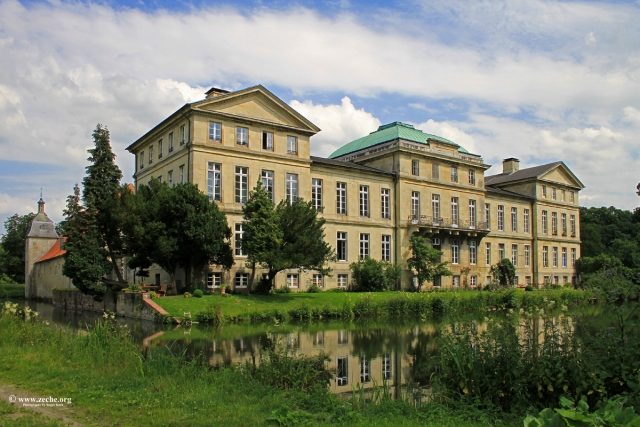
Haus Stapel near Havixbeck, North Rhine-Westphalia, is a Neoclassical moated castle.
Since the early Middle Ages, extensive dam systems existed where the water of the Poppenbecker Aa, a headstream of the Münstersche Aa, was dammed. These dams were then used to operate an extensive fishery. In the Middle Ages and early modern period, the numerous abstinence days (days on which, according to church decree, no meat could be consumed) were strictly observed, so much fish from pond farms was consumed as an alternative to meat. A dam on the Poppenbecker Aa also served to operate the ancient Stapler Mühle, which – only a few hundred meters from the castle – today houses a part-time agricultural business. The deep and wide moats in the castle park are remnants of the former fishery.
As a noble residence, Haus Stapel was probably only built in the 16th century on the site of a previous farm.
The current buildings of the castle complex of Haus Stapel were built in 1607 and 1608 (the flanking towers of the outer bailey and all other outbuildings except the gate tower, which, however, were converted over time to meet the requirements of agriculture). The gate tower was built in 1719 according to the plans of Maximilian von Welsch. He was a teacher of the famous Münster architect Johann Conrad Schlaun. The current castle was built according to the plans of the architect August Reinking from Rheine, who died shortly after the laying of the foundation stone in 1819. The castle was completed in 1828.
The Haus Stapel estate always belonged to noble families. It was never sold throughout its history, but only passed to other families through female inheritance, such as to the widely spread family von Kerckerinck in Münsterland at the beginning of the 16th century. This branch of the family then called themselves von Kerckerinck zu Stapel and was elevated to the hereditary Imperial Baron status in the first half of the 18th century.
About 100 years later, this family died out in the male line. The heiress Maria Theresia Freiin von Kerckerinck zu Stapel (1786–1870) married Ernst Konstantin Freiherr von Droste zu Hülshoff, an uncle of the poet Annette von Droste-Hülshoff, in 1801 at the age of 15. This marriage produced 22 children, but only about half of them reached adulthood. The current castle was built for this huge family. The poet is said to have called the Droste-Stapels "Kalksteins" (limestones) because of the construction of the house from the not very durable sandstone of the nearby Baumberge mountains. She also expressed herself not very kindly about this part of the family. To her chagrin, Droste had to give private lessons to her allegedly only moderately talented cousins out of family helpfulness. None of the original 22 children had legitimate offspring. When the last of these children of the castle builder died without a will in 1880, the family von Droste zu Hülshoff chose the great-grandfather of the current owner, Klemens Friedrich Freiherr Droste zu Hülshoff, formerly district administrator of Büren, again a younger son of Haus Hülshoff, nephew of the aforementioned poet, as heir.
He designated his son Fritz as heir, but he was severely wounded at the beginning of the First World War, did not marry, and in the early thirties adopted Ermengard – the daughter of his brother Clemens von Droste zu Hülshoff, district administrator in the district of Höxter – who succeeded him as heiress after his death in 1936 and is married to Hermann Josef Freiherr Raitz von Frentz. The couple Raitz von Frentz has five daughters and one son.
The Raitz von Frentz family moved out at the end of the 1960s and moved into a new building in the neighborhood. The castle complex was successively re-rented, including to various artists. A visit to the complex is only possible from the outside. Exception: On the two weekends a year (May and September) when concerts take place at Haus Stapel, the inner courtyard, garden, park, staircase, and ballroom can be visited before the concert begins.
Haus Stapel and the Erbmännerstreit+
Baron Johann Ludwig von Kerckerinck zu Stapel (1671–1750) was one of the most ardent advocates of the "Münster Erbmännerstreit," which became famous for its long duration of more than two centuries. After the legal victory of the Erbmänner over the Münster cathedral chapter, the Baron had the magnificent gate tower mentioned above built. The court records and diaries from that time are still partly preserved in the archive of Haus Stapel today.
Haus Stapel in Film+
- Bauer Seesing und Herr Baron. A portrait of two neighbors, LWL-Medienzentrum für Westfalen 2008, ISBN 978-3-939974-00-0
The film by Angelika Schlüter and Julian Isfort tells the story of neighbors Heinz Seesing and Hermann-Josef Freiherr Raitz von Frentz. The two live a few hundred meters apart near Haus Stapel. Against the backdrop of the moated castle, they talk about their lives, but also about the history of the castle and its inhabitants.
Concerts at Haus Stapel+
Since spring 2011, concerts from the Classical and Romantic periods have been held twice a year (May and September). The focus of the repertoire is on lied singing. The grand piano by the Münster company Knake, which has been in the hall for about 140 years and was restored in spring 2012, serves as an accompanying and solo instrument.
Take Mobile History with you
You are reading this text for free. Premium adds what matters on the road: descriptions read aloud, sites found through your camera, whole regions taken offline.
- Every description, including the ~17,700 Premium sites
- Audio guide: have descriptions read to you on location
- AR finder: see sites through your camera, with distance and bearing
- Unlimited saved sites
14 days free, then from €2.99 a month. Cancel anytime.
Source: Wikipedia · Licence: CC BY-SA 4.0 · Image: http://www.zeche.org/
This description draws on the facts documented in the linked Wikipedia article; Wikipedia content is licensed under CC BY-SA 4.0. Wording and editing: Mobile History.
Location: 51.9927, 7.4041