To be privately owned
ManorDortmund - Sölde
Sölde Manor
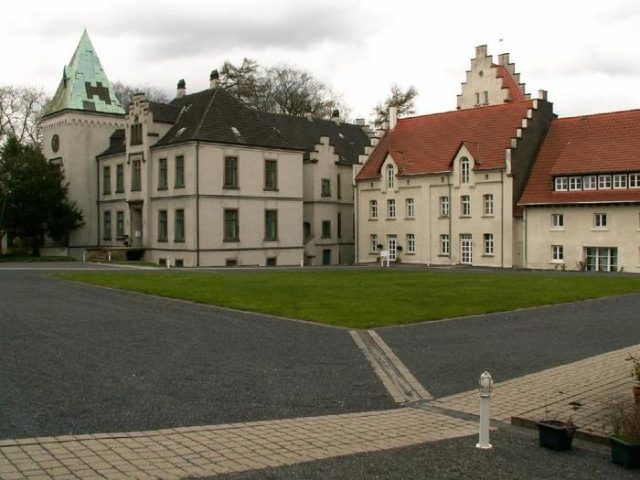
Haus Sölde is a former knight's estate in the eastern Dortmund district of Sölde.
The estate was built in the 13th century and was subsequently under the feudal suzerainty of the Lords of Volmarstein. In 1402, it passed into the possession of the Lords of Hövel zu Sölde.
Haus Sölde included eleven farms and cottages in Sölde. In 1839, Baron von Hövel sold his possessions, including Haus Sölde, to Carl Overweg zu Iserlohn, who in turn resold it in 1841 to Caspar H. Neuhoff, also known as Schulze-Dellwig (1815–1894).
His descendants, son Theodor (1845–1919), grandson Walther (* 1887), and great-grandson Theodor managed Haus Sölde as a large agricultural enterprise until the 1980s.
Today, the buildings are used as residential units. They are listed as a monument in the monument list of the city of Dortmund.
The large agricultural enterprise comprised lands not only in Sölde, but also in Holzwickede and Fröndenberg-Altendorf. The balance sheet totals at the beginning of the century give an idea of the size of the operation. They amounted to around one million Marks. The Schulze-Dellwig family owned extensive coal mine properties; due to their wealth, they must be counted among the most important economic citizens of the Dortmund area.
With the exception of three cadastral maps and two files, the collection consists exclusively of ledgers. It therefore primarily provides an overview of the management of a large agricultural enterprise in the immediate vicinity of the industrial area. Cross-connections to the Sölde mines Margarethe and Freiberg are repeatedly noticeable. In particular, however, the production of agricultural products and their trade on the outskirts of the industrial city of Dortmund are documented.
This is reflected in an accounting system that was in no way inferior to that of merchants and was based on a system of preliminary, main, and subsidiary ledgers. As far as can be seen, the enterprise used the most modern agricultural accounting methods. The basis of all records was the operational daybook or work book, which, due to its extensive scope and external appearance (grey linen cover), was called "Graues Elend" (Grey Misery) by the administrator (F 126 No. 33).
Take Mobile History with you
You are reading this text for free. Premium adds what matters on the road: descriptions read aloud, sites found through your camera, whole regions taken offline.
- Every description, including the ~17,700 Premium sites
- Audio guide: have descriptions read to you on location
- AR finder: see sites through your camera, with distance and bearing
- Unlimited saved sites
14 days free, then from €2.99 a month. Cancel anytime.
Source: Wikipedia · Licence: CC BY-SA 4.0 · Image: http://www.wehrbauten.de/thread.php?threadid=553
This description draws on the facts documented in the linked Wikipedia article; Wikipedia content is licensed under CC BY-SA 4.0. Wording and editing: Mobile History.
Location: 51.5027, 7.5901