Museum
ManorMünster-Gievenbeck
Rüschhaus Manor
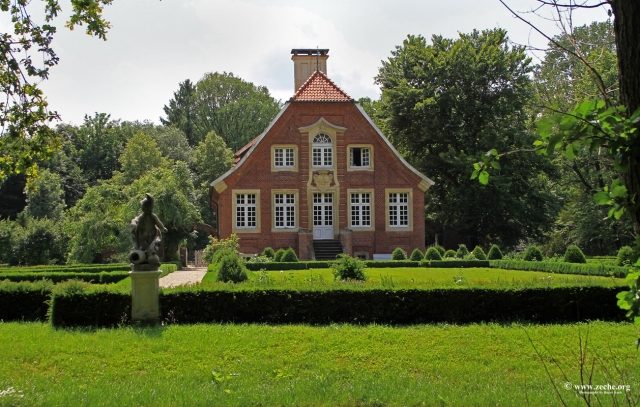
Rüschhaus House is a country estate in the Gievenbeck district of Münster, Westphalia. It was built between 1745 and 1748 according to designs by Johann Conrad Schlaun and was initially inhabited by him as a summer residence.
The estate, surrounded by a moat, whose architecture meets the demands of a feudal noble seat, is designed like a rural moated farm. Schlaun succeeded in a synthesis of a Westphalian farmhouse and a sophisticated country estate in the French style. The sculptor Johann Christoph Manskirch was also involved in the design.
In 1825, the lord of Hülshoff Castle, Baron Clemens-August II von Droste zu Hülshoff, father of the poet Annette von Droste-Hülshoff, acquired the elegant country house. After her father's death in 1826, the poet moved here with her mother and sister Jenny and lived here - from 1838 interrupted by her stays at Eppishausen Castle and Meersburg Castle - until 1846.
The ballads and verse epics, Die Judenbuche, and parts of the poetry cycle Das geistliche Jahr were created in Rüschhaus House.
Until 1853, the house was inhabited by the poet's mother, Therese Louise, née Baroness von Haxthausen, and thereafter by two of the poet's unmarried nephews, initially the officer Moritz von Droste zu Hülshoff, who in 1883 erected a neo-Gothic wayside shrine with a Madonna figure, which is still preserved today. His brother, the Royal Prussian Government Councillor Friedrich von Droste zu Hülshoff (1833–1905), also lived in the house from 1890; he published - like his brother Ferdinand von Droste zu Hülshoff - as a zoologist, renovated the house and brought back the memorabilia that were still available, as he expected visitors. Thereafter, the house was inhabited for two generations by the tenant family Pöppelmann, but could be visited by admirers of the poet. During the Second World War, particularly valuable items were evacuated. After the war damage was repaired, the house was opened as a museum by the family in 1949 and leased to the Droste Society. Jutta Baroness von Droste zu Hülshoff sold the house to the city of Münster in 1979; it can be visited via the Münster City Museum. Most recently, the estate was made available for use by the Annette von Droste zu Hülshoff Foundation, established in 2012.
Behind the main building is the park of Rüschhaus House with strict geometric forms. Typical are the beds and lawns bordered with boxwood.
Take Mobile History with you
You are reading this text for free. Premium adds what matters on the road: descriptions read aloud, sites found through your camera, whole regions taken offline.
- Every description, including the ~17,700 Premium sites
- Audio guide: have descriptions read to you on location
- AR finder: see sites through your camera, with distance and bearing
- Unlimited saved sites
14 days free, then from €2.99 a month. Cancel anytime.
Source: Wikipedia · Licence: CC BY-SA 4.0 · Image: http://www.zeche.org/
This description draws on the facts documented in the linked Wikipedia article; Wikipedia content is licensed under CC BY-SA 4.0. Wording and editing: Mobile History.
Location: 51.9855, 7.5512