To be privately owned
CastleEschweiler - Weisweiler
Palant Castle
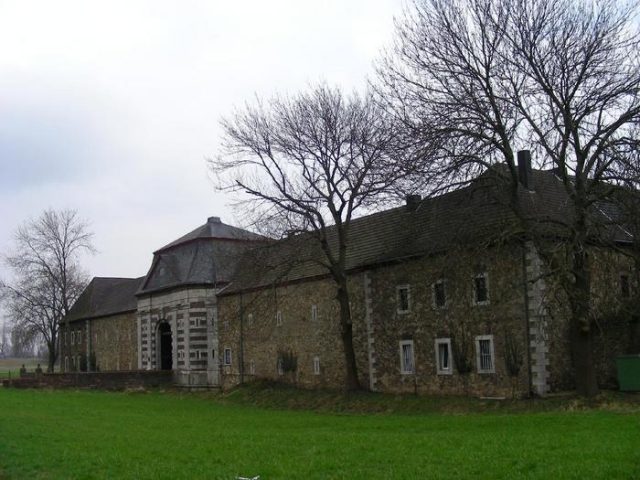
Haus Palant, also known as Palant Castle, was the ancestral seat of the influential noble family of Palant in the Weisweiler district of Eschweiler. It is located on its northeastern edge, directly on the A4 motorway, which connects Aachen and Cologne.
Of the magnificent complex, which contemporaries described as "one of the most beautiful castles in the Jülich region," only the outer bailey remains today. This presents itself as a two-story, three-winged building made of quarry stone with hip roofs, its open side facing southeast – the location of the former manor house.
The facade is very simple, with the exception of slightly emphasized side risalits and corner quoins made of bluestone. For this reason, the richly detailed gatehouse with a mansard roof, projecting from the wall line in the middle of the north front, is particularly striking. In earlier times, it was accessible via a drawbridge, which has now been replaced by a brick arch bridge. Wide pilasters of hewn bluestone and alternating, vertical layers of brick and ashlar adorn its north side.
Although Palant Castle was first mentioned in a document in 1456, historians see the estate as the starting point for the emergence of Weisweiler, as the complex probably dates back to an old Frankish royal estate.
In 1323, a Reinhard von Palant is first mentioned in a document as a vassal of the Lords of Cuyck. However, it is still unclear what kinship he had with the later family of Palant, as this family demonstrably goes back to Karsilius, a son of the Aachen mayor Arnoldus Parvus. From 1342/44, Karsilius called himself "von Palant" after his castle at the time.
Emperor Charles V elevated the family to the status of Imperial Barons and transferred the County of Culemborg in the Duchy of Guelders to Floris I von Palant (Dutch Floris I van Pallandt) in 1555. His son Floris II (1577–1639) had Haus Palant renovated around 1600 in the style of the Dutch Renaissance. A view in the Codex Welser from 1723 shows the manor house as a square complex with four corner towers and a bridge to the north and south.
During the Third Guelders War of Succession, the von Palants had been temporarily expelled from Haus Palant by William the Rich, Duke of Jülich, but had regained their property in 1543 through the Peace of Venlo.
After Floris II died in 1639 without male descendants, his daughter inherited the barony and castle and brought them through marriage to her husband Wolrad IV von Waldeck-Eisenberg. His descendants sold the castle in 1682 to Count Adolf Alexander von Hatzfeld, whose family already owned the nearby Weisweiler Castle.
After the complex had been largely destroyed by a severe earthquake in 1755 and by the earthquake near Düren in 1756, the Hatzfeld counts had the main house restored and a new outer bailey built. In 1769, the von Hatzfeld family left Weisweiler and sold Haus Palant together with Weisweiler Castle and the Breitenbend estate to the Jülich Duke and Elector Karl Theodor von der Pfalz, who acquired the properties for his illegitimate son Karl August, Prince of Heideck and Bretzenheim.
Haus Palant was again severely damaged by French revolutionary troops in 1794. Karl August's heirs then sold the complex at the beginning of the 19th century to the Counts of Hompesch-Bollheim. They had the dilapidated main house demolished down to the ring walls in 1828.
In 1840, it was sold to the Aachen industrialist Charles James Cockerill (* 1817), a son of James Cockerill, whose descendants sold it in 1917 to the Leyers-Brück family. They still own the complex today and use it for agricultural purposes, which is why Haus Palant cannot be visited.
In 1945, the then vacant property was plundered and set on fire by Polish prisoners of war. However, most of the damage was repaired by 1957.
The Legend of the Hard-Hearted Administrator+
When the French invaded the Rhineland at the end of the 18th century and established the Département de la Roer, they appointed the Frenchman Rapolt as administrator in the ownerless Haus Palant. Rapolt quickly became hated by the population because he ruthlessly collected taxes and had an imperious nature. Their resentment erupted when Rapolt, due to the announced arrival of the Allies in Eschweiler, wanted to quickly sell the goods and ride off with the proceeds. The enraged crowd killed him just outside Weisweiler.
Take Mobile History with you
You are reading this text for free. Premium adds what matters on the road: descriptions read aloud, sites found through your camera, whole regions taken offline.
- Every description, including the ~17,700 Premium sites
- Audio guide: have descriptions read to you on location
- AR finder: see sites through your camera, with distance and bearing
- Unlimited saved sites
14 days free, then from €2.99 a month. Cancel anytime.
Source: Wikipedia · Licence: CC BY-SA 4.0 · Image: http://www.wehrbauten.de/thread.php?threadid=845
This description draws on the facts documented in the linked Wikipedia article; Wikipedia content is licensed under CC BY-SA 4.0. Wording and editing: Mobile History.
Location: 50.8314, 6.3266