Museum
Youth hostel
ResidenceKoblenz-Altstadt
Palais Metternich
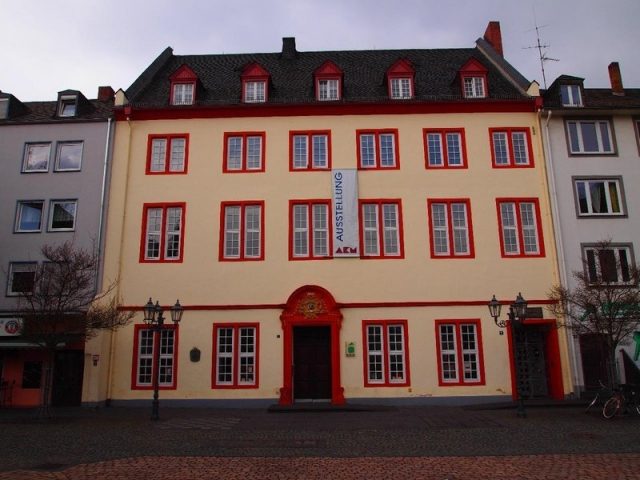
The Metternich House, also known as Metternicher Hof, is a former city estate in the old town of Koblenz. Built in 1674, the building was the birthplace of the Austrian statesman Klemens Wenzel Lothar von Metternich.
The estate, built around 1230, initially belonged to the von Bachem family and developed from a medieval residential tower in the western section of the former late Roman castellum. The area of the estate stretched from the Altenhof to the moat of the Alte Burg along the medieval city wall. Since this wall was located slightly west of the former Roman city wall, the buildings of the estate were erected on the remains of three Roman towers. The city of Koblenz gained full possession of the Bachemer Hof by 1388. In the 15th century, the city of Koblenz transferred the estate as a fief to the Lords of Eltz. In the mid-16th century, the estate was in such poor condition that the owners were asked by the city to repair it. As they failed to do so, they lost the fief.
In 1644, the property came as a fief to the two barons Wilhelm and Lothar von Metternich-Winneburg-Beilstein. As the estate was in poor condition, the new owners were obliged to renovate it for 600 thalers. With the alterations to the estate, the building that still exists today was created in 1674. Subsequently, several well-known personalities inhabited the estate, such as Count Philipp Emmerich Freiherr von Metternich († 1698), the Mainz cathedral canon Franz Ferdinand von Metternich (1623-1719), Johann Hugo von Metternich-Winneburg, and Franz Georg Karl von Metternich (1746-1818), who held the highest offices in the Electorate of Trier and was a diplomat and minister in Austrian service. The latter was the father of the most famous resident, the Austrian State Chancellor Klemens Wenzel Lothar von Metternich, born at Metternicher Hof in 1773, who played a leading role at the Congress of Vienna.
With the conquest of the city of Koblenz by French revolutionary troops in 1794, all property of the Metternich family became state property. The estate initially served to quarter soldiers, and later as a residential building. Around 1800, parts of the estate, especially the outbuildings, were demolished. After France introduced the Code civil in the Département de Rhin-et-Moselle from 1804, a law school (university) was established in Metternicher Hof on November 1, 1806, under Prefect Adrien de Lezay-Marnésia. Franz von Lassaulx, a brother-in-law of Joseph Görres, was one of the most famous professors at the law school. Among other things, he translated the Code civil into German. After the reconquest of the left bank of the Rhine in 1814 and its incorporation into the Prussian Rhine Province, decisive impulses for the retention of the Code civil, instead of the Landrecht valid in the rest of Prussia, came from the jurists who studied at the Koblenz law school. In the Rhineland, the Code civil remained in force until the introduction of the Civil Code in 1900. The end of the law school came on September 24, 1816, in the form of a cabinet order from King Friedrich Wilhelm III. The reason for this was the re-establishment of the University of Bonn.
During the Prussian era, Metternicher Hof initially served as the official residence for General Georg Wilhelm von Hofmann and in 1817 housed the Commercial and Revision Court. In 1818, the Prussian king gifted Prince Metternich his birthplace, but Metternich sold it back to Prussia in 1819 for 38,000 guilders, probably to maintain Schloss Johannisberg. Prince Metternich visited his birthplace and his parents' home until old age.
The citizens of Koblenz at Münzplatz feared that if a Prussian city commandant were to move into Metternicher Hof again, they would have to give up their market on the square. Without further ado, they formed a joint-stock company and bought the estate from Prussia for 18,000 thalers. Afterwards, in 1823, the area was parceled out and sold individually. The city of Koblenz bought the forecourt and was thus able to expand the vegetable market.
In the 19th century, Metternicher Hof underwent significant changes. At the beginning of the 20th century, the "Winninger Weinstube," a popular local establishment among Koblenz residents, moved into the ground floor. During the air raids on Koblenz in World War II, Metternicher Hof was severely damaged and finally burned out completely on February 25, 1945. After the war, it was provisionally rebuilt by its owner Ernst Mölich, and the "Winninger Weinstube" was re-established. The city of Koblenz bought the building in 1969 and subsequently made it available to artists as a gallery. It was not until 1975-1976 that the house could be completely rebuilt and restored. Today, the house houses a museum for art objects and a youth meeting center.
Construction+
Although Metternicher Hof has been frequently altered over time, the building is one of the last remaining examples of the noble estates that were widespread in Koblenz's old town since the Middle Ages. Only the building Münzplatz 7/8 remains, a simple three-story structure with a plastered facade. The current six-axis building was shortened by a third in the 19th century. The side of the building facing Münzplatz is characterized by paired windows with basalt frames on the two upper floors. The artistically designed sandstone portal was subsequently shifted to the left and is adorned with cartouches featuring a five-pointed count's crown, framed by shell work and leaf bands. The gable roof is equipped with dormer windows. The cellar, whose southern section is the oldest, has a groin vault on central pillars, which was extended by a Baroque barrel vault, probably from the construction phase around 1674. The interior of the building is modern and dates back to the general renovation in 1975/1976, after the provisional reconstruction, based on plans by architect Friedhelm Worm.
The neighboring building (Münzplatz 9) of the estate, which was still preserved before World War II, was completely destroyed in 1945 and not rebuilt.
Museum and Youth Meeting Center+
The museum, which is used by the AKM - Arbeitsgemeinschaft bildender Künstler am Mittelrhein e.V. (Working Group of Visual Artists in the Middle Rhine), hosts changing exhibitions on various themes. Particularly outstanding were the following exhibitions:
- Initiative "Peace Needs Experts - Alternatives to Violence"
- Exhibition of the groups MOMENTE and ELEMENTE
The youth meeting center in Metternich House is an institution of the city of Koblenz. It is designed for boys and girls aged 12 and over. Opening hours and current programs can be found on the youth meeting center's website.
Take Mobile History with you
You are reading this text for free. Premium adds what matters on the road: descriptions read aloud, sites found through your camera, whole regions taken offline.
- Every description, including the ~17,700 Premium sites
- Audio guide: have descriptions read to you on location
- AR finder: see sites through your camera, with distance and bearing
- Unlimited saved sites
14 days free, then from €2.99 a month. Cancel anytime.
Source: Wikipedia · Licence: CC BY-SA 4.0 · Image: http://www.wehrbauten.de/thread.php?threadid=614
This description draws on the facts documented in the linked Wikipedia article; Wikipedia content is licensed under CC BY-SA 4.0. Wording and editing: Mobile History.
Location: 50.3615, 7.5936