Museum
Cultural Events
ManorSchwelm
Martfeld Manor
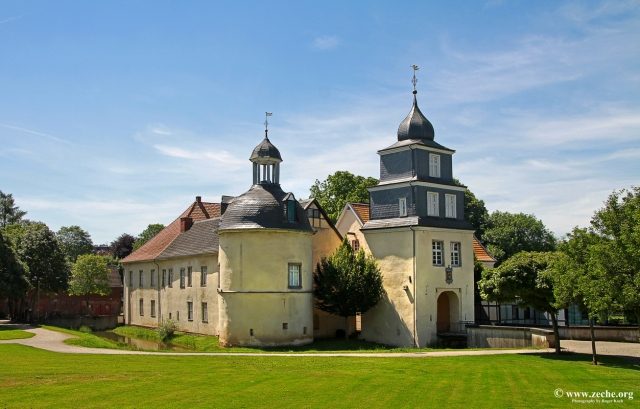
The former manor house Haus Martfeld is located on the eastern edge of the urban area of Schwelm and emerged from a moated castle, whose origins lie in the 14th century.
Haus Martfeld, whose name can be translated as "marshy terrain", was built at the beginning of the 14th century as a burgmann's seat for the Electorate of Cologne. However, even before that, a motte, considered the predecessor of the Martfeld building, was located about 80 m from the current complex. The former moated castle Martfeld belonged to a network of strongholds that was intended to protect the possessions of the Archbishop of Cologne between the Ruhr and Wupper rivers. The Bergisch counterpart to the Martfeld border castle was Beyenburg Castle. The Knights Wandhoff are known as early owners of the building, who also owned an ore mine near Haus Martfeld, among other things.
The main building of the early Martfeld complex was just a simple stone house with two rooms: a heated kitchen-living room and a bedroom. In addition, there were probably a few wooden outbuildings. Later, Haus Martfeld included forests, estate land, a water mill in Rauental, and a fishery on the Wupper.
The core of the round tower of Haus Martfeld dates back to 1450 and is the oldest part of the current building. In the 17th century, the then owner Adolf Wilhelm Raitz von Frentz first had the north wing built in 1618 and then the square gate tower with a drawbridge in 1627. The merchant Johann Peter Hochstein bought Haus Martfeld in 1752 and invested in the dilapidated complex. He had the south wing built and gave the building its current appearance. This also included having the west wing demolished in 1755; since then, the house no longer has a closed courtyard. When the von Elverfeldt family owned Haus Martfeld during the 19th century, Friederike Freifrau von Elverfeldt had a park laid out around the building complex.
In 1954, the city of Schwelm acquired the Haus Martfeld complex from the then owner Freiherr Johannes von Hövel, who is still commemorated by the nearby Freiherr-von-Hövel-Weg. Since 1962, the local history museum has been housed in Haus Martfeld, and since 1966, the city archive as well. The building has since been rebuilt and modernized several times on behalf of the city: in 1978, the renovation of the south wing was completed, and in 1982, that of the central wing. After several years of restoration, the north wing of the house, with a museum café and conference room, was also reopened in the summer of 2002. A restaurant has also been located in Haus Martfeld since then.
The Martfeld Park+
When Friederike Freifrau von Elverfeldt owned Haus Martfeld in the 19th century, she had the park laid out, which received its current form in the 1970s. With an area of 9.4 hectares, the park is the largest in the Schwelm urban area, and a 0.7-hectare part of the park is considered a valuable urban biotope. In the 19th century, Friederike von Elverfeldt also commissioned the construction of a neo-Gothic burial chapel, which was built in 1860 according to the plans of the Cologne master builder Vincenz Statz. Seven years later, the Barmen architect Gerhard August Fischer extended the rear part of the chapel with an annex that served as a burial place for the Elverfeldt family. From 1996 to 1998, the Schwelm Beautification Association had the Martfeld burial chapel restored. Today, the painting "Lot's Flight from Sodom" by the Baroque painter Johann Heinrich Damelet, once discovered under a pile of coal in a Schwelm cellar, hangs in the building. Fossils from the Schwelm mass limestone are permanently exhibited in the chapel's annex, and guided tours of the building take place regularly.
In the immediate vicinity of Haus Martfeld, two monuments commemorate the Schwelm personalities Friedrich Christoph Müller and Johann Heinrich Christian Nonne. Other historical objects in the park of Haus Martfeld include an oat box from the 16th century and a pan mill from the 1930s, which was originally used in the Schwelm paper factory Erfurt & Sohn. The immediate surroundings invite leisure activities with a playground, sports facilities, walking and hiking trails. For example, the circular hiking trail around Schwelm crosses the Martfeld.
South of Martfeld is the deep cut of a railway line, which is still in operation today. The cut was already built in 1849 by the Bergisch-Märkische Eisenbahn-Gesellschaft and is one of the oldest structures of its kind in Germany. Problems during the construction of the cut significantly delayed the commissioning of this early railway line in West Germany.
In the eastern part of Martfeld, there is an allotment garden complex and the Helios Clinic Schwelm.
Current Use+
Haus Martfeld is now the venue for various events: In addition to a Christmas market and a craft market, a two-day wedding fair has been held at Haus Martfeld every year since 1997. The south wing of the building is used for classical and jazz concerts, exhibitions, lectures, readings, and smaller theater performances. Since 1962, the Schwelm Local History Museum has been housed in Haus Martfeld, whose exhibits have been presented on several floors in the central and south wings since 1985. In addition to the museum, the city archive is located in the south wing and complements the cultural-historical offerings with its collections.
Take Mobile History with you
You are reading this text for free. Premium adds what matters on the road: descriptions read aloud, sites found through your camera, whole regions taken offline.
- Every description, including the ~17,700 Premium sites
- Audio guide: have descriptions read to you on location
- AR finder: see sites through your camera, with distance and bearing
- Unlimited saved sites
14 days free, then from €2.99 a month. Cancel anytime.
Source: Wikipedia · Licence: CC BY-SA 4.0 · Image: http://www.zeche.org/
This description draws on the facts documented in the linked Wikipedia article; Wikipedia content is licensed under CC BY-SA 4.0. Wording and editing: Mobile History.
Location: 51.2915, 7.3083