Museum
Local government
CastleIssum
Issum Castle
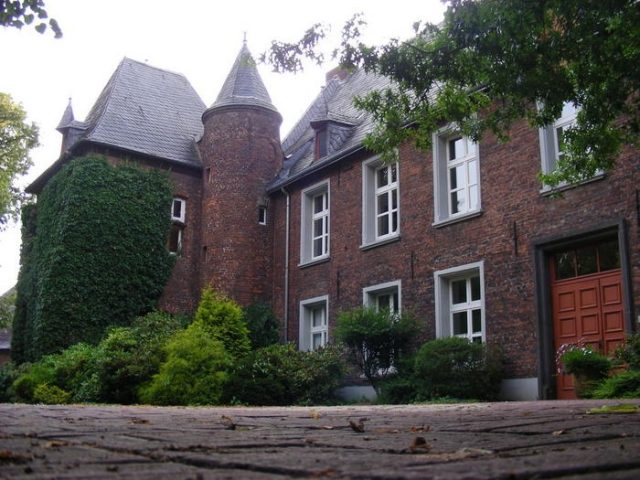
Haus Issum is a moated castle in the middle of the North Rhine-Westphalian village of Issum. The complex is located on the Issumer Fleuth and was built in the second half of the 16th century as a successor to a destroyed castle. Used as a town hall until 1989, it now houses parts of the municipal administration and a local history museum, among other things.
Center of Lordship
Haus Issum, together with the lordship of the same name, is first mentioned in a document in 1338, when the Gelders Count and later Duke Rainald II acquired it from the Vogt Gerardus de Belle. Subsequently, the then castle belonged to the Vogtei Menzelen, a fief of Geldern, and was owned by the noble family von Alpen, before it was sold in 1388 to the Cologne Archbishop Friedrich III von Saarwerden.
At the beginning of the 15th century, the complex came into the possession of the Counts of Moers, who transferred it to Emont von Eyll on October 23, 1403. Later, Friedrich IV von Moers gave Haus Issum for 400 Rhenish gold guilders to the Gelders hereditary marshal Johann von Boedberg, who was followed in the 16th century by the von Pallant family as owners.
In 1551, Otto Schenk von Nideggen besieged the complex, was able to capture it, and subsequently had it burned down. However, Haus Issum was rebuilt as a castle-like complex in the second half of the 16th century. About 100 years later, the town and castle were plundered by French troops in 1673. In the second half of the 19th century, the complex was finally owned by the Beissel von Gymnich family, who resided at Schloss Frens. They sold the property in 1879 to the well-known Düsseldorf ophthalmologist and Privy Medical Councillor Albert Mooren.
In 1912, the municipality of Issum acquired the house including 200 acres of land. At that time, the gatehouse of the complex was used as the residence of the caretaker and park warden. In the 1980s, no tenant could be found for these rooms, so in 1984 the idea was born to set up a local history museum there. Therefore, a redesign and renovation of the building took place until 1990.
Current Use
The local history museum His-Törchen, opened in 1993, houses a collection on the history of the lordship and the town of Issum, which is managed by a local working group of interested citizens. One room of the 145 m² museum area is used for changing exhibitions. In addition, artworks by local artists are displayed, such as ceramics by Agnes Wetzling-Lenders and sculptures and tools by the sculptor and painter Clemens Pasch.
Until 1980, the manor house was the seat of the municipal administration. Today it houses the council chamber of the municipality, the wedding room, and some office spaces.
Description+
Haus Issum is a two-part complex surrounded by moats, consisting of a manor house and an economic courtyard located to its southwest. To the south, a castle park adjoins the brick complex.
Northeast of the buildings lies a part of the former castle grounds, which is now called "Insel" (island) and is surrounded by the Issumer and Nenneper Fleuth. On it stands the Issum town hall, beneath which are the remains of a motte-and-bailey castle.
A stone bridge leads to the two-story gate tower with its round-arched passage, which is spanned by a barrel vault. The hipped tower roof is crowned by a weather vane with the year 1338. Two short, former economic wings adjoin the gatehouse at an obtuse angle. The northern one has two stories, the southern one has one. Northeast of this building complex stands the simple manor house with a tile-covered gable roof. Its two stories rise on a floor plan measuring approximately 30x10 meters. At its southern corner, a rectangular gate tower with two floors adjoins at a right angle, its gate passage is now walled up. In the inner corner of the two buildings stands a slender, round stair tower.
South of the buildings lies an approximately 0.6-hectare park with old trees, which possibly dates back to a late Baroque garden. Its 80-meter-long hornbeam arbor is one of the great rarities in the Lower Rhine region.
Take Mobile History with you
You are reading this text for free. Premium adds what matters on the road: descriptions read aloud, sites found through your camera, whole regions taken offline.
- Every description, including the ~17,700 Premium sites
- Audio guide: have descriptions read to you on location
- AR finder: see sites through your camera, with distance and bearing
- Unlimited saved sites
14 days free, then from €2.99 a month. Cancel anytime.
Source: Wikipedia · Licence: CC BY-SA 4.0 · Image: http://www.wehrbauten.de/thread.php?threadid=566&hilight=Borghees
This description draws on the facts documented in the linked Wikipedia article; Wikipedia content is licensed under CC BY-SA 4.0. Wording and editing: Mobile History.
Location: 51.5349, 6.4268