Nursing home
CastleKalkar
Horst Castle
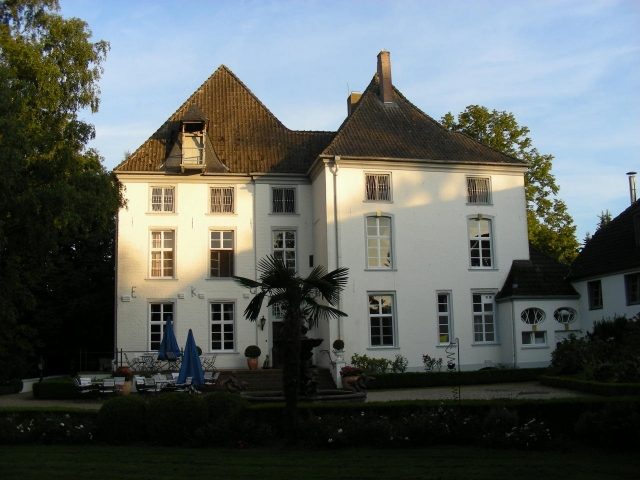
In 1290, the former knight's seat of the Counts of Kleve "Auf der Horst" was rebuilt on old Roman walls. In 1319, Haus Horst "auf der Horst" with all its lands is mentioned for the first time in a document in the Urbar, the income register of Count Dietrich von Kleve. In 1369, Ruitger van Boitzelar (Botzelar) received "auf der Horst" as a fief. Ruitger van Boitzelar was the Droste of the Counts of Kleve. In 1395, "Dat gericht to Aldenkalkar, dat oeverste gericht in den lande Cleve" after a three-day trial found Ruitger van Boitzelar guilty of instigating the murder of Adolf von Suytkamen, the then rent master of the Counts of Kleve. On May 27, 1395, judges and aldermen pronounced the verdict: Ruitger van Boitzelar was declared an outlaw, banished from the country, and all his possessions were transferred to Count of Kleve Duke Adolf II.
In 1505/06, Wilhelm van den Butzeler pays the church bill and the house rent to the city of Kalkar in the amount of 6 sol for "auf der Horst".
In 1609, Duke Johann Wilhelm von Cleve dies. His death marks the end of the country's history. The Duchy of Kleve, along with all its estates, becomes Prussian. At the "Ritter-Zedul" (Diet), which is convened to reorganize the administration, "auf der Horst" is given as a fief to Johann van Ulfft zu Luikhuisen (called Dornick), vassal of the King of Prussia.
In 1648, Haus Horst was severely damaged and partly burned down after its conquest in the Thirty Years' War by Spanish, Dutch, and imperial troops.
In 1678, the house became the property of the Vellbrüggen family, who, however, remained without male heirs.
In 1719, the granddaughter Maria Anna Freiin van Tingnagel zur Horst marries Freiherr Christopher Friderich von Amelunxen.
In 1762, the biological children Carl Henrich von Amelunxen, Maria Adriana von Hockerbach, née Freiin von Amelunxen, Theresia Anna von Heeremann, née Freiin von Amelunxen, sell Haus Horst to Arnoldus von Knipscheer with a "Koopkontrakt" dated March 15, 1762, in Münster. Arnoldus von Knipscheer had already been born in this house. His parents, Adrianus von Knipscheer and Weyrina Knipscheer, had rented Haus Horst for many years.
In 1795, the severe damages from the Thirty Years' War are repaired, and all alterations and new constructions are completed. Since this time, Haus Horst has remained unchanged.
In 1831, a part of the old moat in the area of the drawbridge is filled in, and a "Lower Rhenish Hall House" is erected at this spot.
In 1869, after the death of the last Knipscheer, the heirs sell Haus Horst to Nikolaus von Steengracht, the owner of Moyland Castle. This family uses Haus Horst as a hunting lodge.
In 1948, Baron Adolf von Steengracht sells Haus Horst to the merchant Walter Eikhoff.
In 1983, Consul Theodor Decker, Knight of the Order of Malta, and his wife Isolde buy Haus Horst. After being renovated and restored for two years, as it is a listed building, it is intended to remain in family ownership.
In 1985, the "Lower Rhenish Hall House", built in 1831 and listed as a historical monument, is converted into today's Haus Horst health clinic as part of the renovation.
In 1987, the Haus Horst health clinic is opened. Since May 1992, Haus Horst has been owned by the Heinz-Josef Keller family.
Take Mobile History with you
You are reading this text for free. Premium adds what matters on the road: descriptions read aloud, sites found through your camera, whole regions taken offline.
- Every description, including the ~17,700 Premium sites
- Audio guide: have descriptions read to you on location
- AR finder: see sites through your camera, with distance and bearing
- Unlimited saved sites
14 days free, then from €2.99 a month. Cancel anytime.
Source: Wikipedia · Licence: CC BY-SA 4.0 · Image: http://www.wehrbauten.de/thread.php?threadid=566&hilight=Borghees
This description draws on the facts documented in the linked Wikipedia article; Wikipedia content is licensed under CC BY-SA 4.0. Wording and editing: Mobile History.
Location: 51.7403, 6.2712