To be privately owned
CastleEssen - Horst
Horst Castle
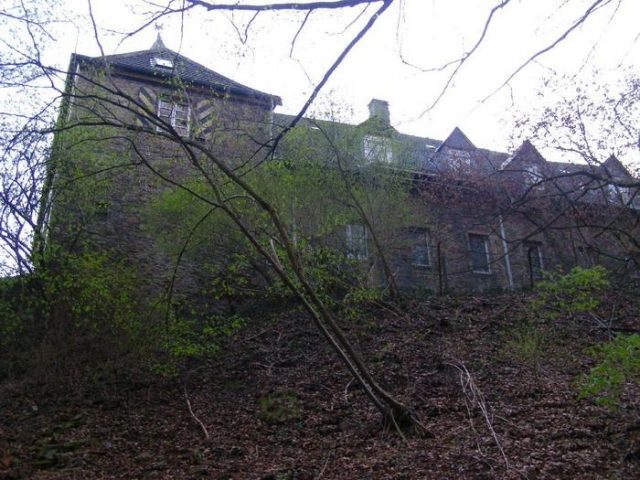
Haus Horst, also known as Burg Horst, is a former knight's seat on the northern bank of the Ruhr, high above the river in the Horst district of Essen. It is protected as a building and archaeological monument.
Unclear Beginnings
The exact time of origin of Haus Horst is unknown. It is possible that it was a successor to the immediately adjacent Vryburg, but this assumption has not yet been scientifically proven. Both complexes are located at an old ford across the Ruhr at a branch of the Hellweg, which was important in the Middle Ages. They may have been intended to control and protect it.
The lineage of the Lords of Horst has been documented since the 12th century. Their member Heinrich von Horst is mentioned in 1280 as Drost of the Counts of Berg. In 1282, his brother Hugo is documented as Marshal of the Essen Princess-Abbess Berta von Arnsberg. The family had thus risen to the status of ministerials, which corresponded to the rank of an unfree knight. This made them one of the most important families in the territory of the Imperial Abbey of Essen. However, the noble seat Haus Horst is only mentioned in 14th-century documents; previously, a rural estate stood on the site.
Changing Owners
After the Lords of Horst died out around 1400, the complex subsequently saw changing owners. In 1457, it came to Bernd von Voerst and was later owned by the von Schüren family. From 1644 to 1652, it belonged to Alexander II von Velen, who had gained much wealth during the Thirty Years' War. In 1663, it passed to Johann Heinrich von Ree(r)de, before Jobst Dietrich Freiherr zu Wendt became owner in 1674.
At the beginning of the 19th century, the complex belonged to a member of the "Wendt auf Hardenberg" family, who leased it to Friedrich Wilhelm Fürchtegott Niemann. His son Friedrich Ludwig had the current Villa Vogelsang built on the western grounds of the knight's seat in 1840. The property passed to the entrepreneur Wilhelm Vogelsang in 1910 through an auction and remained in his family's possession until the 1970s.
In 1934, under Ernst Kahrs, director of the Ruhrlandmuseum, additions and restorations were made to the southern part of the former outer bailey, before it was redesigned in 1945.
Haus Horst Today
The industrialist Hans-Dieter Abring acquired Haus Horst in 1980 and founded the "Foto-Museum Burg Horst", whose collection includes exhibits such as a camera obscura and laterna magica, as well as cameras from 1839 and pieces on three-dimensional photography. It can be visited by appointment.
Description+
Current Building Fabric
The complex today measures approximately 150x150 meters. Only a part of the historical building fabric remains. This includes, in addition to previously unexplored vault and wall remains in the ground, two round towers and the curtain wall of the outer bailey, dating from approximately the 17th century, in the east of the area, which is also called the tournament courtyard. Furthermore, the former dairy farm is preserved. Its L-shaped Renaissance-style building dates from around 1680 and is said to have been built with stones from the ruined main castle. It measures approximately 32 meters in length and is topped by a hip roof, which has a roof turret on the shorter south wing.
Northwest of the dairy farm is the former chapel from 1359. The small sacred building has a Romanesque vault, pointed arch windows, and a – now walled-up – round-arched portal. The chapel – like the dairy farm – is now used for residential purposes.
Murder Cross
Approximately 100 meters northwest of Haus Horst, at the edge of its access road, the so-called Mordstein – a low stone cross with an inscription – commemorates the master builder Conrad Fischer, who was murdered by robbers on May 4, 1717. The cross has been protected as an independent architectural monument since August 2008.
Memorial
South of Haus Horst is a memorial in the form of a ring of stone columns. It was erected by the National Socialists from April to November 1934, on the initiative of Oskar von Watters, to commemorate the Freikorps soldiers, Reichswehr and police units, and local militias who fell between 1918 and 1920 during the suppression of the Ruhr Uprising. These fought against revolutionary workers at that time.
The plot of land was provided by the Essen entrepreneur Wilhelm Vogelsang. With the participation of the then still voluntary Reich Labor Service, the necessary Ruhr sandstone was extracted from the neighboring Silberkuhle quarry. In imitation of Stonehenge, which was still relatively unknown in Germany at the time, the memorial has a circular shape. Today, the site is a memorial to the victims of National Socialism.
Take Mobile History with you
You are reading this text for free. Premium adds what matters on the road: descriptions read aloud, sites found through your camera, whole regions taken offline.
- Every description, including the ~17,700 Premium sites
- Audio guide: have descriptions read to you on location
- AR finder: see sites through your camera, with distance and bearing
- Unlimited saved sites
14 days free, then from €2.99 a month. Cancel anytime.
Source: Wikipedia · Licence: CC BY-SA 4.0 · Image: http://www.wehrbauten.de/thread.php?threadid=575
This description draws on the facts documented in the linked Wikipedia article; Wikipedia content is licensed under CC BY-SA 4.0. Wording and editing: Mobile History.
Location: 51.4321, 7.1168