To be privately owned
ManorEssen - Werden
Heck Manor
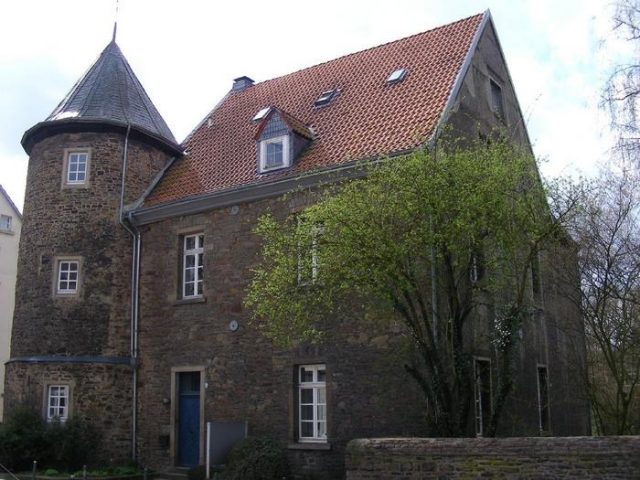
Haus Heck is an old knight's seat located in the Heckstraße, named after it, in the Werden district of Essen. As one of the first buildings in the former Rhine Province, it was placed under monument protection in 1910 by Provincial Conservator Paul Clemen.
Haus Heck is a simple, almost square building with a floor plan measuring approximately 11.85x11.85 meters and a small annex, 1.35x2.25 meters, on the northern part of its west side, which was probably used as a latrine on the first floor. The two stories of the building are topped by a gable roof and have wall thicknesses of up to 1.10 meters. At the southeast corner of the house stands a mighty, three-story round tower, crowned by a polygonal spire. The tower, whose walls are about 70 cm thick, measures approximately six meters in diameter. Both structures were built using quarry stones of local Ruhr sandstone. Older publications often state that the round tower is the oldest part of the house and probably dates back to the 11th century. However, an old engraving by Frans Hogenberg from 1581 depicts the square building, but a round tower is completely absent. The execution of the masonry and the thinner wall thickness compared to the main house also argue against this.
The current window openings of the tower were only broken out in 1929 in place of the former loopholes. In the basement of the house, which was formerly the plinth floor of the building, original medieval barrel vaults are still preserved. The well-preserved mosaic floors from the first quarter of the 19th century are considered the most historically significant interior features.
The exact date of construction of the house is unknown because no preserved documents can provide information. It was first mentioned in a document in 1390 as "dat hys an der Hecghe," but a knight Heinrich von Hecga already appears in 1259. In 1412, another documentary mention of the house followed, this time in a feudal register of Werden Abbey. "Hys an der Hecghe" stood for a rampart planted with hedges, thus clarifying the building's function: it belonged to Werden's fortification system. During a city fire in 1498, it was probably destroyed, like numerous other Werden buildings, because in 1572 the building was a ruin, which can also be seen in an illustration from 1581 and is referred to there as "Ruine Castri Hegge." It provides information about the former building stock: it was a two-part complex, consisting of a main castle and an equally large outer bailey, connected by a wall and an archway.
As early as 1599, Dietrich von der Hoven and his wife Margarethe von Oefte may have begun rebuilding the structures, as a fireplace still preserved inside shows this year. The Werden abbot Adolph von Borcken acquired the property for his monastery and had it converted into his residence around 1669. After the secularization in 1803, Haus Heck fell to Prussia and was the seat of the Ruhr Customs Inspection from 1805 to 1829, which collected lock fees for ships on the Ruhr.
In 1829, the cloth manufacturer Mathias Wiese acquired the building from the Prussian government for 3000 thalers. His family remained the owner until 1960, before selling it to the Catholic parish of St. Ludgerus. This in turn sold it in 1966 to the Protestant parish of Essen-Werden. They have been using the building as a community center since 1980, which was rebuilt and restored between 1980 and 1981 while preserving its historical substance.
Take Mobile History with you
You are reading this text for free. Premium adds what matters on the road: descriptions read aloud, sites found through your camera, whole regions taken offline.
- Every description, including the ~17,700 Premium sites
- Audio guide: have descriptions read to you on location
- AR finder: see sites through your camera, with distance and bearing
- Unlimited saved sites
14 days free, then from €2.99 a month. Cancel anytime.
Source: Wikipedia · Licence: CC BY-SA 4.0 · Image: http://www.wehrbauten.de/thread.php?threadid=575
This description draws on the facts documented in the linked Wikipedia article; Wikipedia content is licensed under CC BY-SA 4.0. Wording and editing: Mobile History.
Location: 51.3911, 7.0015