Museum
Cultural Events
CastleLangenfeld-Wiescheid
Graven Castle
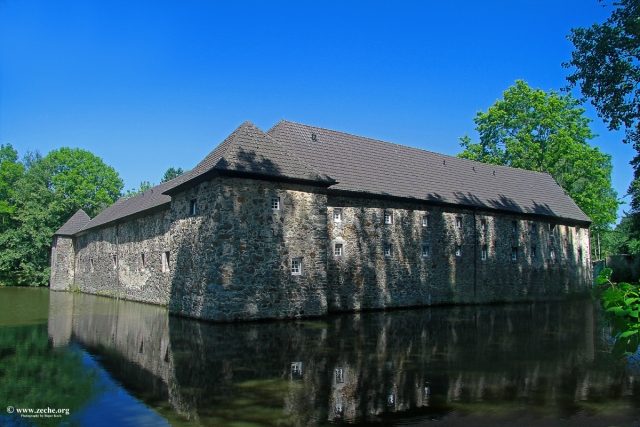
Haus Graven is a moated castle in the Wiescheid district of Langenfeld and was presumably built around 1300 as a successor castle to the "Motte Schwanenmühle", formerly located 800 meters to the north.
Haus Graven is a U-shaped quarry stone building, surrounded on three sides by wide moats. The current building is the center of the outer bailey, built in the 17th century, which has protruding square towers with pyramid roofs at its corners. The coat of arms of the Counts of Mirbach above the main portal, together with the year 1656, provides information about the construction date and the builders. Nothing remains of the former manor house with its six towers. It is said to have been demolished in 1790.
The settlement name Graven was first mentioned in a document in 1334. The castle complex itself first appears in writing in 1341, when Knight Adolf von Graven was enfeoffed with it by the Archbishop of Cologne, Walram von Jülich.
From the aforementioned von Graven, the castle later passed through Johann von Overheid and his wife Agnes von Kessel by purchase in 1592 to Rütger von Bottlenberg-Kessel. His daughter Agnes von Bottlenberg-Kessel married Gerhard von Aldenbrüggen, also known as Velbrück, in 1618, who also owned Mauel (Windeck) on the Sieg and the Lanquit estate (today: Langfort). It was his son Conrad Gumprecht von Velbrück (1624-1672) who had the complex restored in 1656 after severe destruction during the Thirty Years' War. The latter also holds a prominent position in Langenfeld's city history, as it was he who led Langenfeld to independence from the Monheim office on December 30, 1666.
Through further marriage, Haus Graven then passed to Baron Johann Wilhelm Josef von Mirbach zu Harff in 1769 and was listed in the register of estates eligible for the Landtag in 1832. The Mirbach-Harff family remained owners of the complex until 1974, before selling it to a private individual who set up workshops and studios in the outer bailey.
From 1994 to 1996, the castle was completely restored through private initiative - albeit for residential use. However, the owner passed away, so the castle stood empty for several years. At the end of 2010, it was leased by the city of Langenfeld for ten years to use the premises as a museum and event venue, thus making the complex accessible to the public for the first time. The city of Langenfeld has transferred the operation of the complex for the duration of the lease to the Förderverein Wasserburg Haus Graven e.V. and subsidizes it with currently 50,000 euros annually.
Take Mobile History with you
You are reading this text for free. Premium adds what matters on the road: descriptions read aloud, sites found through your camera, whole regions taken offline.
- Every description, including the ~17,700 Premium sites
- Audio guide: have descriptions read to you on location
- AR finder: see sites through your camera, with distance and bearing
- Unlimited saved sites
14 days free, then from €2.99 a month. Cancel anytime.
Source: Wikipedia · Licence: CC BY-SA 4.0 · Image: http://www.zeche.org/
This description draws on the facts documented in the linked Wikipedia article; Wikipedia content is licensed under CC BY-SA 4.0. Wording and editing: Mobile History.
Location: 51.1369, 6.9861