To be privately owned
CastleHamm-Bockum-Hövel
Ermelinghof Castle
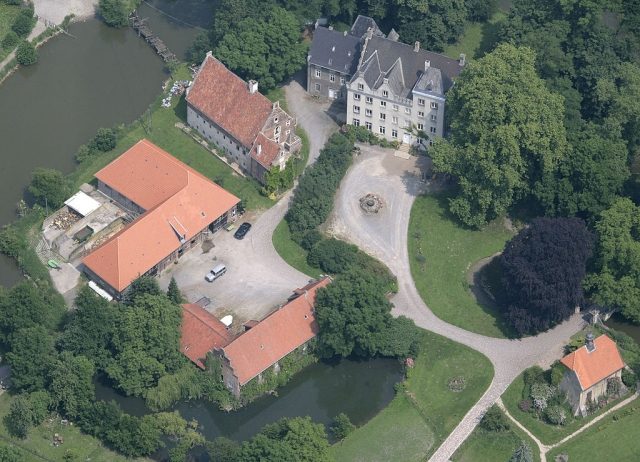
Haus Ermelinghof is a former knight's estate, eligible for the state parliament in the Diocese of Münster, located in the Hamm district of Bockum-Hövel (old parish of Hövel). It lies immediately east of Bockum-Hövel train station. It was first mentioned in a document in 1350. The estate is also referred to as Schloss Ermelinghof, Gut Ermelinghof, noble house Ermelingshof, or simply Ermelinghof. Around the turn of the 15th and 16th centuries, it is attested several times as Memerinc(k)hove or Mermelinchave.
Schloss Ermelinghof is located at Geinegge 38 in Hövel (formerly: Ermelinghofstraße, named after the estate), part of the Bockum-Hövel district in the northwest of the city of Hamm. It is near Bockum-Hövel train station, which was originally built solely to provide transport access to the castle and was therefore initially called Ermelinghof station. Haus Ermelinghof is situated in a rural idyll and is surrounded by old trees. It has been a protected monument since 1985.
Building Ensemble+
Haus Ermelinghof is a moated complex. Originally, it was located on two islands surrounded by the Geinegge stream, with a third island to the south serving as an outwork. After the removal of the inner moats, all buildings are now on one island. The estate is surrounded by a moat fed by the Geinegge.
Approaching the castle, one first sees an elongated gatehouse with a stepped gable and a Doric portico (columned portal). This dates from 1831. Compared to the original building located here, it has been shortened and altered in a Neoclassical style.
Before crossing the bridge to the courtyard and the main building, one sees a statue depicting the "Bridge Saint" John of Nepomuk. The bridge itself is framed by gateposts.
Behind the gatehouse is a low farm building with a hip roof. The two-winged half-timbered farm building was built around 1800.
The stately two-story brick or tile brewery, located on the north side of the courtyard, with a three-stepped gable and a narrow, gabled projection adorned with a coat of arms, stands next to the main house and has remained almost unchanged since the fire of 1627. It was formerly used for the production and storage, primarily of beer and bread.
Also worth seeing is the small, plastered, three-bay St. Bartholomew's castle chapel, consecrated in 1654, with a tiled saddle roof and a roof turret with a cupola, which houses a bell tower.
The current Neo-Gothic main house was built in 1875 after the old residential building burned down. It is a four- by nine- or ten-axis plastered building with tall rectangular windows. The structure features narrow sides with stepped gables, an inner front with a four-story tower two axes wide, and a pointed arch frieze under its hip roof. It also has a tiled saddle roof, a two-story annex, and a three-story tower structure on the outer front. Significant remnants of the older building fabric have been preserved.
In the garden, two small gateposts with bowl-shaped finials can still be seen.
Besides the farm buildings, only the stepped gable of the main house, which burned down around 1875 and was rebuilt in Neo-Gothic forms, bears witness to the old building stock.
The monument status refers to the exterior of the estate, which is free of modern additions (after 1945), as well as to the interior, which is preserved in its historical form, and to the structural framework.
Earlier local historians from Bockum-Hövel claim that Haus Ermelinghof was inhabited in ancient times by the Alamarich family. This family was then supposedly succeeded by the knightly family of Summeren. These statements cannot be proven or disproven with currently available documents.
It is true that a family von Ermel lived there as early as the 12th century. For this reason, Ermelinghof was formerly called Imberlinckhem or Emelrikenhoff. An heiress of von Ermel then married the squire von Schredigen (Scheidingen) around 1230. Around 1278, a castellan Hermann von Scheidingen appears with Count Engelbert von der Mark. Around this time, the house chapel is first mentioned as a proprietary church.
In 1350, Schloss Ermelinghof is mentioned in a document. The estate and the associated chapel were still in the possession of the Scheidingen family. In 1355, the squire Henrich von Schedingen is named as a guarantor. In addition to the von Scheidingen, the von Sümmern also had rights to Ermelinghof.
Around 1410, when the family died out in the male line, Ermgard von Scheidingen married Heinrich von Galen. The heiress of the von Scheidingen received the castle in 1410 as a dowry for her marriage to the Count von Galen, who probably came from the neighboring Haus Venne. The von Galen were castellans of the Counts von der Mark. The family bore three red wolf hooks on a golden shield as their coat of arms.
From Ermelinghof, the principle of Cuius regio, eius religio influenced the locality: in 1534, the owner of Ermelinghof, Gert von Galen, and his wife Mechthild von Korf converted to Protestantism. He had been persuaded by his brother, a canon and parish priest. Dietrich von Galen later converted to the Lutheran faith in 1550. The extended family probably believed in better support through the Lutheran faith. As a rule, all noble families had a family seat in a parish church. However, this did not apply to the von Galen. The St. Pankratius Church in Hövel was not available to them for this purpose. The von Galen probably only received their family seat in the St. Pankratius Church when a close relative, namely Gerd von Galen, whose father Philipp von Galen was mayor in Hamm around 1591, became a minor pastor in Hövel. Thereupon, Alexander von Galen converted to the Catholic Church with his family in 1652 – influenced by the re-Catholicizer of Münsterland, Prince-Bishop Christoph Bernhard von Galen (1650–1678).
The house chapel in Ermelinghof had already been unused for a hundred years by then and was consequently dilapidated. Therefore, Prince-Bishop von Galen gave Alexander von Galen a sum of 1,200 thalers for the construction of a new house chapel. This was consecrated in 1654 by Father Bernhardus Hackfort from Münster. However, Prince-Bishop von Galen demanded that the old chapel site be fenced off for all eternity. In 1657, the amount of 1,200 thalers was increased to 1,425 thalers. Around 1662, a house vicariate named "ad Stum Bartholomaeum" was established. Alexander von Galen was appointed executor of the will after the death of Prince-Bishop von Galen in 1678. For this activity, the Prince-Bishop had given him an altar cross for the house chapel during his lifetime. The altar cross most likely dates from the time when Dietrich von Isenberg became Prince-Bishop of Münster around 1218, as it bears a coat of arms of the Counts of Altena. The altar cross of Dietrich von Altena was thus returned to its former home – Dietrich von Altena had temporarily resided at Nienbrügge Castle in Hövel. It was then completely redesigned in 1714 by the silversmith Christian Hövel, who lived in Hamm. The consecration of the chapel is recorded for the year 1680.
After economic decline and due to the extravagant life of the von Galen family, Franz Joseph von Galen zu Ermelinghof had to declare bankruptcy. In 1781, the entire property was foreclosed. On May 26, 1787, Baron Anton von Wintgen, who also acquired Haus Braam in 1793, bought Haus Ermelinghof at auction. He bore a blue crossbar with a red lion on a silver shield as his coat of arms. He died in 1798 and was buried in the church in Hövel. His son had no male descendants; the heiress married Baron Josef von Twickel von Havixbeck in 1840 (alternative date: 1844), who founded his own line here. His family bears a black cauldron hook on a silver background as their coat of arms. The house has been in the possession of the von Twickel family ever since.
Around 1800, the gatehouse was built in the Greek style. According to an old drawing, the bridge saint Saint Nepomuk was not yet standing there at that time. During this period, the castle park and its entrance were also redesigned.
The last male descendant of the Ermelinghof Galens, Klemens August, drowned in the Weser in 1809 as a canon in Minden.
In 1875, due to the carelessness of a servant, the main house burned down to its foundations. The house was rebuilt in the Gothic style.
Baron Fritz von Twickel was a long-serving honorary bailiff of the Drensteinfurt district, to which Bockum and Hövel also belonged until 1908. In 1908, Bockum-Hövel was separated from the Drensteinfurt district and thus became independent. The first administrative building of Bockum and Hövel was housed in the gatehouse of Haus Ermelinghof. After a short time, it moved to the garden house of Haus Ermelinghof.
In 1913, Baron Fritz von Twickel died as a result of a hunting accident in the Wiehenholt forest, shortly before the inauguration of the newly built administrative building in Hövel. He died childless.
Ignaz von Twickel, who came from Recklinghausen, inherited the estate. His granddaughter Walburga von Aretin was subsequently the owner of Haus Ermelinghof.
The knight's estate formerly included significant landholdings. About a dozen farms and cottages in the farming communities of Hölter and Geinegge were subject to its jurisdiction and therefore liable for taxes.
The Chapel SS. Maria and Bartholomaeus at Haus Ermelinghof+
The Chapel Beatae Mariae Virginis et S. Bartholomaei, belonging to the noble house of Ermelinghof and built during the Counter-Reformation, is still completely preserved today. The Catholic chapel, dedicated to the Mother of God and St. Bartholomew, stands at the entrance on the former outer bailey. It is a small, bright hall building. Its predecessor probably stood in this position in the Middle Ages. Of the stone figures on either side of the entrance in front of the building, only Saint Catherine standing on the left side is still recognizable.
The large altarpiece in the chapel, fitted into a baroque frame added at a later date, with the life-sized wooden figures of Saint Nepomuk and Saint Agatha, gives the room a festive character, more in keeping with the late 18th century than with the time of its construction.
When the otherwise inaccessible roof turret of the chapel of Haus Ermelinghof was ascended with the help of a fire ladder, a bell from 1649 was found there (strike tone e''+7, diameter 503 mm, weight approximately 75 kg). Although it is not signed, its design and excellent casting suggest that it was cast by the Lorraine master Johann Fremy. He supplied bells with similar decorative forms for several churches in Münsterland. Among them was a particularly beautiful bell for the former collegiate church in Metelen.
In the attic of the chapel, there is still a small wrought-iron turret clockwork, which probably dates from the first half of the 19th century and has long been out of service.
House chaplains at Haus Ermelinghof for the chapel ad Stum Bartholomaeum were:
- around 1500: Evard Holtmann
- 1511–1541: Wilhelm Sweringe
- 1544: Diricus Schene
- 1550 - 1652: The von Galen family had converted to the Lutheran faith.
- 1662: Theodor Klutmann
- 1709: Johannes Cramer
- 1750: Adolf Johannes Cordes
- 1800: Goswin Rieve
- 1867: Friedrich Nienberg
- 1925: Dr.theol. Theodor Klauser
Castle Mill at Ermelinghof+
The drop in the Geinegge stream at its outflow from the moats was already used in 1400 to operate a mill. The castle mill is first mentioned in a document around 1430. In 1732, a new mill was built on the left side of the Geinegge, at the site of the old structure. Here, oil was pressed when the stream carried enough water, until finally in 1894, the grain mill was built on the right side. In 1906, the water wheel was replaced by a water pressure turbine. When water levels were low, grain was ground with electric power, until about 1955. Since then, the mill and miller's house were only ruins. In 1978, they were demolished.
Take Mobile History with you
You are reading this text for free. Premium adds what matters on the road: descriptions read aloud, sites found through your camera, whole regions taken offline.
- Every description, including the ~17,700 Premium sites
- Audio guide: have descriptions read to you on location
- AR finder: see sites through your camera, with distance and bearing
- Unlimited saved sites
14 days free, then from €2.99 a month. Cancel anytime.
Source: Wikipedia · Licence: CC BY-SA 4.0 · Image: http://commons.wikimedia.org/wiki/File:Luftbild_Haus_Ermelinghoff.jpg
This description draws on the facts documented in the linked Wikipedia article; Wikipedia content is licensed under CC BY-SA 4.0. Wording and editing: Mobile History.
Location: 51.7083, 7.7756