School of civilian service
ManorHerdecke - Ostende
Ende Manor
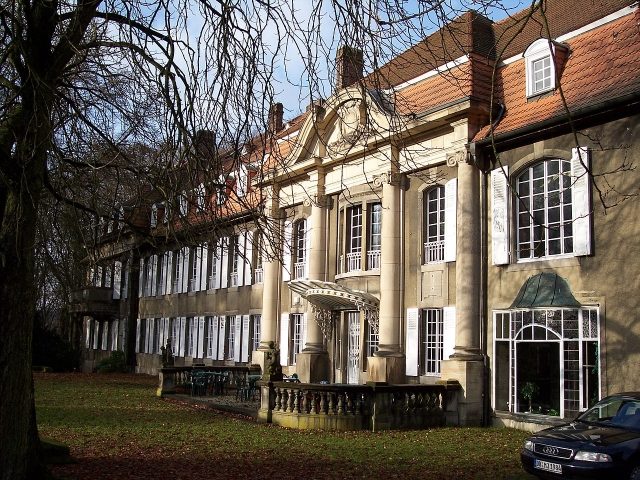
Haus Ende is an industrialist's villa in the Ostende district of the Westphalian city of Herdecke.
Built around 1911 by Kommerzienrat Robert Müser in the style of a Baroque manor house, the property was designed entirely for representation and festivities. Visitors entered the building through an antechamber and stood in an impressive hall dominated by an almost five-meter-tall fireplace, to which several smaller rooms and the library were connected. Behind it were an apartment for the owner and several guest rooms. The house was predominantly used as a venue for parties, of which the convinced bachelor Müser, however, could only host a few, as he died shortly after the First World War.
Under Albert Vögler+
Albert Vögler acquired the house in 1919. Vögler was a close confidant of industrialist Hugo Stinnes and soon became general director of the Vereinigte Stahlwerke (United Steelworks). Therefore, Haus Ende also bears the nickname Villa Vögler. Hoping for orders for his steelworks, he supported Adolf Hitler in his election campaign even before 1933 and invited him several times to his home. The secluded yet impressive estate served him as an ideal starting point to represent the power and influence of the Ruhr industry. When the dictator no longer felt too safe with him at the beginning of the war, Vögler spared no expense or effort to add a huge bunker system and install extensive security measures for the protection of his villa. Vögler made a career in the Nazi state and received a leading position in armaments. Vögler himself was never a member of the NSDAP, but nevertheless took his own life shortly before the end of the war in 1945 to escape captivity by the Allied powers.
Use after the War+
The house on Ostendener Weg passed to the American military administration, which finally handed it over to the city of Herdecke with the condition that Haus Ende be used for social purposes from then on. The house was initially used as a children's home, then a training home for nurses was established. Later, the Arbeiterwohlfahrt (Workers' Welfare Association) bought it, which finally rented it in 1981 to the Federal Office for Civilian Service, which installed a civilian service school there.
Over the years, several outbuildings were constructed in the park surrounding the building, primarily serving as sleeping quarters and teaching facilities for the civilian service personnel. The listed Haus Ende, surrounded by an old park, remains in good condition. The magnificently decorated rooms have been restored; only the park has become overgrown over time. The bunker system is closed.
Take Mobile History with you
You are reading this text for free. Premium adds what matters on the road: descriptions read aloud, sites found through your camera, whole regions taken offline.
- Every description, including the ~17,700 Premium sites
- Audio guide: have descriptions read to you on location
- AR finder: see sites through your camera, with distance and bearing
- Unlimited saved sites
14 days free, then from €2.99 a month. Cancel anytime.
Source: Wikipedia · Licence: CC BY-SA 4.0 · Image: http://de.wikipedia.org/wiki/Datei:Haus_Ende.jpg
This description draws on the facts documented in the linked Wikipedia article; Wikipedia content is licensed under CC BY-SA 4.0. Wording and editing: Mobile History.
Location: 51.4228, 7.4440