The House can be visited
ManorHilden
Haus auf der Bech
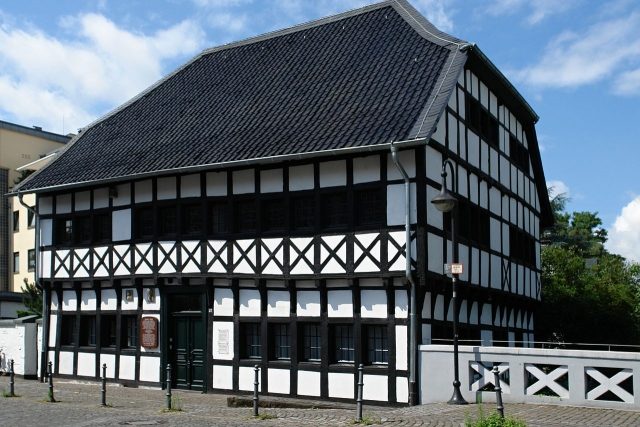
The "Haus auf der Bech" is also called "Haus op der Bech" or "Haus an der Bech". The Haus auf der Bech is a listed secular building in Hilden Schwanenstraße 17 in the district of Mettmann (North Rhine-Westphalia).
The stately, eaves-facing half-timbered house was built in 1588 for a Schultheiß (bailiff). The upper floor projects on consoles. The half-hipped roof was added in more recent times. The building was restored from 1980 to 1982.
The older house
The archiepiscopal feudal estate "Auf der Bech" was mentioned in documents in 1150.
The stately, eaves-facing half-timbered house in Hilden at Schwanenstraße 17, "Haus auf der Bech" (Older House), was built in 1588 for the Schultheiß Dietrich zu den Hülsen. He died in 1589 before its completion.
After the death of the builder Schultheiß Dietrich zu den Hülsen, the house came into the possession of the Hoff family in 1590 through the rapid remarriage of his widow "Gretchen zu den Hülsen". The second husband, Heinrich Hoff, was a notary and called himself Henricus Bech Hildensis. The couple took up residence in the newly built "Haus auf der Bech" and opened an inn there. Around 1590, the farmers of Hilden turned against the appointment of the innkeeper Heinrich Hoff as Hilden's court clerk, because their meager purses did not allow them, "when we had something to write, to constantly sit in the wine house".
Gretchen's (Gertgen's) son from her first marriage, Anton zu den Hülsen, born around 1575/76, renounced the "Haus auf der Bech" in 1596 in favor of his mother and stepfather Heinrich Hoff, whereupon they left him the inherited estates 'zu den Hülsen'.
Hermann Hoff, son of Heinrich Hoff from his first marriage, born around 1588, was the next owner of the Haus auf der Bech. During the turmoil of the Thirty Years' War, despite the Duke's prohibition, he made his house available to the Reformed for divine services. Since Duke Wolfgang Wilhelm tried by all means to eradicate the Reformation in his country, the Haus auf der Bech was officially closed and sealed in 1641. The Reformed were left with only barns or the open sky for their gatherings. During the procession on the Sunday after St. James's Day (July 25, 1641), their anger erupted. The Reformed broke the seal and lock and regained access to the "Haus auf der Bech". A political interplay followed.
After Hermann's death († ?), his son Adolf Hoff, born around 1613, inherited the "Haus auf der Bech". He married Sibylla Eikels from Düsseldorf in 1640 and lived in Düsseldorf, but later moved to Hilden. He served as Schultheiß of Hilden and Haan from 1647 to 1675. Adolf Hoff died in 1679. Adolf Hoff bequeathed the older house to his son Heinrich Hoff, born in 1645.
The newer house
The last owner named Hoff was the court clerk Heinrich Hoff. He and his wife Johanna Margaretha von Diepenbruch ufr Knip built the "newer half-timbered house on the Bech", which still stands today, after their marriage in 1680. After Heinrich Hoff's death, the half-timbered house fell to Heinrich's son-in-law. The son-in-law was the merchant Matthias Kohl (on the Kohlsberg in Höhscheid near Solingen), husband of Anna Sibylla Hoff. They leased the house several times from 1734-60 to the Hilden family Heinrich Volmer and Anna Gertrud née Kirberg.
Oil and barley hulling mill
On April 29, 1762, Tilmann Kirberg received a concession from Elector Karl Theodor to operate an oil and barley hulling mill (pell mill) next door. The mill was powered by the water of the Itter. Kirberg must have operated the mill himself for several years, because in 1778 he took out a debt on it, which he had settled by 1782. Tilmann Kirberg was married to Helena Vollmer.
Johann Wilhelm Frauenhof bought the mill in 1820.
Wilhelm Frauenhof was born in 1829 as one of six children of Johann Wilhelm Frauenhof, married to Wilhelmine, née Tang. After the death of Johann Wilhelm Frauenhof, Wilhelm Frauenhof took over the mill. Wilhelm Frauenhof is listed on the original cadastral map of 1839 as the owner of the property on which the mill stood. Wilhelm Frauenhof bequeathed the mill to his son Karl Wilhelm Frauenhof (* 1857), who also operated it. In 1915 the mill was shut down. The water wheel was dismantled in the last years of the First World War. Since then it has fallen into disrepair, so that today only a few wall remains stand. The breakthrough hole is still visible in the ruin.
Fine tannery
Theodor Hugo Frauenhof, born in 1865, son of the oil miller Johann Wilhelm Frauenhof, founded a fine tannery and shaft factory for shoe and leather production on August 28, 1887, on the grounds of his father's farm "Auf der Bech".
When Theodor Hugo Frauenhof could no longer continue the business due to blindness, his nephew and son of the oil miller Karl-Wilhelm Frauenhof, Richard Frauenhof, took over the company in 1935. Due to lack of demand from the shoe industry, production soon came to a standstill and Richard Frauenhof continued the company as a trading business for leather goods and shoemaker supplies. After the end of World War II, the company's focus shifted to technical wholesale for industrial supplies.
Due to the annual flooding of the Itter, Richard and Susanne Frauenhof built a flood-proof new building next to the former mill building, which they were able to move into in 1960.
In 1998, Hugo Frauenhof GmbH Industriebedarf und Umwelttechnik relocated to a larger site on Mühlenbachweg in Hilden. The trade in shoemaker supplies, which had been operated for almost 70 years, was transferred to a competitor in 2013.
The half-timbered house
The oak half-timbered house "Haus auf der Bech" was the dwelling of a rural farmstead, one of the larger ones in Hilden, with separately built farm buildings. Around 1900, its rear side was clad with shingles.
After Richard Frauenhof's death in 1965, the Frauenhof family leased the half-timbered house to the city of Hilden for a long term starting in 1971. The city carefully restored the flood-proof half-timbered house (front house) from 1976 to 1979. In 2004, further extensive restoration measures were carried out by the city and private tenants under the supervision of the Lower Monument Authority. From 1979 to 2004, the adult education center of the city of Hilden was located in the "Haus op de Bech". Between 1982 and 2004, the "Wohlauer Heimatstube" was also located in the building. The adult education center was followed by a law firm from 2007 to 2012. In 2013, most of the staff of the youth welfare office moved from the closed youth meeting point JUECK to the "Haus auf der Bech". A large weeping willow that stood for many decades on the stream side of the half-timbered house fell victim to Hurricane "Jeanette" in October 2002 and had to be felled.
The grounds of the half-timbered house and the inner courtyard with the grounds of the shaft factory were divided in 2014 and the remaining factory buildings were demolished. A residential complex with 16 apartments is being built on this site. The ruin of the old oil mill is to be spared.
Take Mobile History with you
You are reading this text for free. Premium adds what matters on the road: descriptions read aloud, sites found through your camera, whole regions taken offline.
- Every description, including the ~17,700 Premium sites
- Audio guide: have descriptions read to you on location
- AR finder: see sites through your camera, with distance and bearing
- Unlimited saved sites
14 days free, then from €2.99 a month. Cancel anytime.
Source: Wikipedia · Licence: CC BY-SA 4.0 · Image: http://de.wikipedia.org/wiki/Datei:Hilden_SWA17.JPG
This description draws on the facts documented in the linked Wikipedia article; Wikipedia content is licensed under CC BY-SA 4.0. Wording and editing: Mobile History.
Location: 51.1687, 6.9315