To be privately owned
CastleNürnberg-Fischbach
Harsdorfsches Castle
In 1405, Veit Pfinzing sold to his brother-in-law Karl Holzschuher "his house located in Fischbach with the moat and pond attached"; it was a fief of the Burgraves of Nuremberg. In 1441, Margrave Albrecht Achilles enfeoffed the brothers Karl and Paul Holzschuher, among others, with the "House in Fischbach with the moat and garden", which was presumably destroyed in the First Margrave War in 1449. In 1515, Karl Holzschuher's grandsons Pankraz and Hans opened their seat to the city of Nuremberg. In 1537, Wolf, Peter, and Christoph Harsdorfer acquired the castle from Hans and Sebastian Holzschuher, which is still owned by the family today. In 1542, Wolf Harsdorfer was the largest landowner in the village; his seat included 2 farms and 6 estates. In 1544, the brothers were enfeoffed by the Margraves with the "House in Fischbach with the moat and garden". Barely rebuilt after a fire catastrophe in 1549, the "lord's seat" was destroyed again in 1552 during the Second Margrave War. The total damage to the then three castles in Fischbach amounted to 8,000 guilders.
During the renewed reconstruction after 1553, the so-called "old" castle received its present form, reusing existing building components. The elongated building with an unplastered sandstone ground floor and half-timbered upper floor has a half-hipped roof with dormer windows; the half-timbered bay window has a polygonal spire. Inside, the manor house contained, in addition to the chambers, two kitchens, two parlors, and a stately hall on the upper floor. The two-story former Vogt's house with a projecting half-timbered upper floor and gable roof (Fischbacher Hauptstraße 203) also probably dates from the 16th century. In the courtyard there is a covered draw well with a round basin from the 18th century. The west gable of the castle was severely damaged on August 10, 1943, but was soon rebuilt.
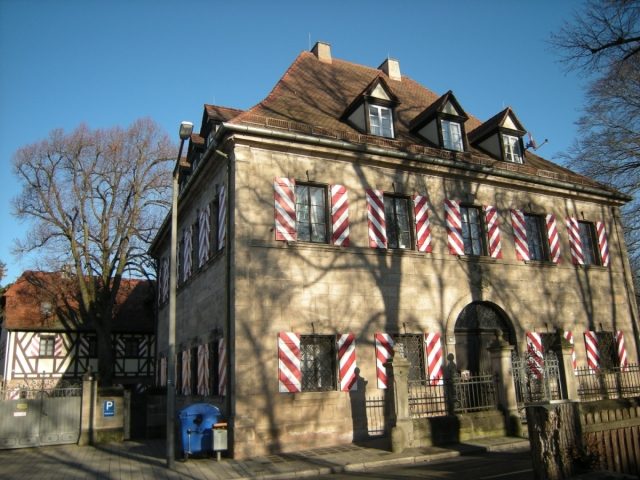
On the grounds of the old seat and on the site of the old dilapidated barn on the street, the Nuremberg district administrator Jobst Christoph Harsdorfer (1721–1786) erected the New Castle in the years after 1771. The district administrator was allowed to transfer the two parlors, fire rights, and two kitchens located upstairs in the old, two-story manor house to the new building. In return, he had to concede that the "hall" in the so-called "old barn" was abandoned again.
The two-story building of unplastered sandstone ashlar with five by five window axes received a mansard roof, probably contrary to plan, in 1771. Above the gate facing the street, there is an alliance coat of arms of the builder Jobst Christoph von Harsdorf and his second wife Philippina Jakobina Haller von Hallerstein with the (incorrectly restored) construction date 1723 (correctly 1773). In 1943, the castle was severely damaged by bomb hits; the reconstruction was carried out with a hipped roof.
Take Mobile History with you
You are reading this text for free. Premium adds what matters on the road: descriptions read aloud, sites found through your camera, whole regions taken offline.
- Every description, including the ~17,700 Premium sites
- Audio guide: have descriptions read to you on location
- AR finder: see sites through your camera, with distance and bearing
- Unlimited saved sites
14 days free, then from €2.99 a month. Cancel anytime.
Source: Wikipedia · Licence: CC BY-SA 4.0 · Image: http://schloesserrundschau.de/bayern/schloesser01/nuernberg30.html
This description draws on the facts documented in the linked Wikipedia article; Wikipedia content is licensed under CC BY-SA 4.0. Wording and editing: Mobile History.
Location: 49.4201, 11.1942